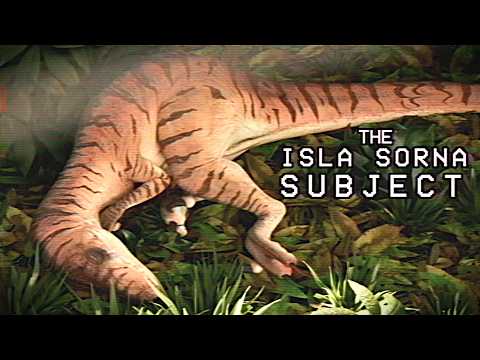
Eve and Evo’s careful inspection of their nest opens the story on an unexpectedly gentle note, with scent recognition, alternating incubation duties, and Muldoon’s obvious affection making the raptors feel like animals rather than simple monsters. That observational approach is one of the production’s better choices. The later comparison with male emus, cassowaries, and ostriches also gives the fictional husbandry discussion a believable scientific flavor without distracting from the unfolding mystery.
That calm material is gradually undermined by evidence of something far less familiar. The unexplained egg clutch, apparently placed inside a carcass, becomes especially unsettling because Muldoon works through mundane possibilities before concluding that the behavior does not resemble the raptor nesting he has observed. Details such as the broken cabin window, displaced vent, scattered glass, and inability of compies to explain everything create a satisfying investigative progression. The decision to keep the discovery quiet to avoid attracting InGen’s attention adds another layer of tension without requiring an immediate reveal.
Alberta’s behavior provides the most effective bridge from animal-care realism into horror. Dr. Harding describes a Styracosaurus that refuses to lie down or sleep and appears chronically frightened, yet relaxes when a familiar person remains nearby as though she needs someone standing guard. His suggestion that an infrasonic sound could be disturbing her remains explicitly speculative, which suits the scene: the important fact within the story is not that a cause has been established, but that the animal appears to sense something her keepers cannot identify.
The stable sequence capitalizes on that setup without becoming excessively explicit. Harding hears an unidentified presence, later recalls what looked like a raptor moving along the beams, and acknowledges that shock may have affected his memory. The discovery of a diagnostic unit in the barn and the decision to return Alberta to the other animals deepen the mystery while preserving uncertainty about exactly what occurred. That restraint is particularly effective for analog horror, where fragmented evidence can be more unsettling than a clearly explained creature encounter.
Away from the immediate threat, the discussion of genetically created animals and their welfare adds welcome thematic weight. Muldoon reflects on the responsibility involved in making creatures, confining them, and then having to determine what constitutes a decent life for them. The Pachycephalosaurus segment extends that husbandry theme through seasonal feeding preferences, environmental variation, and the difference between meeting nutritional targets and recreating naturalistic feeding behavior. Within this fictional setting, these sections make Site B feel like an operating animal facility rather than merely a backdrop for scares.
The tradeoff is pacing. The extended Pachycephalosaurus explanation arrives while several stronger mysteries remain unresolved, so the momentum temporarily drops just as the strange clutch, Alberta’s fear, and Harding’s barn encounter are converging. Its material fits the documentary-log format and reinforces the broader ethical theme, but some tightening would have preserved more urgency. The final discovery that the raptor nest is apparently gone restores that tension effectively, ending on a simple question with potentially serious implications rather than forcing an answer.
Pros
- Eve and Evo’s nesting behavior creates an unusually warm opening that makes the later unease more effective by contrast.
- The mysterious clutch is developed through specific physical clues and alternative explanations rather than an immediate supernatural conclusion.
- Alberta’s persistent fear and the barn encounter build tension through uncertainty, limited visibility, and incomplete evidence.
- Animal husbandry and welfare discussions give the fictional facility convincing day-to-day texture and an ethical dimension beyond the horror.
- The missing raptor nest provides a strong unresolved ending that naturally connects the quieter behavioral material to the emerging threat.
Cons
- The lengthy Pachycephalosaurus feeding discussion slows the central mystery at a point when the barn incident and unexplained clutch have generated considerable momentum.
- Several intriguing threads remain deliberately unresolved, leaving this installment more dependent on continuation than satisfying as a self-contained story.
- Some of the technical husbandry exposition is considerably more detailed than necessary to establish the animals’ management challenges.
Patient observational detail gives the horror room to develop naturally, turning ordinary animal care into evidence that something at Site B is increasingly wrong. Although the midsection becomes overly absorbed in husbandry exposition, the unsettling clutch, Alberta’s fear, Harding’s encounter, and final missing nest create an effective slow-burn mystery.