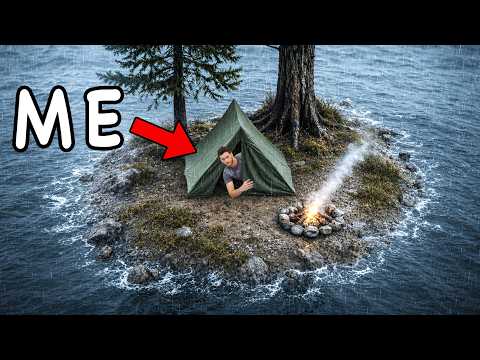
A missing roll of rope turns what should have been a straightforward gear comparison into the challenge’s most revealing problem. The TikTok Shop side has to twist small garbage bags into an improvised cord for its shelter, while the Amazon side arrives with enough paracord, plastic sheeting and tools to follow a much cleaner construction plan. That imbalance gives the competition an entertaining underdog dynamic, although it also exposes a recurring weakness: it is difficult to tell whether the stores themselves or the individual purchasing decisions deserve credit for the dramatically different results.
The shopping sequences establish that problem early. TikTok Shop is repeatedly characterized as expensive, limited and unpredictable, while Amazon appears to offer more practical choices for the same $150 budget. There are useful comparisons once the products arrive—the unexpectedly tiny pads, thin sleeping bags, fishing equipment, multitools, tarps and fire starters all have to perform in real conditions—but the assessment remains anecdotal rather than systematic. Prices fluctuate during the shopping process, some expected items apparently fail to arrive, and mistakes such as choosing undersized equipment complicate any broad conclusion about either marketplace.
The shelter-building portion is much stronger because it forces both sides to work around those purchasing decisions. Turning garbage bags into usable cord is genuinely resourceful, particularly once rain and thunder arrive before the shelter is finished. Amazon's plastic-and-paracord construction proves more orderly, while the TikTok Shop shelter survives despite sagging material, pooled water and improvised connections. Neither setup is presented as expert bushcraft, and the brothers are refreshingly willing to admit when their survival knowledge is lacking rather than pretending every improvised technique is authoritative.
A mountain thunderstorm also supplies the challenge with uncertainty that cannot be manufactured through the store rivalry alone. Both participants retreat from exposed areas when lightning appears close, and concern about getting soaked before temperatures fall gives the shelter test meaningful stakes. At the same time, the footage describes the location as roughly 10,000 feet in elevation and anticipates temperatures in the 40s while both sleeping bags appear poorly suited to those conditions. Their comments show awareness of the risk, but the entertainment format sometimes treats inadequate cold-weather preparation more casually than the situation warrants.
Fishing becomes an unexpectedly satisfying second competition. Brock abandons the conventional rod initially and succeeds at hand-lining a trout, completing a skill he says he had repeatedly failed to master, while Bren prioritizes securing dinner with the TikTok Shop rod. The latter eventually catches fish after changing to a silver spoon, despite criticizing the rod's limited casting distance and troublesome reel. These sequences work because the equipment actually has to accomplish something rather than merely being unboxed, and failures, adjustments and successes remain visible.
The food and fire segments continue that practical testing but also reveal how loose the survival framing is. Starting a fire after the rain proves difficult, the brothers openly acknowledge gaps in their fire-starting knowledge, and one eventually joins the other's fire rather than maintaining a strict separation between teams. The hand-line prize also introduces outside food, a steak and a portable grill, while TikTok Shop snacks supplement an incompletely cooked trout. These additions are fun rewards, but they weaken the premise that the outcome is purely a $150 store-versus-store overnight survival test.
By morning, the challenge has produced a clearer verdict on individual products than on the retailers themselves. Both men report being cold and uncomfortable, the TikTok Shop sleeping bag is judged particularly ineffective, and neither budget creates anything resembling an ideal night. The lengthy sponsored-game interruption slows an otherwise naturally escalating outdoor story, but the combination of bad weather, questionable gear, fishing success and improvised problem-solving gives the episode enough genuine uncertainty to remain engaging through the overnight finish.
Pros
- Testing the purchased equipment through shelter construction, fishing, fire-making and an actual overnight stay gives the comparison more substance than a simple unboxing.
- The missing TikTok Shop rope leads to an inventive garbage-bag cord solution that becomes one of the challenge's best improvisational moments.
- Rain, thunder, wet materials and falling temperatures create genuine complications that force both participants to adapt.
- Brock's successful hand-line catch provides a satisfying skill-based achievement independent of the shopping rivalry.
- Both brothers openly acknowledge their limited survival knowledge and equipment mistakes rather than presenting themselves as experts.
Cons
- Differences in product selection, purchasing mistakes and a missing item make the challenge too uncontrolled to support strong conclusions about TikTok Shop versus Amazon overall.
- The cold-weather setup appears poorly matched to the anticipated mountain temperatures, making some of the overnight risk feel unnecessarily self-imposed.
- Outside prizes, shared resources and supplemental food blur the supposedly store-specific $150 survival premise.
- The extended sponsored-game segment significantly interrupts the momentum of the shelter and storm sequence.
- Several product criticisms are based on immediate impressions without enough information to determine whether the retailer, seller, listing or buyer choice caused the problem.
Real weather, imperfect equipment and some clever improvisation make the overnight experiment considerably more entertaining than its simple marketplace rivalry suggests. It works best as a comedic outdoor challenge and hands-on gear test, while the uncontrolled purchases and shared resources prevent it from becoming a convincing comparison of the two shopping platforms.