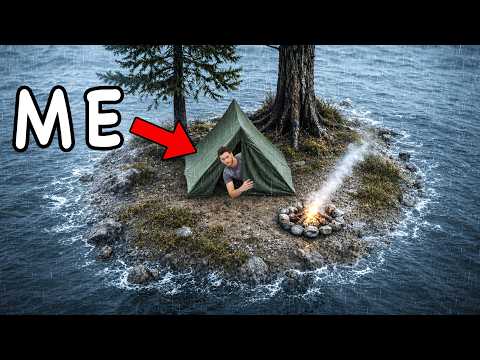
The strongest idea here is the budget imbalance itself. Giving three brothers $25, $100, and $250 at a dollar store creates an immediate problem-solving challenge rather than simply asking who can build the best campsite. The low-budget participant has to decide whether shelter, food, warmth, or comfort matters most, while the higher budgets gradually shift the exercise from survival toward luxury. That contrast gives the video a clear structure and makes the shopping sequences more meaningful than a generic haul, because nearly every purchase has an obvious consequence once they reach the mountains.
The $25 setup produces the most interesting improvisation. Half the budget disappears into basic shelter materials, leaving little room for food, insulation, or useful tools, and the eventual cocoon-style shelter and narrow inflatable sleeping arrangement look appropriately improvised. The video does a good job showing how small purchasing decisions compound later: limited duct tape becomes a construction problem, the lack of string restricts shelter options, and the undersized blanket becomes an obvious concern before bedtime. Borrowing tools and paracord from his brothers weakens the purity of the budget comparison somewhat, but those exchanges are acknowledged openly rather than disguised.
The $100 build occupies a less satisfying middle ground. Britain spends heavily on improvised bedding, including inflatable pool items, towels, blankets, tarps, tools, and cord, yet the final structure does not appear dramatically more sophisticated than the $25 shelter. That becomes part of the comedy when his brothers judge it harshly relative to its budget. The judging system itself is intentionally loose and competitive rather than objective, especially once they openly discuss giving bad scores to improve their own chances at the mystery prize. It works as sibling entertainment, but viewers should not treat those numerical shelter scores as meaningful measures of value or performance.
By contrast, the $250 budget effectively breaks the original survival premise in an amusing way. Pool noodles, pillows, multiple blankets, lighting, a fan, tarps, plastic wrap, cord, and other extras turn Brock's campsite into a homemade outdoor bedroom. The enormous budget also exposes diminishing returns: even the brothers point out that a conventional tent and sleeping pad could potentially have been a more sensible use of that amount. That observation is important because the challenge is ultimately about making something from dollar-store merchandise, not demonstrating the most efficient way to camp for $250.
The construction phase is strongest when it shows ideas failing and forcing revisions. Hard ground makes staking difficult, branches do not always cooperate, cheap duct tape runs out quickly, the inflatable pad proves much narrower than expected, and weather concerns force them to think seriously about keeping their shelters covered. Those moments provide enough genuine uncertainty to keep the overnight portion from feeling predetermined. The restriction on open fires is also clearly acknowledged, with small stoves used for cooking instead, although this remains entertainment rather than a practical survival tutorial and does not attempt to provide systematic outdoor-safety instruction.
There is considerable padding around that core challenge. The sponsor segment arrives in the middle of shopping and makes several product claims about ingredients, satiety, sourcing, and comparisons with jerky or other snacks without independently supporting them within the video. A lengthy promotion for the channel's membership program later interrupts the shelter judging as well. Both are clearly promotional rather than part of the challenge, but together they noticeably slow an otherwise straightforward concept. The repeated jokes about budgets, pool noodles, comfort, and who is going to quit also become repetitive before the overnight test finally begins.
The overnight results provide a worthwhile payoff because the expensive shelter does not simply win every category by default. Brock praises his mattress but reports temperature swings, Britain says his night was roughly a 6.5 or 7 out of 10, while the $25 participant surprisingly lasts until morning despite falling off his narrow pad, feeling cold, and rating the experience around 2 out of 10. A nighttime scare turns out to involve a deer rather than anything threatening, giving the teased opening moment a harmless resolution. Most importantly, all three complete the night, so the challenge delivers the result it promises without needing a dramatic quit or manufactured failure.
Pros
- The three sharply different budgets create clear tradeoffs and make each build distinct.
- Shows plenty of genuine improvisation, failed ideas, rebuilding, and resource limitations during shelter construction.
- The $25 setup provides the strongest test of creativity because every purchase materially affects shelter, food, warmth, or comfort.
- Overnight results give the challenge an actual payoff rather than ending once the shelters are built.
- The brothers openly acknowledge the absurdity and diminishing returns of spending $250 on dollar-store camping supplies.
Cons
- Borrowed tools and materials blur the boundaries between the supposedly separate budgets.
- Shelter scoring is openly strategic and inconsistent, making the mystery-box competition more comedic than meaningful.
- Sponsor and membership promotions substantially interrupt the pacing.
- Repeated banter about budgets, comfort, pool noodles, and quitting stretches several sections longer than necessary.
- Product claims in the sponsor segment are presented promotionally without supporting evidence within the video.
This challenge works best as sibling comedy built around unequal resources rather than as a serious survival experiment. The budget differences generate real creativity, the construction problems produce entertaining setbacks, and the overnight portion gives the concept a satisfying conclusion, especially when even the miserable $25 setup survives until morning. Loose rules, subjective judging, repeated jokes, and lengthy promotional interruptions reduce the competitive rigor and pacing, but the central experiment remains easy to follow and consistently entertaining.