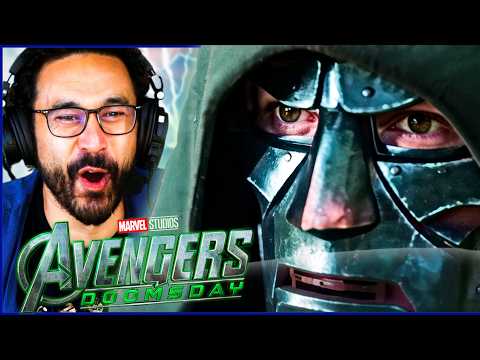
The most revealing part of this reaction is not the spectacle of another enormous Marvel crossover, but how quickly the discussion gravitates toward whether Doctor Doom can provide the film with a meaningful emotional center. After initially admitting that covering D23 in person left him distracted and unable to properly absorb the footage, the host approaches the trailer again with noticeably greater attention. That unusual setup gives the reaction a useful point of comparison: what barely registered amid the demands of live event coverage becomes considerably more compelling when he can actually concentrate on the material.
Robert Downey Jr.'s Doctor Doom naturally dominates the analysis. The host remains conscious of the baggage created by Downey's history as Tony Stark, and he does not pretend that a trailer has eliminated that problem. Instead, he identifies the voice, mask, physical presentation, and apparent commitment to Victor's personality as reasons the performance might eventually feel distinct. His suggestion that keeping Doom masked could help preserve that separation is speculative, but it is grounded in what concerns him about the casting rather than being presented as proof of how the completed film will handle the character.
The discussion becomes stronger when it moves beyond casting and considers what kind of Doom the movie may be constructing. The trailer's emphasis on family and loss leads the host to wonder whether Victor is being positioned primarily as a grieving husband and father. He finds the emotional accessibility promising while worrying that such an approach could simplify the character he values from the comics, particularly Doom's arrogance, controlling nature, belief in his own superiority, and more complicated personal history. This is one of the reaction's better observations because enthusiasm for the footage does not prevent him from questioning whether an immediately sympathetic motivation could flatten a more contradictory villain.
That same mixture of excitement and caution shapes the discussion of Reed, Sue, and Victor's apparent shared history. The suggestion that these characters knew Doom before his transformation gives their confrontations potential emotional weight, but the host correctly frames his interpretation as an inference from the footage rather than established information about the movie. His larger concern is more persuasive: if important relationships already exist before the story begins, the film will need to communicate that history while simultaneously servicing an unusually large collection of heroes and conflicts. He openly wishes audiences could have experienced more of that relationship beforehand rather than relying on this movie to establish it retrospectively.
The ensemble therefore becomes both the trailer's attraction and the reaction's central reservation. Thor confronting Doom, Cyclops, the X-Men, Sentinels, the Fantastic Four, and the broader Avengers material all generate genuine excitement, yet the host repeatedly returns to the question of whether these elements will receive enough time to matter. He does not want Reed and Victor reduced to a handful of strong scenes or the X-Men treated as pieces being positioned for the next action sequence. That concern gives the reaction more substance than a straightforward breakdown of recognizable characters because it evaluates what the footage implies about storytelling priorities rather than simply cataloging appearances.
The presentation is less disciplined around that analysis. The extended opening about attending D23, managing social media, tweeting during the event, meeting fans, and preferring livestream coverage is candid and explains why the host wants to watch the footage again, but it takes considerable time before the video reaches its main subject. Similar personal remarks return near the end. The conversational style fits an informal reaction and makes the enthusiasm feel spontaneous, yet tighter editing could preserve the useful context without allowing event logistics and channel updates to compete with the trailer discussion.
Once focused, however, the reaction develops a coherent reason for becoming more optimistic: the footage leaves the host thinking about Victor's motivations rather than merely the crossover's scale. Questions about what Doom lost, why he resents heroes who still have families, and how that loss might connect to the larger multiverse conflict give him hope that the character could unify an otherwise unwieldy story. He remains appropriately uncertain about those interpretations and about whether the finished movie can balance everything being promised. That restraint makes the final enthusiasm more convincing, because the trailer has increased his interest without being treated as evidence that Marvel has already solved the movie's substantial structural challenges.
Pros
- Focuses on Doctor Doom's characterization and potential emotional role rather than simply celebrating cameos and spectacle.
- Thoughtfully addresses the difficulty of separating Robert Downey Jr.'s new performance from his long association with Tony Stark.
- Identifies the potentially important history between Victor, Reed, and Sue while acknowledging how little is actually confirmed.
- Balances excitement about the X-Men, Sentinels, Thor, and other crossover elements with a legitimate concern about overcrowding.
- Clearly distinguishes personal interpretation of the trailer from certainty about the finished film.
Cons
- The lengthy discussion of attending D23 and managing social media delays the substantive trailer analysis.
- Several ideas are revisited multiple times, particularly concerns about the enormous ensemble and the hope that Doom will provide emotional cohesion.
- Comic-based expectations occasionally make the discussion less accessible to viewers unfamiliar with Doom's established characterization.
- The highly spontaneous delivery can become repetitive and fragmented even when the underlying observations are worthwhile.
This reaction succeeds because its excitement remains tied to a meaningful question about whether Doctor Doom can give an enormous crossover an emotional and narrative center. The loose, late-night presentation could be considerably tighter, but the thoughtful consideration of characterization, casting baggage, preexisting relationships, and ensemble overload gives the discussion more substance than a simple trailer celebration.