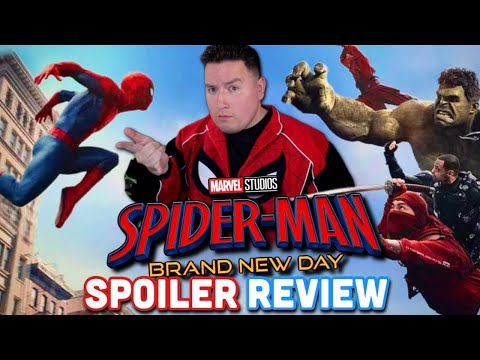
The review carries unusual weight because the presenter openly establishes himself as a Spider-Man fan who has never been fully enthusiastic about Tom Holland's previous solo films. Rather than pretending to approach the movie neutrally, he explains exactly what he has wanted from this version of the character: stronger visual identity, greater emotional hardship, a more mature Peter Parker, and a street-level story that lets Spider-Man exist as more than one piece of a larger Marvel machine. That history makes his enthusiasm meaningful when he describes this installment as the Holland film he has been waiting for, although the depth of that personal investment also means much of the evaluation is framed around whether the movie fulfills his particular idea of Spider-Man.
The strongest part of the review is its explanation of why Peter's characterization works for him. The emphasis is not simply that Peter is lonely or depressed, but that he has effectively retreated into being Spider-Man while neglecting Peter Parker, with the consequences of that isolation becoming the emotional foundation of the story. The comparison to The Batman helps communicate the approach without suggesting the movie merely imitates its darkness: Spider-Man apparently spends much of the runtime suited up, investigating events around New York, while still retaining the energy and humor expected from the character. The discussion of Peter watching the people he loves move forward without him, combined with praise for how the film handles MJ after No Way Home, gives the review a clear explanation for why this interpretation finally connected with the presenter.
The visual discussion is similarly specific. Calling this the best-looking Holland Spider-Man film is subjective, but the review supports that judgment with observations about the practical suit, Holland's physical performance through it, glimpses of his eyes behind the mask, camera movement during action, New York's presence, and the distinction between practical material and fully digital swinging shots. The presenter even notes that the practical costume can make the CGI version more conspicuous by comparison. His enthusiasm for the Spider-Man-versus-Hulk material and especially the fight against the Hand further establishes that the praise for director Destin Daniel Cretton is rooted in particular filmmaking choices rather than simply excitement about familiar characters.
The crowded supporting cast was clearly one of the presenter's major concerns going in, and the review makes a useful distinction between Marvel characters existing to advertise other projects and characters whose appearances actually advance Spider-Man's story. He argues that Punisher, Hulk, and Sadie Sink's character satisfy the latter purpose, while acknowledging that some viewers may disagree. Punisher receives especially strong praise because Tom Holland and Jon Bernthal's banter apparently creates a compelling contrast without stripping Frank Castle of his harsher personality. The review is less detailed about Hulk, but it does candidly warn that viewers expecting substantially more than the marketing suggests may be disappointed.
That enthusiasm is balanced by several concrete criticisms. The opening 15 to 20 minutes are described as rapidly edited and awkwardly assembled while catching viewers up on the intervening years, with some material feeling displaced from elsewhere in the movie. At two hours and 40 minutes, the film is also said to flirt with being overstuffed through its number of characters and plot threads, and an extended pool sequence is singled out as a gag that outstays its usefulness. These complaints are more persuasive than a vague assertion that the movie is messy because they identify where the pacing and construction apparently become noticeable, even though the spoiler-free format limits how thoroughly the structural problems can be demonstrated.
The discussion becomes less precise around the villain material and final act. The presenter suggests Sadie Sink's character functions as the central problem for much of the story and admits that this feels like an odd choice when Spider-Man's rogues gallery offers so many possibilities. He also calls the third-act conclusion a major dividing point for viewers, but spoiler avoidance prevents him from explaining exactly why. That restraint is understandable for a release-day review, yet it leaves some of the most important criticisms dependent on assurances that the movie eventually makes unconventional choices work. The same limitation affects comments about clunky editing supposedly resulting from a longer version of the film; without more support, that reads as inference rather than something the review establishes.
The presentation is highly enthusiastic and personal, sometimes to the point of repetition, but the excitement is accompanied by enough specificity to remain informative. The category ratings for action, comedy, drama, and suspense provide a quick summary of the presenter's priorities, while his recommendation that newcomers have familiarity with the earlier Holland films is useful given how heavily he says this story builds on their foundation. Most importantly, his praise of Cretton does not require dismissing Jon Watts: he ultimately argues that the new direction succeeds because it preserves and develops what the earlier trilogy established. That recognition gives the review more nuance than its celebratory tone initially suggests.
Pros
- Clearly explains why Peter's isolation and commitment to being Spider-Man create a stronger emotional connection for the presenter.
- Supports the visual praise with specific observations about the practical suit, physical performance, camera work, New York setting, and action design.
- Addresses concerns about Punisher, Hulk, and other Marvel characters by evaluating whether they serve Spider-Man's story.
- Gives concrete warnings about the rushed opening, crowded plotting, lengthy runtime, and an overextended comedic sequence.
- The presenter's longstanding reservations about Holland's earlier films provide useful context for why this installment changed his opinion.
- Gives credit to the earlier trilogy's foundation rather than treating the new director's approach as a complete rejection of what came before.
Cons
- Intense fan enthusiasm leads to repetition about finally getting the Spider-Man interpretation the presenter has wanted.
- Spoiler avoidance leaves the villain choice and divisive third act too vaguely explained to fully assess the criticism.
- The suggestion that awkward editing reflects material being rearranged from a longer version is presented without enough support.
- The review is strongest as an account of what satisfies this particular Spider-Man fan and somewhat less developed as an assessment of whether those choices work independently of that expectation.
This is an enthusiastic but substantive review whose strongest insight is that the new direction succeeds not merely through bigger action or familiar Marvel characters, but by making Peter Parker's isolation emotionally consequential while giving Spider-Man a stronger physical and visual presence. Some structural criticisms remain frustratingly vague under the spoiler-free approach, and the presenter's excitement occasionally overwhelms concision, but his detailed discussion of characterization, filmmaking, supporting characters, and shortcomings makes the recommendation convincing even while acknowledging a noticeably imperfect movie.