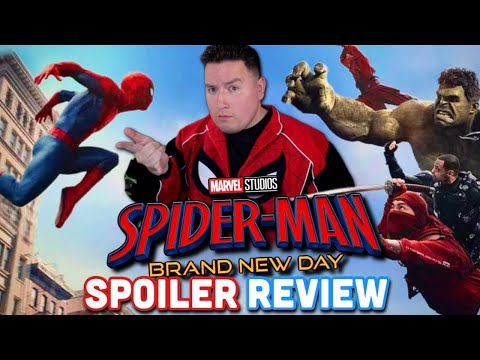
The review’s enthusiasm rests on a revealing contradiction: the presenter sees this as both the most authentically Spider-Man-focused of Tom Holland’s films and one of the most deeply integrated into the larger MCU. Rather than ignoring that tension, she makes it central to her assessment. Peter Parker’s personal journey supplies the emotional identity of a Spider-Man story, while the main plot involves characters and developments extending well beyond his traditional corner of Marvel. That distinction is useful because it explains both why she loves the film and why she suspects other viewers may find it less satisfying as a standalone adventure.
Her strongest argument concerns Peter’s maturation. A four-year time jump moves Holland beyond the student role, allows Peter to use his scientific abilities in a more adult context, and changes his relationship with established figures such as Bruce Banner. The presenter describes the adjustment as initially jarring, particularly because Holland’s vocal performance feels different, but ultimately considers adult Peter a welcome evolution after years of school-centered stories. More importantly, she identifies Peter’s transition into adulthood as the film’s emotional throughline rather than simply praising the novelty of seeing an older version of the character.
That emotional assessment becomes more specific through Peter, MJ, and Ned. Holland and Zendaya receive substantial praise for maintaining the characters’ emotional distance where necessary while preserving a convincing connection, and the presenter considers MJ a distinctive partner rather than merely a variation on the traditional Mary Jane Watson. Even Ned, whom she strongly disliked across the previous films, wins her over here. Her comparison to Spider-Man 2 is exceptionally generous, but she at least explains what motivates it: the personal relationships give the superhero spectacle an emotional foundation she believes can sustain repeat viewings.
The discussion of filmmaking is similarly concrete. Destin Daniel Cretton receives credit for spectacular action, Spider-Man point-of-view sequences, convincing New York imagery, strong establishing shots, and visuals that remind the presenter of Sam Raimi’s films without simply reproducing them. She is especially impressed that the movie creates a strong sense of New York despite not actually being filmed there. Her Dolby screening is relevant context for the praise of image quality, although it also means viewers seeing the movie under different presentation conditions may not experience its visuals quite as dramatically.
The supporting Marvel characters are where the review’s excitement becomes particularly infectious. Jon Bernthal’s Punisher is described as funnier, more dimensional, and better integrated than in his recent appearances, while the PG-13 environment is presented as an unexpected advantage because the character does not need extreme violence to make an impression. Hulk receives less screen time but apparently anchors the reviewer's favorite action sequence, while Scorpion exceeds her expectations and the Hand receives enthusiastic praise. The downside is that spoiler avoidance limits how much evidence she can provide for several of these judgments, sometimes reducing potentially interesting analysis to assurances that a sequence or surprise is excellent.
The larger MCU discussion is more mixed and arguably the review’s most valuable reservation. Department of Damage Control developments, characters inherited from streaming projects, and apparent setup for future stories make the universe feel unusually interconnected, but they also leave the film feeling like one chapter of something unfinished. The presenter even acknowledges that its smaller scale and serialized construction could make the two-and-a-half-hour feature resemble several Disney+ episodes assembled together. Her concern that important developments may sit unresolved while Doomsday and Secret Wars occupy Marvel’s attention further exposes the cost of using a Spider-Man movie to advance a wider franchise narrative.
The review is less disciplined when it expands from this film into sweeping judgments about superhero entertainment and filmmakers. Claims that most current comic books, animation, and superhero movies are watered down are personal assessments rather than demonstrated conclusions, while the detour into Kevin Feige’s directing choices, James Gunn’s producing abilities, and the Russo brothers’ post-Marvel careers adds relatively little to the evaluation at hand. Likewise, speculation about whether audiences will eventually turn against the movie, whether hardcore Spider-Man fans will object to its villain choices, and what Marvel is planning for Sadie Sink remains necessarily tentative. Still, the presenter repeatedly acknowledges her own biases, recent viewing enthusiasm, comic-book preferences, and uncertainty about broader reception, which keeps the exuberance from masquerading as consensus.
Pros
- Clearly identifies the unusual balance between Peter Parker’s personal story and a much larger MCU-driven plot.
- Gives specific reasons adult Peter Parker feels like a meaningful evolution for Holland’s version of the character.
- Grounds visual praise in the action staging, POV sequences, New York imagery, establishing shots, and presentation.
- Evaluates Punisher, Hulk, Scorpion, MJ, Ned, and Damage Control in terms of what each contributes rather than merely celebrating their inclusion.
- Openly acknowledges personal enthusiasm, recency bias, and the possibility that other viewers may respond differently.
- Raises a substantial concern about the film functioning as franchise setup rather than a fully independent Spider-Man story.
Cons
- Extreme enthusiasm produces repetition and occasionally substitutes excitement for detailed analysis.
- Strict spoiler avoidance makes several major claims about action, characters, surprises, and weaknesses difficult to evaluate.
- Speculation about future audience reactions and MCU plans extends beyond what the review can establish.
- Broad criticism of modern comic-book entertainment and tangents about Marvel filmmakers distract from the otherwise focused assessment.
- The implications of having so little traditional Spider-Man villain material could have been explored more deeply without revealing specific plot details.
This is an unusually enthusiastic review that still finds a meaningful tension beneath its praise: Peter Parker finally seems to have matured into a compelling adult hero just as his movie becomes more dependent on Marvel’s interconnected universe. Specific discussion of Holland’s evolution, the emotional relationships, Cretton’s visual direction, New York atmosphere, and supporting characters makes the recommendation persuasive, while concerns about serialized storytelling and franchise setup prevent it from becoming pure celebration. Spoiler restrictions and occasional MCU tangents limit the analysis, but the presenter makes a strong case for why this particular interpretation of Spider-Man worked so powerfully for her.