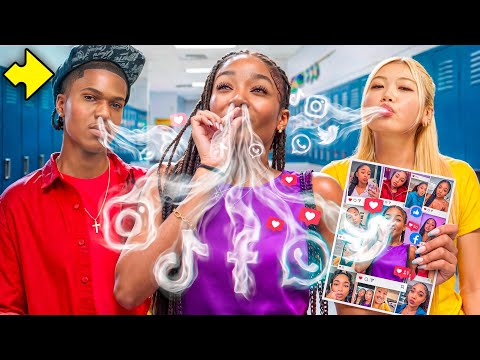
Giving every student 10,000 followers initially looks like a clean break from the school's old high-count, mid-count and low-count hierarchy, but the equality lasts only long enough for a new competition to replace it. With Jilly gone and Zaza and Roman taking control, the story cleverly shifts from an imposed social-media caste system to one supposedly determined by popularity itself. That distinction gives the conflict more substance than simply introducing another pair of obvious villains.
Zaza and Roman's mandatory meeting provides the clearest statement of the new philosophy. Everyone begins from the same numerical position, but students are then expected to prove whether they are funny, talented or influential enough to gain followers. Sarah immediately identifies the contradiction: removing fixed tiers means little when public follower counts are still being used to establish status. The exchange works because Zaza can plausibly argue that nobody is being forced to participate, while Sarah sees how displaying and celebrating the rankings inevitably creates social pressure.
Sarah is also used effectively as the story's central contradiction. She repeatedly insists that she does not care about followers, yet her public rejection of the system attracts followers anyway, eventually placing her third in the school's rankings. Roman interprets even her resistance as an influencer "angle," turning authenticity itself into marketable content. It is a sharp satirical idea: in an environment where everything becomes content, refusing to chase popularity can become another route to popularity.
The supporting students demonstrate how quickly incentives change behavior. Ken is willing to join people who previously mocked him because they can help increase his numbers, while the proposed T-girls group considers exposing Jilly's fake followers and other personal information as a growth strategy. Maya's refusal to exploit her former friend for followers provides one of the more grounded moral boundaries in the story, particularly because she remains conflicted about Jilly leaving without saying goodbye.
The ranking reveal makes the consequences explicit. Zaza and Roman publicly celebrate the students who have accumulated the largest audiences, praise content targeting Jilly, and tell everyone outside the top seven to try again. Their earlier claim that they are merely allowing popularity to develop naturally becomes increasingly difficult to separate from active encouragement of competition. The story does not need a lengthy explanation of that contradiction because the ceremony itself demonstrates it.
Presentation is energetic and packed with interpersonal friction, but some exchanges are repetitive or difficult to follow as characters interrupt one another and repeatedly return to follower counts, groups and rankings. Several potentially interesting relationships—particularly Maya's unresolved feelings about Jilly and Ken's willingness to abandon his earlier position—move quickly because so much time is devoted to establishing the new social order. Even so, the closing suggestion that Sarah's unexpected popularity makes her a "problem" creates an effective hook by showing that the people claiming not to control popularity may be uncomfortable when popularity produces a result they did not anticipate.
Pros
- Replacing fixed social tiers with supposedly organic rankings gives the social-media premise a meaningful new variation.
- Sarah's accidental rise in popularity creates an effective irony around authenticity becoming content.
- Ken and the T-girls storyline shows how follower incentives can quickly reshape friendships and loyalties.
- Maya's refusal to expose Jilly provides a credible counterpoint to the escalating competition.
- The ranking ceremony effectively exposes the contradiction between proclaimed equality and publicly reinforced status.
Cons
- Some conversations become repetitive as the same follower-count conflict is restated several times.
- Rapid, overlapping dialogue can make portions of the character interaction difficult to follow.
- Interesting emotional threads involving Jilly's departure and shifting friendships receive less development than the popularity competition.
- Zaza and Roman's distinction between rankings and the previous tier system becomes increasingly thin without much exploration of why students continue accepting their authority.
The school-wide reset develops into a useful satire of how changing the rules does not necessarily change a culture obsessed with measurable popularity. Sarah's unwanted success and the students' rapidly shifting alliances give the story enough character-driven tension to keep its familiar social-media themes engaging, even when the dialogue and repeated follower discussions could be tighter.