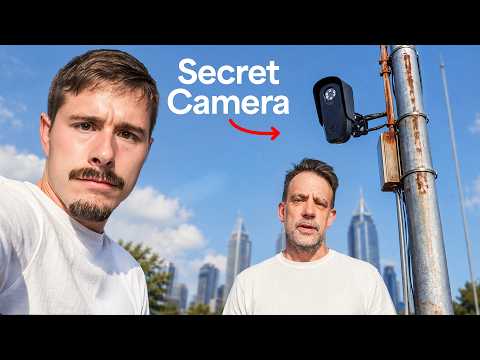
Rather than presenting a technical overview of surveillance technology, this video builds a broad argument that expanding camera networks, automated license plate readers, facial recognition systems, and drone surveillance represent a fundamental threat to privacy and individual liberty. Drawing heavily on 1984 by George Orwell, the discussion frames modern surveillance as a system that shapes behavior through constant observation rather than overt physical coercion. The presentation is less interested in explaining how surveillance technology works in isolation than in examining its potential social and political consequences.
The opening establishes the video's central theme by comparing Orwell's fictional "Big Brother" with modern digital surveillance. The argument emphasizes that privacy is not merely a personal convenience but a prerequisite for intimacy, independent thought, and freedom. This philosophical framing gives the discussion a broader scope than a simple policy debate and remains a recurring reference point throughout the program.
Much of the video focuses on automatic license plate reader systems, particularly those produced by Flock Safety. The host argues that these systems have expanded rapidly with limited public debate while collecting far more information than many people realize. The discussion questions whether the promised public safety benefits justify the loss of privacy and repeatedly argues that widespread surveillance has not demonstrably eliminated violent crime in cities where the technology has been widely deployed. While crime statistics and examples are presented to support this position, the broader conclusion that surveillance does not meaningfully improve public safety reflects the video's interpretation rather than an established consensus.
The program is strengthened by lengthy interviews with technology researcher Ben Jordan and former Rhode Island police officer Noel Pichardo. Jordan discusses privacy concerns, data collection practices, community policing, and his investigations into surveillance technology, while Pichardo recounts his opposition to license plate reader deployment within his former police department and the professional consequences he says followed. These extended conversations provide substantially more detail than the opening monologue and introduce perspectives from individuals directly involved with the issue.
Throughout the discussion, the presentation raises concerns about facial recognition, data retention, third-party technology vendors, warrantless tracking, drone surveillance, cybersecurity risks, and the relationship between private companies and government agencies. Many of these are legitimate public policy questions that continue to be debated by courts, legislators, privacy advocates, and law enforcement organizations. At the same time, the video frequently moves beyond documented concerns into broader predictions about future government behavior and societal consequences. Those projections are presented confidently but remain speculative rather than established fact.
The video's rhetorical style is highly opinionated and emotionally charged. Analogies, historical comparisons, sarcasm, and sharp personal criticism of individuals and institutions are used extensively to reinforce its central message. This approach makes the presentation engaging and memorable but also tends to blur the distinction between verified information, interpretation, and advocacy. Viewers looking for a comprehensive examination of surveillance technology may notice relatively little discussion of arguments offered by law enforcement agencies or supporters of these systems beyond brief acknowledgments.
Even so, the program succeeds in raising important questions about privacy, constitutional protections, government transparency, and public oversight. Regardless of whether viewers ultimately agree with its conclusions, it encourages consideration of how emerging surveillance technologies should be balanced against civil liberties and what level of democratic accountability should accompany their deployment.
Pros
- Presents a clear and consistently developed argument about the relationship between privacy, surveillance, and individual freedom.
- Uses Orwell's 1984 as an effective thematic framework throughout the discussion.
- Includes lengthy interviews with a technology researcher and a former police officer who explain their concerns in considerable detail.
- Explores a wide range of issues surrounding license plate readers, facial recognition, drones, data retention, and private surveillance vendors.
- Raises meaningful questions about constitutional protections, public oversight, and transparency that remain relevant policy debates.
Cons
- Frequently presents contested interpretations and predictions with greater certainty than the available evidence alone establishes.
- Gives comparatively little attention to evidence or perspectives offered by supporters of widespread surveillance technologies.
- Relies heavily on emotionally charged rhetoric and personal attacks that sometimes distract from the substantive policy discussion.
- Broad conclusions about crime reduction, government intent, and future surveillance practices often extend beyond what the examples presented can conclusively demonstrate.
This is a forcefully argued commentary that treats mass surveillance as one of the defining civil liberties issues of the modern era. Its greatest strength lies in encouraging viewers to think seriously about privacy, government power, and technological oversight while highlighting concerns that deserve public scrutiny. At the same time, it is unmistakably an advocacy piece rather than a neutral investigation, combining documented examples with speculation, interpretation, and strong rhetorical persuasion. Viewers interested in surveillance policy will likely find it thought-provoking, but should distinguish between the video's documented reporting, its interview subjects' experiences, and its broader political conclusions before drawing their own judgments.