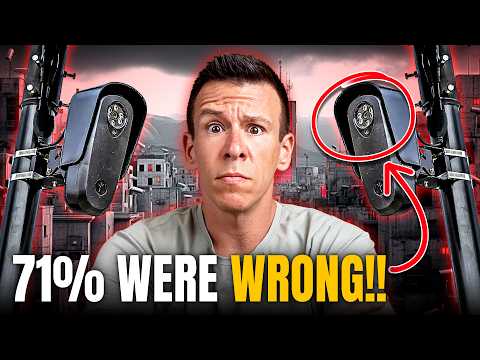
The central joke is established immediately: after showing Flock cameras being cut down, the video adopts the voice of an increasingly intrusive surveillance advocate who cannot understand why anyone would object to being watched. The character insists that these systems protect the public while casually addressing imaginary citizens by name, Social Security digits, address, family circumstances, and behavior. That contradiction drives nearly the entire piece. Every reassurance that the cameras merely promote safety is followed by another exaggerated demonstration of exactly why someone might worry about the reach of a surveillance network.
The satire works particularly well around the distinction between license-plate readers and broader surveillance. The video repeats the claim that Flock cameras simply read plates and alert police when vehicles are associated with crimes, then immediately undercuts that narrow description with examples involving people, behavioral identification, and access to collected information. The recurring correction that authorities are not “spying” but merely conducting “warrantless surveilling” is blunt, but it captures the video's argument efficiently: changing the terminology does not resolve the privacy concern.
Public safety receives a similarly skeptical treatment. A report about a three-month-old baby being recovered after an abduction initially appears to provide the strongest possible argument for the technology, only for the video to highlight a community note claiming local police said Flock was unnecessary to that particular case and suggesting favorable media coverage may have been paid for. Because those assertions are presented through the source material rather than independently demonstrated, they should not be treated as established conclusions. Still, the sequence effectively illustrates the video's broader concern that emotionally compelling success stories can be used to discourage scrutiny of how much a technology actually contributed.
The presentation also raises a meaningful issue about data moving beyond the local agencies that collect it. Its sarcastic response to concerns about federal access—essentially that the government cannot protect people's privacy unless it possesses their information—is one of the sharper jokes because it exposes the tension between centralized data collection and promises of responsible use. The claim that cameras can see inside windows further escalates that concern, though the short format provides little technical context about camera capabilities, retention practices, agency access, safeguards, or how representative the highlighted examples are.
Where the video becomes more problematic is in its treatment of camera vandalism. It mocks appeals not to cut down, cover, label, spray, or otherwise interfere with the devices, then references a camera map and describes several methods people could use to disable or obscure cameras. Those details are unnecessary to make the privacy argument and distract from the stronger criticism of surveillance policy. Satire can expose the absurdity of a system without drifting into actionable descriptions of damaging equipment.
The magnesium sponsorship is also unusually disruptive. The video abruptly moves from surveillance cameras and privacy to claims that a supplement containing seven forms of magnesium can improve sleep, calm nerves, and accelerate recovery, before returning briefly to the main material. Those health benefits are promotional claims within the advertisement, not findings established by the surrounding video, and the segment offers no evidence for evaluating them. More importantly as presentation, the long tonal detour interrupts a compact satire just as its argument has built momentum.
Pros
- The recurring contradiction between claiming cameras merely read license plates and portraying increasingly invasive surveillance gives the satire a clear, consistent target.
- Exaggerated personal knowledge about imaginary citizens effectively communicates the privacy concern without requiring a lengthy explanation of why large-scale data collection can feel intrusive.
- The baby-abduction example questions whether emotionally powerful success stories necessarily establish that surveillance technology was essential to an outcome.
- The distinction between local collection and potential broader government access introduces a substantive issue beneath the comedy.
Cons
- Claims about specific Flock capabilities, federal access, media promotion, and individual incidents receive limited context or independent support within the presentation.
- References to maps and specific methods for disabling or obscuring cameras are unnecessary to the argument and weaken an otherwise focused critique of surveillance.
- The satire overwhelmingly argues one side, giving little serious consideration to the strongest public-safety case for automated license-plate readers or possible safeguards.
- The extended supplement advertisement sharply interrupts the pacing and introduces health claims without supporting evidence.
The video is most effective when its fictional surveillance advocate keeps accidentally proving the privacy argument he is supposed to be dismissing. Repeating that Flock cameras only read license plates while joking about personal identities, addresses, behavior, federal access, and identifying people turns reassuring surveillance language into the punchline. That approach makes the concern immediately understandable, but it is satire rather than a comprehensive examination of Flock's technology, policies, effectiveness, or legal boundaries, and several factual claims would need substantially more evidence before supporting broader conclusions. The unnecessary descriptions of interfering with cameras and the abrupt supplement promotion further dilute the piece. As a pointed argument about how quickly “public safety” can become justification for expanding surveillance, however, it lands its central joke effectively.