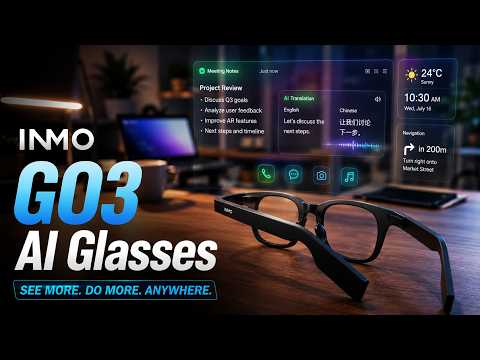
Rather than presenting the inmo GO3 as another futuristic concept, this video evaluates it through the lens of everyday usability. The central argument is straightforward: unlike many smart glasses that promise features through future software updates, the GO3 already delivers the functionality it advertises. That framing shapes the entire review, with the presenter systematically working through each major feature while describing personal experience after roughly ten days of use.
The strongest aspect of the presentation is its emphasis on practical testing instead of marketing language. Rather than simply listing specifications, the reviewer explains how features behaved in real-world scenarios, including live translation from Mandarin, walking navigation, teleprompter use, battery performance, and outdoor display visibility. Where performance claims come from the manufacturer—such as support for 98 languages or offline translation capabilities—the video presents them alongside demonstrations and personal observations instead of treating them as independently verified facts.
Translation receives the most attention, and understandably so. The reviewer reports readable English subtitles appearing with approximately half a second to one second of delay while translating spoken Mandarin, describing the experience as surprisingly responsive. The discussion also highlights two-way conversations through an optional speaker accessory and offline support for selected languages. While these demonstrations suggest the feature performs well in the tested scenarios, the review does not attempt broader accuracy testing across multiple languages, accents, or more challenging conversational environments.
The teleprompter functionality is another standout section because it focuses on a specific audience rather than presenting it as universally useful. The reviewer openly acknowledges that the feature is niche but argues it can replace larger teleprompter setups for content creators by allowing scripts to scroll while maintaining eye contact with the camera. That combination of enthusiasm and acknowledgment of limited appeal makes the discussion feel measured rather than promotional.
Battery life is discussed with similar balance. Instead of simply repeating the manufacturer's estimates, the reviewer explains that the swappable battery modules typically lasted closer to three hours during heavier translation use and nearly four hours during lighter tasks such as notifications and music playback. More importantly, the emphasis is placed on the hot-swappable design itself, which avoids downtime by allowing depleted batteries to be replaced almost instantly.
The review also earns credibility by pointing out meaningful limitations. Walking and cycling navigation are supported, but driving navigation is not. The microLED displays remain monochrome green rather than full color. The glasses are described as comfortable enough to stop noticing over time, yet the reviewer avoids claiming they disappear entirely due to their weight. These concessions help distinguish practical evaluation from outright endorsement.
Presentation quality is polished and engaging throughout. The feature-by-feature structure makes the information easy to follow, and the reviewer generally explains why individual capabilities matter in everyday use instead of relying on specifications alone. However, viewers should recognize that the video includes a paid sponsorship from the manufacturer, which is disclosed. While the reviewer remains willing to discuss drawbacks, long-term durability, privacy considerations surrounding the integrated camera, and broader comparisons with competing smart glasses receive relatively little attention.
Pros
- Clearly distinguishes between features personally tested and manufacturer specifications.
- Demonstrates translation, navigation, teleprompter, camera, battery, and display performance through practical examples.
- Provides balanced commentary by acknowledging both strengths and limitations.
- Reports observed battery life rather than relying solely on advertised figures.
- Explains which features are likely to appeal to specific users instead of portraying every capability as universally valuable.
- Evaluates the companion app's usability alongside the hardware experience.
- Discloses the sponsorship while still identifying shortcomings such as monochrome displays and limited navigation modes.
Cons
- Includes only limited comparisons with competing smart glasses.
- Translation performance is demonstrated in selected scenarios rather than extensively validated across varied languages and environments.
- Long-term reliability and durability are not explored after only a short period of use.
- Camera quality and privacy implications receive relatively brief discussion.
- Some product capabilities, including language support and historical improvements over previous models, rely on manufacturer claims rather than independent verification.
This is a well-organized product review that succeeds by concentrating on real-world functionality rather than speculative future updates. The reviewer methodically demonstrates how the inmo GO3 performs across its major features while remaining willing to acknowledge practical compromises such as monochrome displays, walking-only navigation, and finite battery life. Although the sponsored nature of the video and limited long-term testing warrant some caution, the presentation generally supports its conclusions with hands-on observations instead of hype, making it a useful evaluation for viewers interested in everyday AI smart glasses.