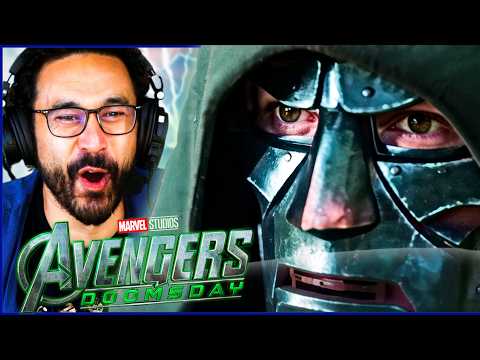
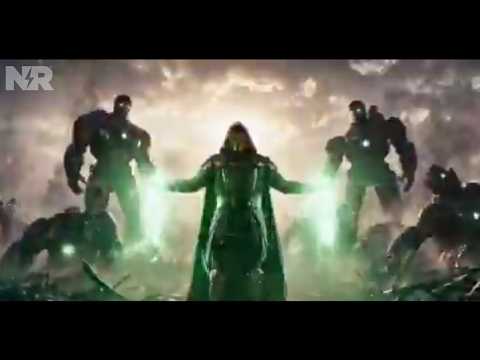
The strongest part of this breakdown is its attention to visual continuity and character placement. Rather than merely cataloging recognizable faces, Charlie scrutinizes Steve Rogers’ longer hair and beard, the cracked Mjolnir in his hand, Bucky and Sam’s suspicious reactions, and the conspicuous gaps in group shots where characters may have been digitally removed. That kind of frame-by-frame observation gives the discussion a clear purpose, especially when it connects trailer imagery with Marvel’s past habit of altering promotional footage to conceal story details. The difficulty is that plausible observation quickly becomes a launchpad for much larger theories that the footage itself does not establish.
Steve Rogers becomes the centerpiece, with the video entertaining the possibility that the unfamiliar-looking Captain America is an alternate or antagonistic version rather than the Steve who retired with Peggy Carter. The discussion of a potential “Hydra Captain America” draws on Secret Empire as a conceptual comparison, particularly the question of how an evil Steve could wield Mjolnir, while also acknowledging that the character might not literally reproduce that comic storyline. That qualification matters, but the subsequent proposal that Doctor Doom could rewrite Steve’s worthiness through magic is still entirely speculative. The theory is inventive and internally coherent, yet the video spends enough time elaborating it that the distinction between evidence and imagined mechanism sometimes becomes thin.
The broader Doom theory is similarly ambitious. Charlie proposes that Doom may initially manipulate different universes into fighting one another, reveal himself as the central threat after the heroes unite, and ultimately defeat them before becoming God Emperor Doom in Secret Wars. He also interprets the poster’s woman and child as Doom’s deceased family, speculates that his wife may have been a version of Sue Storm, and suggests Steve Rogers’ decision to remain in the past could have caused the incursion that destroyed Doom’s universe. These ideas create an appealing narrative through-line, but they depend on several layers of assumptions stacked together. The video works better as prediction than explanation whenever it moves this far beyond what the trailer visibly supplies.
Its discussion of Loki and the TVA is more tightly constructed. The identification of Steve’s ring alongside Loki’s TVA card and the comparison between Loki’s surroundings and Steve and Peggy’s home give the theory at least a specific visual foundation. From there, Charlie imagines Loki confronting Steve about the multiversal consequences of living in the past. Even here, the exact scenario remains conjecture, but the reasoning is easier to follow because viewers can see which details motivated it rather than being asked to accept an unseen plot leak or rumor as the starting point.
The second half becomes a rapid inventory of characters absent from the trailer, including Doctor Strange, Deadpool, Wolverine, Spider-Man, Hulk, Captain Marvel, Monica Rambeau, Beast, Nightcrawler, Scarlet Witch, the Eternals, Black Widow, and both versions of Blade discussed here. Some projections are sensibly framed as expectations or assumptions, such as saving major characters for Secret Wars because the cast is already crowded. Others rely more heavily on rumors, leaked material, reported roles, unfinished visual effects, or imagined post-credit scenes. Because those categories are not always separated cleanly, the video occasionally gives equal rhetorical weight to something visible in the trailer and something merely reported or theorized elsewhere.
There is nevertheless an effective structural idea holding the speculation together: Doomsday and Secret Wars are treated as a two-part event analogous to Infinity War and Endgame, with some characters deliberately withheld from the first installment and positioned for larger roles in the second. That framework makes the sprawling character discussion easier to understand and explains why trailer absence does not necessarily imply narrative absence. The repeated comparisons to Hickman-era incursions, Battleworld, and God Emperor Doom also give comic readers useful reference points, provided they are understood as possible inspiration rather than confirmation of the film’s actual plot.
Presentation is energetic and densely informed, but the pacing can become overwhelming because nearly every observation branches into another rumor, comic parallel, hypothetical cameo, or future-film prediction. Terms such as “supposedly,” “rumor,” “my assumption,” and “I think” appear frequently enough to signal uncertainty, yet the sheer specificity of the proposed scenarios can still make tentative information sound more settled than it is. A more disciplined hierarchy separating visible trailer evidence, established MCU continuity, reported information, and pure theory would make the breakdown considerably easier to evaluate without sacrificing its enthusiasm.
Pros
- Close attention to Steve Rogers’ appearance, Mjolnir, character reactions, and suspicious empty spaces gives the trailer analysis several concrete visual anchors.
- The Loki theory is built around identifiable details such as the TVA card, Steve’s ring, and the apparent setting rather than speculation alone.
- Comparisons with Secret Empire, Hickman’s incursions, Battleworld, and the Infinity War/Endgame structure provide useful context for understanding the proposed story possibilities.
- The discussion repeatedly acknowledges that major conclusions about Steve Rogers, Doom, Spider-Man, Scarlet Witch, and other characters are theories rather than confirmed plot points.
- Treating Doomsday and Secret Wars as complementary ensemble films offers a coherent explanation for why many expected characters may be absent from the first trailer.
Cons
- Visible trailer evidence, rumors, leaks, reported roles, comic inspiration, and personal predictions are frequently blended together without a strong hierarchy of reliability.
- The Hydra Captain America theory becomes increasingly elaborate despite limited direct evidence that this Steve Rogers is actually evil.
- Several Doom theories depend on one unverified assumption supporting another, including his family history, connection to Sue Storm, and Steve Rogers causing the destruction of his universe.
- The long catalog of missing characters becomes repetitive because many conclusions amount to predicting that they will appear later in Secret Wars.
- Rapid delivery and constant branching into hypothetical plot mechanics can obscure which observations are genuinely supported by the footage.
This is an engaging and impressively detailed piece of trailer theorizing whose best moments come from genuine visual detective work, especially around Steve Rogers, Mjolnir, Loki, and Marvel’s potentially altered group shots. Its weaker stretches turn uncertain rumors and imaginative predictions into elaborate narrative chains before the available evidence can support them, making it more rewarding as informed speculation than as a reliable reconstruction of the film.