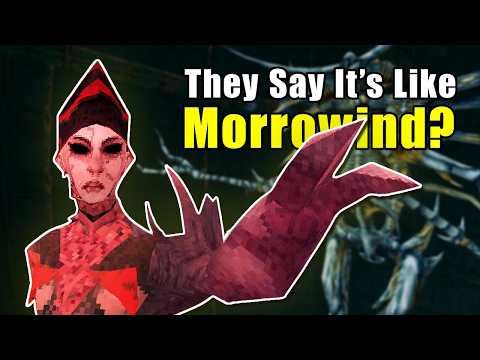
A cursed mining town populated by werewolves, suspicious lawmen, occultists, talking skulls, and supernatural vultures gives Silverload an identity far stronger than its mechanics deserve. The presenter immediately recognizes that contradiction, treating the game as something genuinely fascinating rather than simply another failed 1990s curiosity. Comparing the poorly received PC release with the substantially remade PlayStation version also provides a useful framework for understanding how an intriguing concept could survive two very different executions without ever becoming a particularly good game.
The version-to-version comparisons are among the presentation's best features. Changes in voice acting, backgrounds, character designs, cutscenes, dialogue, and even small details such as the PC mayor's lack of pants reveal just how extensively the PlayStation edition was rebuilt. The contrast between the PC saloon's lively Western music and the PlayStation version's eerie whispers and relentless coughing is especially effective at showing how the remake pursued a darker atmosphere. Rather than merely declaring one release definitive, the presenter repeatedly demonstrates how each version gains and loses particular pieces of personality.
Silverload itself has a remarkably fertile premise. A frontier settlement grows wealthy after discovering silver, participates in the massacre of the area's original inhabitants, becomes cursed, and then discovers that its monstrous residents can no longer touch the metal responsible for their prosperity. The preacher exploits the situation by forming a cult, humans are forced to work the mines, and the kidnapped child becomes part of an attempted ritual. The presentation correctly treats those events as the game's fictional mythology rather than historical fact, while the brief discussion of post-mortem photography is carefully framed as contextual information rather than evidence for the game's supernatural ideas.
Unfortunately, the game appears determined to hide that mythology behind hostile design. Extremely precise pixel hunting repeatedly produces the dreaded "Nothing happens" response, progression mechanics can be poorly communicated, puzzles sometimes rely on questionable logic, and missed triggers can remove significant story scenes altogether. The presenter also describes repeatedly soft-locking the game. These are not minor inconveniences in an adventure title built around investigation; they directly interfere with discovering the material that makes Silverload worth examining in the first place.
Story delivery creates another significant problem. Important information arrives through scattered conversations, optional events, flashbacks, notebooks, graves, and an enormous mayoral journal that effectively dumps much of the town's history at once. The underlying plot eventually forms a coherent enough chain involving the preacher, sheriff, anthropologists, massacre, curse, protagonist's childhood, and impending sacrifice, but the game makes assembling those pieces unnecessarily difficult. The gunslinger's sudden connection to murdered adoptive parents is particularly awkward because the revelation is important while his apparent lack of memory receives little attention.
Comedy prevents the lengthy walkthrough from becoming as cumbersome as the game itself. The presenter repeatedly turns bad dialogue, strange performances, crude animation, bizarre puzzle solutions, and accidental timing into jokes without losing sight of why the setting remains appealing. Sheila's wonderfully obvious advice to "try the gates," the endlessly groaning townsman, the sheriff's awkward intimidation, the cut-off vulture sound, and the mine werewolf's peculiar performance all become entertaining examples of Silverload's accidental charm. There are stretches where the riffing overtakes critical analysis, and the mid-video sleep-product sponsorship significantly interrupts the trip through town, but the energetic editing and affection for obscure games generally keep the extensive plot reconstruction lively.
That affection ultimately produces a more interesting assessment than simply celebrating a bad game for laughs. The presenter readily calls Silverload awful to play, criticizes its soft locks and story structure, and still makes a persuasive case that its visual mixture of cartoon-like artwork and live performers, Gothic Western atmosphere, voice acting, and central curse deserve preservation. The concluding complaint about platform moderation is understandable within the creator's circumstances but feels detached from the examination that precedes it, weakening an otherwise natural ending. Even so, this is an engaging excavation of a deeply flawed game whose imagination survived failures that its mechanics could not overcome.
Pros
- Detailed comparisons between the PC and PlayStation releases show how dramatically the remake changed visuals, performances, atmosphere, dialogue, and story presentation.
- The cursed silver-mining town provides an unusually memorable combination of Western, Gothic, werewolf, and occult imagery.
- Humor makes numerous awkward performances, strange animations, and poorly designed interactions entertaining without disguising the game's substantial flaws.
- The walkthrough successfully reconstructs a complicated story that the game itself often communicates badly.
Cons
- Extensive plot coverage can become lengthy, particularly when numerous optional characters and minor interactions are shown.
- The sponsorship interrupts the atmosphere during an otherwise focused exploration of Silverload.
- Some comedic riffing receives more attention than the underlying design criticism needs.
- The closing discussion of platform moderation is largely disconnected from the game and makes the ending less focused.
Silverload emerges as an excellent example of a game whose atmosphere and imagination are considerably better than the experience of actually playing it. An entertaining comparative walkthrough exposes the miserable mechanics and confused storytelling while preserving the strange Gothic Western charm that makes this forgotten failure worth revisiting.