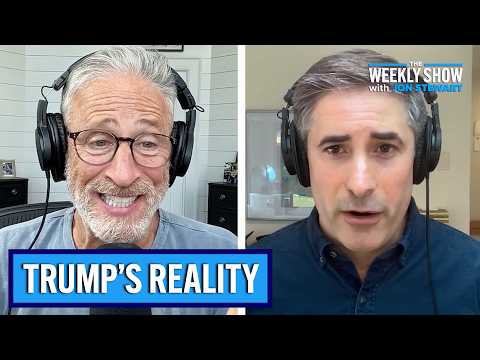
Donald Trump’s United Nations address becomes the organizing event for a much broader argument about American democracy, international institutions, press freedom, immigration enforcement, corruption, and the postwar global order. Rather than treating Trump’s remarks as another collection of provocative statements, the host argues that they reveal a coherent worldview built around military power, spheres of influence, weakened international constraints, and concentrated executive authority. Trump did in fact threaten at the UN to “annihilate” Iran if a deal is not reached, making the speech’s unusually confrontational language a legitimate subject for close scrutiny. Axios +1
The discussion is at its best when it slows down and supplies historical context. The explanation of post-World War II institutions, international trade, national sovereignty, and the purpose of the United Nations gives viewers a framework for understanding why presidential rhetoric about territorial dominance and unilateral force matters beyond a single news cycle. The host also acknowledges that this international system has never operated perfectly and identifies George W. Bush’s doctrine of preemption as an earlier challenge to the norms she is defending. That qualification makes the historical argument more substantial than a simple claim that everything changed with Trump, although the enormous sweep from the Atlantic Charter to current foreign policy inevitably compresses complicated history.
The section on press access is similarly useful because it distinguishes the White House ban from the journalists’ ability to cover Trump at the UN under separate UN credentials. That distinction is supported by current reporting: CNN, MS NOW, and Politico remained barred from the White House while covering Trump at the United Nations, and the organizations have challenged the White House restrictions in court. Reuters +1 The host’s categorical declaration that Republicans now simply lie rather than spin, however, illustrates a recurring weakness. It replaces case-by-case scrutiny with a sweeping partisan judgment, making the presentation less analytical precisely when careful distinctions would strengthen it.
That tendency becomes considerably stronger as the conversation progresses. Trump’s remarks are repeatedly interpreted through labels including dictatorship, fascism, Nazism, oligarchy, and kleptocracy, while immigration detention facilities are categorically described as concentration camps. The host sometimes explains the definitions and historical reasoning behind those terms, which is more useful than merely deploying them as insults, but she generally presents her interpretations as settled conclusions rather than contested political and historical classifications. Her reading of Trump’s Iran statement as sounding like a nuclear threat is another example: the annihilation language itself is documented, but interpreting it specifically as a threatened nuclear attack goes beyond what the quoted remarks establish. CNN Transcripts
The Susan Collins discussion shows both the value and the risk of the program’s approach. ProPublica reported that the FBI sought in 2024 to pursue a broader corruption investigation involving Collins and defense contractor Navatek, while also documenting significant credibility problems surrounding contractor Martin Kao and noting that no one working for Collins was charged. Collins’ office vigorously denied bribery or pay-to-play allegations and said it had cooperated with investigators. ProPublica The host correctly presents the reporting as potentially significant, but then moves quickly from an unfinished investigation to speculation that Collins may have owed Trump because his administration dismantled the unit handling the inquiry. That causal conclusion is much stronger than the evidence presented supports.
As political commentary, the hour is unusually transparent about its perspective. The host explicitly says she is advocating her own worldview, calls for opposition to MAGA Republicans, praises particular Democratic politicians, encourages political action, and discusses traveling to raise money for midterm candidates. That openness means viewers are never being sold neutrality under another name, but it also establishes the program’s central limitation: competing explanations and counterarguments receive little sustained consideration. Even potentially testable claims, such as assertions about Trump’s approval ratings and the political “crack up” of MAGA, are used primarily to advance the larger narrative rather than carefully establish its boundaries. The result is an energetic and often informative political argument whose historical framing can illuminate current events, but whose confidence regularly outruns the distinctions between documented fact, interpretation, allegation, and advocacy.
Pros
- The extended discussion of the post-World War II international order gives Trump’s UN remarks meaningful historical and institutional context.
- The explanation of why White House restrictions did not prevent CNN, MS NOW, and Politico from covering Trump at the UN accurately clarifies an easily misunderstood press-access dispute.
- Direct excerpts from Trump’s UN speech allow viewers to hear important portions of the rhetoric being analyzed rather than relying entirely on characterization.
- The host openly identifies her democratic and political commitments instead of presenting an advocacy-oriented discussion as neutral reporting.
- The Susan Collins segment directs attention toward substantive investigative reporting while acknowledging that the underlying FBI inquiry faced evidentiary complications.
Cons
- Loaded classifications such as fascism, Nazism, dictatorship, concentration camps, and kleptocracy are frequently presented with greater certainty than the discussion establishes.
- Trump’s threat to “annihilate” Iran is interpreted as sounding like a nuclear threat even though the quoted statement does not specify nuclear weapons.
- The Susan Collins discussion moves from serious but unresolved investigative reporting to speculation about political indebtedness that the evidence presented does not demonstrate.
- Broad declarations about Republicans lying and MAGA “cracking up” substitute partisan certainty for more careful analysis of individual claims and political trends.
- The sprawling format moves through press access, trade, the UN, Iran, immigration, health care, corruption, historical reform movements, and Democratic politics with limited discipline, producing repetition and several lengthy digressions.
The host offers an ambitious attempt to connect a day of political news to larger questions about democratic government, international order, and the rule of law, with historical context giving the discussion considerably more substance than a routine news reaction. Its usefulness declines when strongly contested interpretations become categorical conclusions and allegations become springboards for speculation, leaving viewers with a forceful piece of political advocacy rather than a consistently rigorous examination of the evidence.