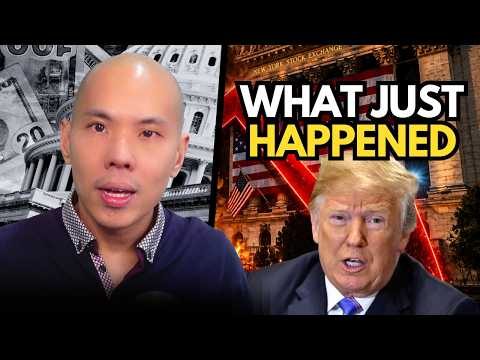
The most useful idea here is also the least dramatic: investors should resist making major portfolio decisions simply because frightening headlines make action feel urgent. Felix organizes conflict-driven market behavior into three stages—shock, repricing, and rotation—and argues that retail investors are vulnerable both when panic pushes them toward selling and when fear of missing out sends them chasing whatever has already surged. That framework provides a sensible organizing principle for the presentation, particularly because his eventual advice is not to make an enormous geopolitical bet but to adjust exposure carefully, diversify, manage risk, and decide on exits before entering trades. The difficulty is that this restrained message shares space with much more confident claims about institutional behavior, inflation, government debt, and where capital will flow next.
The three-phase model is the video's clearest contribution. In the shock phase, Felix describes fear, volatility, falling risk assets, and sudden commodity moves as emotional reactions that can mislead investors. Repricing comes when markets begin evaluating whether the conflict actually changes inflation, interest rates, economic growth, or supply chains. Rotation then describes capital moving between sectors as investors respond to those consequences. It is an intuitive way to think about markets adapting to unexpected events, and the repeated warning against panic selling or chasing an initial spike is appropriately cautious. The model should still be understood as Felix's framework rather than a mechanical sequence that every conflict must follow in exactly the same way.
The portfolio section becomes more practical by translating that framework into five suggested "tilts." Energy infrastructure is favored over simply chasing oil, defense is presented as benefiting from longer-term increases in military spending, gold and silver are treated as multi-year rather than short-term holdings, companies with genuine pricing power are preferred during inflationary conditions, and rate-sensitive sectors such as utilities and real estate are identified as potentially vulnerable when borrowing costs remain elevated. Felix repeatedly emphasizes position sizing and diversification rather than putting everything into one prediction. He even qualifies his general warning about real estate by noting that he is examining specific self-storage investments, which illustrates why broad sector narratives do not automatically determine the prospects of every individual asset.
The analysis becomes much less convincing when it moves from observable market relationships into a sweeping explanation of inflation and U.S. debt. Felix links conflict-driven oil prices, persistent inflation, stablecoin demand for government debt, gradual dollar depreciation, and postwar debt reduction into what he presents as a connected mechanism. He explicitly rejects the conspiracy label and invokes financial repression after World War II as precedent, but demonstrating that inflation can reduce debt burdens is not the same as establishing that today's geopolitical conflict, stablecoin legislation, monetary policy, and fiscal incentives are functioning as one coordinated or predictable process. The provocative suggestion that Iran is effectively accelerating a useful debt-reduction mechanism goes considerably beyond the evidence actually developed in the presentation.
Several other claims would also benefit from visible sourcing and fuller context. Felix cites unusually low corporate insider buying, retail purchasing at nearly twice normal levels, Bank of America research covering 90 years of oil shocks, central-bank gold accumulation, defense-spending trends, and specific political trading activity. These may be relevant data points, but the methodology, dates, comparison periods, definitions, and underlying sources are not examined in enough detail for viewers to independently evaluate them. The claim that professionals are executing a "great tech handoff" to retail investors is especially strong because insider selling, institutional positioning, valuation, and retail flows are different measures that do not by themselves establish a coordinated transfer from sophisticated investors to ordinary buyers.
There is also tension between the video's anti-hype message and its own presentation. Viewers are warned that fear, urgency, FOMO, and dramatic news can lead to expensive decisions, yet the opening says getting the moment wrong could cost years of savings while getting it right could set investors up financially. The free report, repeated requests to comment, promotion of a two-hour live event, repeated URL mentions, and demonstration of the Winston platform consume substantial attention. Felix says the channel has no sponsors or fund to sell, but he does promote his own investing resources and software within the episode. That does not invalidate the analysis, but it makes the presentation feel more commercially driven than the opening description of the channel initially suggests.
Felix is strongest when he returns to risk management rather than prediction. The closing argument that no single position should be capable of wrecking a portfolio is more durable than trying to determine which sector will win from a specific war. His admission that he is not an expert in Middle Eastern geopolitics, defense technology, or oil shipping also provides a useful limitation on his own authority. Yet the claim that investors can essentially ignore news and simply follow market prices risks oversimplifying the relationship between markets, fundamentals, policy, and geopolitical developments. A rules-based process can reduce emotional decision-making without making information irrelevant, and the episode would be stronger if it maintained that distinction as consistently as it advocates disciplined position sizing.
Pros
- The shock, repricing, and rotation framework gives viewers an accessible way to think about how markets may process geopolitical disruptions over time.
- Repeated warnings against panic selling and chasing assets after sudden spikes directly address two common forms of emotionally driven investing.
- The five suggested portfolio tilts cover energy infrastructure, defense, precious metals, pricing power, and interest-rate sensitivity rather than reducing the strategy to one war trade.
- Felix emphasizes diversification, position sizing, downside awareness, and predetermined exits instead of encouraging viewers to make an all-or-nothing geopolitical bet.
- Distinguishing longer-term themes from short-lived commodity reactions adds useful nuance to the discussion of oil, gold, defense, and inflation.
Cons
- The proposed connection between war, oil, inflation, stablecoins, dollar depreciation, and government debt reduction is presented with greater certainty than the evidence shown supports.
- Numerous statistics and claims about insider activity, retail flows, historical oil performance, central-bank buying, defense spending, and political trades receive too little sourcing or methodological context.
- The "great tech handoff" framing implies a clearer transfer from sophisticated investors to retail buyers than the evidence presented establishes.
- The urgent opening and repeated promotion of a report, live event, and proprietary investing platform sit awkwardly beside the video's warning against emotional financial messaging.
- Suggesting that investors can largely ignore news because prices reveal what matters understates the role of fundamentals, policy, and context in interpreting market movements.
The three-phase framework and emphasis on disciplined risk management provide a useful antidote to panic-driven investing, especially when Felix advises modest portfolio tilts rather than betting everything on a geopolitical prediction. The episode is considerably weaker when that practical philosophy expands into confident narratives about smart money, inflation, stablecoins, debt reduction, and institutional positioning without enough evidence to establish the connections being asserted. There is worthwhile investing discipline underneath the dramatic framing, but viewers should treat the specific macroeconomic narrative and sector calls as arguments to investigate rather than a proven map of what markets will do next.