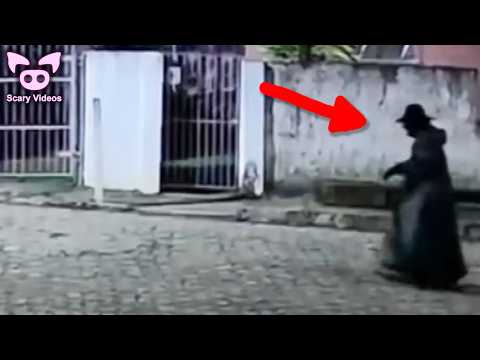
A violently shaking basement door establishes the collection’s basic formula immediately: ordinary domestic or outdoor settings are paired with unexplained movement, sounds or figures, then left unresolved. The opening segment is one of the more effective examples because it at least acknowledges proposed mundane explanations involving air pressure and appliances, along with the uploader’s claim that follow-up testing failed to reproduce the effect. That does not establish anything paranormal, but it gives the mystery more structure than simply presenting strange footage and declaring it inexplicable.
The encounter involving a woman hearing what seems to be her son’s voice is considerably more theatrical. Her uncertainty about whether the speaker really is her son creates an effective escalation, culminating in the alarming claim that the voice is behind her and an immediate burst of panic. As horror material, the sequence understands how to exploit a familiar fear: hearing someone you trust from somewhere they should not be. As evidence of anything supernatural, however, the presentation offers little basis for evaluating the recording’s origin, circumstances or authenticity.
That evidentiary limitation becomes especially important with the farm-camera footage. A figure described as resembling a translucent little girl approaches a horse, while the owner reportedly finds nobody outside and says surrounding cameras recorded no arrival or departure. The narrator properly attributes the ghost interpretation to the owner and asks viewers what they think rather than presenting a spirit as established fact, but alternatives such as image artifacts, staging or missing contextual information are not meaningfully explored.
A hotel-room drawer slowly opening by itself is similarly effective because of its simplicity. There is no elaborate apparition or violent confrontation, just a small movement reportedly discovered after the employee reviewed her recording. Yet an unsecured or uneven drawer can move for ordinary mechanical reasons, something the narration itself briefly recognizes. Without more information about the furniture, floor, camera setup or recording conditions, the footage remains creepy precisely because it is ambiguous rather than because it demonstrates a paranormal cause.
The nighttime forest clip pushes further toward conventional internet-horror imagery, with what appears to be a small child running backward toward a hiker. The strange movement and dark surroundings make the image immediately unsettling, but the accompanying questions about why a child would behave this way do more to amplify the mystery than investigate it. There is no supporting context establishing who the figure was, where the footage originated or whether the encounter was spontaneous, leaving viewers with a disturbing visual but almost nothing against which to test it.
The final whistling encounter is the most aggressively constructed scare: a couple hears whistling outside their bedroom, the boyfriend searches the house, the sound stops, and a scream accompanied by what is described as a powerful rush of air sends them retreating to call police. The sequence benefits from clear escalation and restrained narration before the payoff, but the suggestion that whatever screamed might not have been human goes beyond what the described sounds can establish. That tension captures both the collection’s entertainment value and its weakness: it is skilled at converting uncertainty into dread, but rarely provides enough provenance or examination to turn uncertainty into meaningful evidence.
Pros
- The basement segment acknowledges ordinary explanations and reports an attempt to test them rather than immediately insisting on a paranormal cause.
- Several clips build suspense effectively from simple details such as a voice, an opening drawer, unusual movement or distant whistling.
- Paranormal interpretations are generally framed as claims or questions rather than established facts.
- The brisk pacing keeps the compilation moving without burying its strongest moments under excessive commentary.
Cons
- Most clips lack enough information about their origins, recording conditions or authenticity to evaluate them beyond their entertainment value.
- Possible conventional explanations receive only limited investigation outside the basement segment.
- Leading questions sometimes encourage supernatural interpretations despite the footage remaining fundamentally ambiguous.
- The backward-running figure and final screaming encounter rely heavily on dramatic presentation without providing corroborating context.
Uncertainty is used effectively here as a horror device, with mundane locations and incomplete information allowing viewers’ imaginations to supply much of the fear. The collection is engagingly paced and appropriately cautious about declaring its mysteries solved, but its limited verification means the encounters work far better as creepy internet curiosities than evidence of anything paranormal.