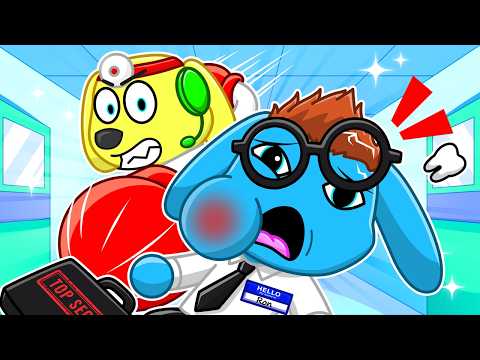
The appeal of this hospital session comes almost entirely from how little interest the group has in behaving like competent medical staff. Patients arrive with strange problems, suspicious figures appear around the building, sanity can apparently decline, and anomalies need to be identified, yet nearly every interaction becomes an excuse for a joke. Coffee, bizarre patient behavior, insults between the players, a mysterious stalker, a clown-like figure, and an officer searching for a dangerous killer create a constant stream of distractions. The actual objective is easy enough to understand, but the entertainment comes from watching the players repeatedly derail themselves while trying to accomplish it.
The anomaly system provides the clearest gameplay structure. Ordinary-looking visitors can apparently conceal something abnormal, forcing the players to watch behavior rather than simply process appointments. A crawling patient immediately raises suspicion, while another character is eventually identified as an anomaly after being photographed with a UV camera. That camera becomes the most interesting mechanic introduced during the episode because it turns observation into an active investigation: the players are specifically instructed to photograph Philip Lim and later Lola, giving them a concrete reason to inspect characters rather than simply react to whatever strange event happens next.
The hospital setting also works well as a container for unpredictable encounters. Doctor Harlow, Barney, the stalker, patients asking for help, and other unusual visitors keep interrupting whatever task currently has the group's attention. The serial-killer warning creates a potentially effective layer of suspicion because the officer supplies a picture and asks the players to report anything suspicious, while a threatening message immediately complicates that request. Unfortunately, the session moves so quickly between characters and jokes that this setup never develops into much tension. Threats are introduced, reacted to, and then displaced by the next absurd encounter.
Coffee becomes an unexpectedly persistent running mechanic and joke. Characters ask for it, the players consume it, toxic or strange versions appear, and low sanity apparently gives drinking it some practical relevance. Combined with comments about hiding, storage, suspicious visitors, and declining sanity, these details suggest a game built around balancing routine hospital duties against increasingly unsettling events. The video only partially explores those systems, however. Mechanics are usually encountered in passing and immediately folded into the comedy, so viewers get a strong sense of the game's chaotic personality but a weaker understanding of how its systems fit together or what failure actually costs.
That emphasis is consistent with the players' style. They tease one another constantly, dismiss suffering patients, make jokes about appearances and bodily functions, interrupt instructions, and celebrate completing relatively simple tasks as proof that they are exceptional doctors. The rapid back-and-forth gives the episode plenty of energy, and the funniest moments arise when the game itself provides the setup, particularly the crawling patient, suspicious photographs, the stalker's presence, and the camera being taken away after the group has demonstrated questionable reliability. Their chemistry makes even routine interactions lively.
The same approach also limits the episode. Nearly every moment is filled with commentary, shouting, jokes, or quick reactions, leaving little space for suspense to build around the anomalies or the alleged killer. Characters and objectives appear so rapidly that several potentially interesting threads are barely developed before attention shifts elsewhere. The UV-camera investigation starts to provide a stronger direction near the end, but the session finishes soon after the camera is removed. As a result, the update feels more like a collection of funny encounters with new content than a sustained attempt to understand what that content adds to the game.
Pros
- The UV-camera assignments give anomaly detection a more active investigative element than simply waiting for obviously strange behavior.
- A varied stream of patients, suspicious visitors, hospital staff, and unusual events keeps the short session moving.
- The serial-killer warning, stalker, declining sanity, and hidden anomalies create several potential sources of tension beneath the comedy.
- The players' constant teasing and exaggerated incompetence suit a game where routine hospital work repeatedly turns absurd.
- Several jokes emerge naturally from gameplay events, particularly the crawling patient, suspicious photographs, coffee obsession, and loss of the camera.
Cons
- Constant jokes and interruptions leave little opportunity for the horror or suspicion surrounding the anomalies to develop.
- New characters and objectives arrive rapidly without enough time to establish why many of them matter.
- Systems involving sanity, coffee, hiding, patient processing, and anomaly detection are encountered without much explanation or experimentation.
- The serial-killer setup introduces an intriguing threat but receives little development before the video moves elsewhere.
- The session ends shortly after the UV-camera mechanic becomes interesting, making the new content feel only partially explored.
This episode works better as chaotic multiplayer comedy than as a showcase of the hospital's deeper anomaly mechanics. The setting supplies plenty for the group to react to: strange patients, suspicious visitors, declining sanity, coffee-related nonsense, a threatening killer subplot, and finally a UV camera capable of exposing anomalies. The players respond with the kind of relentless joking and mutual sabotage that keeps even basic hospital tasks entertaining. That energy comes at the cost of atmosphere and understanding. The killer warning never develops into sustained suspense, several mechanics remain barely explained, and the potentially interesting photographic investigation arrives too late to become the session's centerpiece. Still, the chemistry between the players makes the brief encounter consistently lively, and the game's ability to interrupt routine duties with increasingly strange characters provides a strong foundation for their style of comedy. It is a funny return to the hospital, though the new update itself deserved more time in the spotlight.