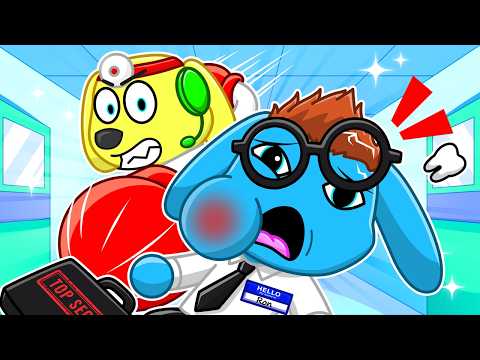
Collecting patient DNA and feeding the resulting samples combinations of milk, strange jelly, mushrooms, ginger and other ingredients gives the hospital a much more experimental role than its usual check-in routine. The potion system provides a strong foundation for the chaos because every mixture creates a small mystery: some transform patients, others alter their behavior, and unstable anomaly samples introduce effects that are harder to predict. The simple DNA-sequencing minigame and potion press also give the experimentation enough structure that it feels like more than randomly throwing items at characters.
The early fish transformation quickly establishes the comic possibilities, while later discoveries escalate effectively. Patients can catch fire, receive new hair, shrink to miniature size, become invisible, dance, glow, change colors or produce overwhelming amounts of slime. Tyler and Snowy consistently find ways to turn those effects into jokes, particularly with tiny Barney, the improvised barber-shop routine and the invisible patient whose name tag remains visible. The reactions are deliberately exaggerated, but they fit the playful game environment.
Anomaly DNA adds the most interesting wrinkle because the green samples behave differently from ordinary purple ones. Some experiments fail or catch fire, while another produces a potion Tyler can drink to become a ghost capable of passing through doors. That ability briefly turns experimentation into exploration, revealing areas of the hospital that cannot normally be reached. The game consequently rewards curiosity with more than cosmetic transformations, even though the video does not spend long investigating what those hidden spaces might contain.
The creepy clown encounter provides a welcome tonal shift from slapstick experimentation. Its cryptic dialogue, disappearance and discarded newspaper point toward sealed hospital wards and a past accident involving an Anomaly Burger delivery truck. The clues are intriguing precisely because they are not fully explained, suggesting a larger mystery beneath the hospital without derailing the potion-focused gameplay. Unfortunately, the thread is abandoned almost as soon as it becomes interesting, making it feel more like a teaser than a developed discovery.
The best potion sequences create gameplay complications rather than merely visual jokes. Enlarged eyes drain sanity when viewed, explosive syrup knocks patients unconscious, and excessive slime makes it difficult to select and carry a patient because cleaning prompts overwhelm the interaction. Combining transformations can become especially absurd, as patients dance in beds, change colors or leave the hospital as fish. These moments make the experiments feel consequential within the game's mechanics, even when the consequences are intentionally ridiculous.
The pacing eventually becomes repetitive as the central loop settles into mixing DNA, producing a potion, throwing it at someone and reacting loudly to the result. Tyler and Snowy's energetic banter keeps that formula moving, but several discoveries receive only seconds of attention before another potion replaces them. Calls for likes and subscriptions are also incorporated into jokes about making potions work or curing patients, which suits the exaggerated style but interrupts an already busy progression. Even so, the sheer variety of effects and occasional hints of a larger hospital mystery give the session enough surprises to sustain its playful premise.
Pros
- Potion effects are varied enough to keep the experimentation unpredictable, ranging from shrinking and invisibility to dancing, slime production and explosive reactions.
- Anomaly DNA introduces a useful distinction from ordinary samples and leads to the especially entertaining ghost transformation.
- Tyler and Snowy repeatedly turn game mechanics into effective visual jokes rather than relying entirely on scripted banter.
- The clown, sealed laboratory references and newspaper clues add an intriguing layer of mystery beneath the comedy.
- Several potions have meaningful gameplay consequences involving sanity, patient handling and access to normally unreachable areas.
Cons
- The potion-making loop becomes repetitive once most discoveries follow the same mix-test-reaction structure.
- Interesting mystery elements surrounding the clown and closed hospital wards are introduced but barely explored.
- Some potion effects are passed over so quickly that their mechanics never receive much investigation.
- Frequent exaggerated reactions and engagement prompts occasionally crowd out the gameplay itself.
A surprisingly broad collection of transformations keeps the hospital experiment entertaining, especially when potion effects begin interfering with ordinary patient care or opening unusual gameplay possibilities. The repetition and underdeveloped mystery prevent the session from fully capitalizing on its best ideas, but the escalating absurdity and strong chemistry between the players make the experimentation consistently fun.