A child's birthday present becomes the foundation for an increasingly elaborate aerospace operation when a simple bottle rocket starts acquiring custom fins, improvised bodies, stronger nozzles, experimental propellants, solid fuel, onboard electronics, a camera, a parachute, and eventually programmable control surfaces. The updated Basement to the Sky demo initially looks modest, placing the 10-year-old protagonist in a redesigned home and backyard with instructions to launch a toy rocket, but the scale of the engineering systems quickly becomes apparent. Early flights barely clear the house and occasionally end on neighboring property; later experiments climb thousands of meters above the clouds. That progression gives the session an effective sense of discovery because each milestone reveals another layer rather than presenting the game's considerable mechanical depth all at once.
The bottle-rocket phase does a particularly good job of turning experimentation into comedy without making experimentation meaningless. Fins can be positioned around the body, different noses alter mass and drag, liquids change thrust characteristics, and bodies range from familiar containers to increasingly ridiculous options such as a large water bottle. The creator moves through oil, juice, Coke, and bleach while swapping nozzles and adjusting fins, sometimes producing a stable vertical flight and sometimes launching something closer to an uncontrolled missile. The game provides enough numerical feedback—mass, drag, lift, thrust power, thrust duration, altitude, and centers of mass and pressure—to encourage reasoning, even though the creator frequently admits uncertainty about what particular indicators mean. That combination works well for the video: genuine trial and error sits comfortably beside deliberately absurd engineering.
The fictional MyTube economy gives failure an amusing secondary purpose. A camera records launches, footage earns views, subscribers, and money, while flips and crashes can generate additional attention. As a result, an unsuccessful rocket is not necessarily wasted progress because spectacular failure can finance the next component. The creator quickly learns to upload almost everything and even discovers that retrieving a rocket before impact can prevent damage, while broken vehicles can otherwise be repaired at the crafting table. The system creates a satisfying loop of build, launch, observe, upload, earn, upgrade, and launch again. It also means the video rarely stalls after a failed design, since even a disastrous flight can contribute toward buying the part that enables the next experiment.
Progression expands considerably after the 250-meter milestone. A powerful magnet-equipped vehicle allows scrap to be collected from the street and sold to the hardware store, which introduces equipment for wind measurements, backyard workshops, painting, and electronics teardown. The creator then pushes toward 1,000 meters with progressively better bodies, nozzles, liquids, and lightweight fins, eventually producing a bleach-filled bottle rocket capable of clearing the target. Some of the game's physics are clearly simplified or playful, and the video treats them accordingly rather than presenting Coke, bleach, juice, or household containers as realistic aerospace engineering. The useful part is the underlying design mindset: changes have measurable consequences, poor configurations tumble, and optimization becomes a process of balancing mass, drag, thrust, stability, and geometry.
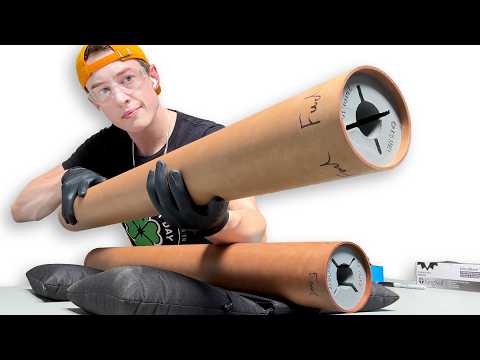
Solid fuel marks the biggest jump in complexity. Instead of selecting a liquid and launching, the creator buys ingredients, combines a fuel and oxidizer, weighs quantities, grinds the mixture, cooks it, casts it into a chosen geometry, and tests the finished grain to obtain a thrust curve and performance figures. The resulting homemade fuel dramatically outperforms the starter grain, sending the rocket beyond 4,000 meters and eventually above 6,000 as better components and body dimensions are introduced. This is one of the session's most impressive demonstrations of how much the game has expanded, but it is also an area where entertainment and real-world practice need clear separation: the video is showing a game system in which household-style materials can be combined into rocket propellant, not establishing that its recipes, procedures, performance figures, or safety assumptions correspond to real rocketry.
The wider economy is both charming and disruptive. Stealing several ingredients from the grocery store locks the creator out until a large restitution payment is made, which becomes especially inconvenient when food and a later boiled-egg delivery job require access to the shop. Paying off the debt means returning to rocket launches for MyTube income, after which cooking, lawn mowing, rubbish collection, and deliveries provide hardware-store tickets needed for further technology. These diversions make the neighborhood feel more like a small sandbox than a rocket-building menu wrapped in scenery, and the badly mowed lawn and improbable egg logistics provide some good comedy. They also interrupt the strongest engineering sections, particularly when progress toward advanced electronics depends on performing unrelated chores.
Electronics teardown and programming provide the most ambitious glimpse of where the game is heading. A broken calculator can be physically opened, components removed and desoldered, and its processor installed as a flight computer. A dismantled camera provides an onboard camera module, another device yields parachute control, and a fan supplies a wing-control chip. The creator then enters a block-based programming interface where launch events, key presses, conditions, loops, parachute deployment, and wing rotation can theoretically control the vehicle. The camera immediately produces a useful onboard perspective, and the programmed parachute successfully deploys once one is actually installed. Wing control proves much harder: despite wiring components and experimenting with rotation commands and a more conventional body, the creator never gets the system working properly before the video ends.
That unfinished experimentation is representative of both the video's appeal and its limitation. The creator constantly discovers mechanics by poking at them, stretches rocket bodies into absurd proportions, minimizes mass and drag, crashes designs, accidentally creates better ones, and reacts with genuine surprise when the game allows something as detailed as desoldering a circuit board or programming movable fins. He also skips past explanations, guesses at terminology, struggles with interfaces, and leaves potentially important systems such as wing control, grain geometry, wind measurement, painting, and advanced coding largely unexplored. For a demo reportedly made by a solo developer, the breadth shown here is striking, and the creator's enthusiasm communicates that effectively. As an engineering guide the session is intentionally loose, but as a tour of a sandbox that keeps revealing deeper systems, it makes the expanded game look unusually promising.
Pros
- Rocket construction provides meaningful variables involving mass, drag, lift, thrust, fuel duration, component placement, and body dimensions, giving experimentation consequences beyond cosmetic customization.
- Progression from bottle rockets to custom solid fuel, onboard cameras, parachutes, flight computers, and controllable wings makes the engineering systems feel substantially deeper as the session continues.
- The MyTube economy cleverly rewards both successful flights and entertaining failures, keeping crashes productive while financing further experimentation.
- Solid-fuel crafting introduces weighing, grinding, casting, geometry, testing, and thrust data, making it one of the clearest demonstrations of the game's expanded mechanical ambition.
- Electronics can be physically dismantled and repurposed into rocket modules, creating a satisfying connection between neighborhood jobs, hardware acquisition, teardown, and aerospace upgrades.
- Block-based programming suggests considerable potential for advanced rocket control, while the onboard camera and programmed parachute provide immediate demonstrations that the electronics are functional rather than decorative.
Cons
- The creator frequently guesses at engineering terminology and mechanics, so viewers looking for precise explanations of stability, aerodynamic centers, grain geometry, or flight control receive an incomplete picture.
- Household liquids and improvised solid-fuel systems operate according to playful game mechanics that should not be interpreted as realistic recipes or performance models for actual rocketry.
- Grocery shopping, cooking, lawn mowing, rubbish collection, and the repayment required after stealing supplies add variety but repeatedly interrupt the more compelling rocket-development progression.
- Several promising systems—including wind equipment, workshops, advanced fuel experimentation, and especially controllable wings—are introduced without being meaningfully explored or successfully demonstrated.
- Trial and error sometimes replaces controlled comparison, with multiple variables changed between launches and limited effort to isolate exactly why one configuration outperforms another.
What begins as a toy rocket in a backyard develops into an impressively broad engineering sandbox where propulsion, aerodynamics, fabrication, electronics teardown, programming, cameras, parachutes, jobs, and a creator economy all feed into increasingly ambitious launches. The improvised approach leaves several mechanics unexplained and the final flight-control experiments unresolved, but the steady escalation from a rocket stuck on the roof to programmable vehicles traveling thousands of meters makes the updated demo feel inventive, funny, and packed with systems worth exploring more carefully.