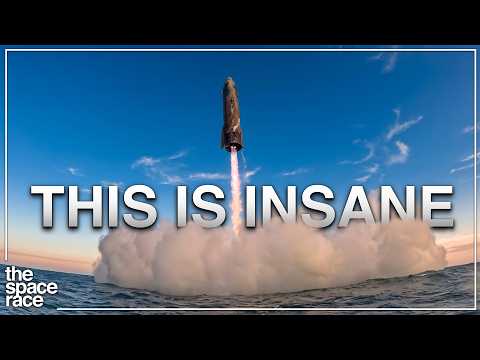
The most convincing part of this presentation is how many distinct Flight 13 objectives are shown progressing successfully rather than simply being declared a success at the end. After an earlier launch attempt was aborted following engine ignition, multiple booster engines were replaced and weather caused another delay, the eventual flight begins with all 33 Super Heavy engines operating through liftoff and an ascent intentionally described as more demanding than Flight 12. The presenter reinforces that change with concrete comparisons, noting higher speed and altitude at specific points in the ascent while connecting the more aggressive profile to testing structural loads and heat-shield performance.
Hot staging provides one of the clearest examples of improvement from the previous mission. Flight 12's booster had rotated in the wrong direction before boostback, while Flight 13 used a modified startup sequence intended to make that maneuver more predictable. The available views show the booster separating and flipping in the intended direction before its engines relight for boostback. The presentation is particularly effective here because it explains what changed, why it mattered, and what viewers should watch for. It also acknowledges that SpaceX later described the boostback as ending early, resisting the temptation to portray an apparently smooth sequence as completely flawless.
That qualification becomes important during Super Heavy's return. The booster appears well controlled through much of entry, but the final landing sequence does not achieve the intended result. Of 13 engines expected to ignite, the video identifies 10 initially lighting, followed by additional shutdowns before a hard ocean impact. This is the mission's clearest unresolved problem, and the presenter appropriately connects it to uncertainty over how soon another tower-catch attempt might occur. The enthusiasm surrounding Flight 13 is substantial, but the booster outcome prevents the mission from being presented as an across-the-board success.
Ship 40 provides the stronger half of the story. Its ascent proceeds without the vacuum-engine loss discussed from Flight 12, followed by deployment of 20 full Version 3 Starlink satellites. The satellites are described as testing solar arrays, antennas, thrusters, and connections with the existing constellation before their planned reentry, while six also carried cameras and lights intended to inspect Starship from multiple perspectives. The successful in-space Raptor relight adds another important milestone. These objectives give the mission more substance than a simple launch-and-reentry demonstration, although predictions that these results could lead to a fully orbital Flight 14 or even a ship catch remain expectations rather than accomplished milestones.
Reentry and splashdown produce the video's strongest visual and technical payoff. The discussion explains why heat-shield durability matters for rapid reuse, highlights the deliberately aggressive banking maneuver, and follows Ship 40 through its flip and landing burn to a soft ocean splashdown. Most notably, the vehicle remains largely intact after falling over rather than immediately being destroyed. Broken tiles are visible, so the presentation does not claim perfect thermal protection, but surviving while continuing to transmit camera views gives SpaceX potentially valuable information. Speculation about eventually towing a vehicle back for inspection is clearly framed as a possibility rather than something demonstrated by this flight.
The later spaceflight roundup contains worthwhile material but also weakens the focus implied by the headline. Falcon 9's expendable 32nd flight of booster 1069 provides an interesting illustration of reusable hardware eventually being consumed for a high-performance mission, while the Northrop Grumman payload introduces satellite servicing, robotic manipulation, and mission-extension pods. The coverage of India's Vikram 1 debut is another substantial segment, walking through its multi-stage architecture, payload capacity, propulsion, and successful deployment of six spacecraft. Updates on another Falcon 9 mission and Blue Origin pad work broaden the weekly overview further, but by this point the video has moved well beyond Flight 13.
Presentation is energetic, visually attentive, and unusually good at directing viewers toward details in engine sequences, vehicle orientation, deployment operations, plasma, and landing behavior. The presenter also distinguishes observed shortcomings from future possibilities reasonably well, especially around Super Heavy's landing and Flight 14. Still, the constant superlatives can make genuinely important milestones compete with routine excitement, and the lengthy sponsored AI segment abruptly interrupts the Starship narrative just as the payload phase begins. A tighter structure and more restrained emphasis would make the technical significance of Flight 13 stand out even more clearly.
Pros
- Flight 13 is explained through specific mission objectives and observable outcomes rather than treated as a generic successful launch.
- Comparisons with Flight 12 give useful context for ascent performance, hot staging, engine reliability, and booster control improvements.
- Payload deployment, satellite inspection cameras, in-space engine relight, reentry testing, and intact splashdown demonstrate substantial upper-stage progress.
- The unsuccessful Super Heavy landing is acknowledged clearly despite the video's strongly enthusiastic tone.
- Falcon 9, satellite servicing, Blue Origin, and Vikram 1 coverage adds substantive context for viewers interested in the wider launch industry.
Cons
- Super Heavy's hard splashdown and incomplete landing-engine sequence leave a major part of the recovery system unresolved.
- Expectations surrounding a fully orbital Flight 14, renewed booster catching, and a possible first ship catch remain prospective rather than demonstrated achievements.
- The lengthy sponsor segment interrupts the central Flight 13 discussion at a particularly important transition.
- Frequent superlatives and celebratory commentary sometimes obscure the distinction between technically significant milestones and visually impressive moments.
- The extended launch-industry roundup makes the video less focused than its Starship-centered framing suggests.
Flight 13 comes across as a major step forward primarily because Ship 40 successfully combines ascent, meaningful payload operations, an in-space engine relight, demanding reentry testing, and an unusually intact splashdown, while the corrected hot-staging behavior also addresses a visible weakness from Flight 12. Super Heavy's failed landing sequence remains an important limitation, and predictions about Flight 14 should be treated as possibilities rather than results already earned. The presentation captures the mission's significance with strong visual detail and useful technical context, though tighter editing and less relentless enthusiasm would make an already compelling account more precise.