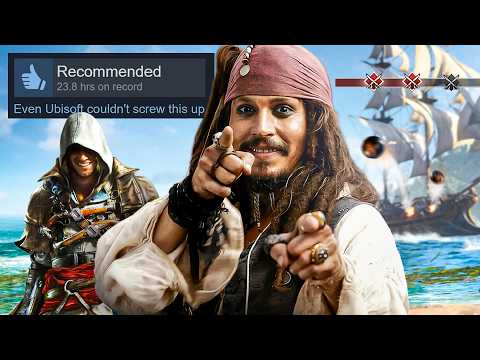
A ship already burning under cannon fire is an efficient introduction to a game about pirates, and the opening hours give this first-time player almost no opportunity to ease into Edward Kenway's world. The session moves from a naval battle and shipwreck into chasing an Assassin across a tropical island, stealing his identity, reaching Havana, meeting Templars, infiltrating a prison, freeing captives, stealing a brig, and escaping through a violent storm. The streamer begins without having played Black Flag before and spends much of the early game learning controls in real time, but that unfamiliarity becomes the video's main appeal. Instead of revisiting a favorite through nostalgia, he discovers why the game remains so highly regarded while reacting to its mechanics, characters, world, and pirate fantasy as genuinely new experiences.
Edward's introduction works particularly well because the streamer quickly understands the character even while missing pieces of the larger Assassin-Templar conflict. Edward's desire to make money, his willingness to impersonate Duncan Walpole, and his strained flashback with Caroline establish someone chasing wealth partly because he believes financial success will create a better life. The streamer jokes about Edward throwing away the broken hidden blade, changes his preferred name to Duncan, and repeatedly mocks the deception, but he also recognizes the more serious tension in Edward's relationship and understands that Caroline is considerably less impressed by wealth than Edward assumes. That mixture of commentary and attention keeps the story visible beneath the constant improvisational humor.
Havana becomes the session's best playground for discovering how much freedom the game allows. Synchronization points, rooftop parkour, community photographs, shops, weapons, pickpocketing, smoke bombs, hiding places, assassination mechanics, and optional exploration repeatedly distract the streamer from his objective. He feeds and then kills a sea turtle after chat claims there will be a reward, carries corpses into public areas, interrupts civilians, climbs architecture simply because it is available, and becomes fascinated by synchronization as a way to reveal the map and eventually expand fast travel. Much of this behavior has little to do with the narrative, but it demonstrates something more useful than a conventional feature rundown: the city immediately encourages experimentation, even from someone who barely understands its systems.
Combat creates a more complicated impression. The streamer quickly finds the default encounters too easy, increases combat difficulty to hard, and still becomes confident enough to abandon stealth whenever infiltration becomes inconvenient. Guards are frequently handled by fighting everyone in sight, and the prison sequence becomes particularly revealing when failed sneaking repeatedly turns into open combat that he finds faster and easier. His enthusiasm for counters, multi-enemy attacks, pistols, smoke bombs, hidden blades, and elaborate executions shows how satisfying the combat appears to him, but it also undermines some of the intended Assassin fantasy when poor stealth can be solved by simply eliminating an entire group. Because the session is primarily entertainment rather than systematic testing, it remains unclear whether this imbalance persists deeper into the game.
The Templar meeting introduces enough mystery to keep the story moving despite the streamer's partial confusion. He initially struggles to understand why his hosts want demonstrations of assassination techniques, then grasps the larger objective once the Observatory is described as a device capable of locating people anywhere in the world and the Sage is presented as essential to finding it. His questions about the Templars' intentions, the Sage, and Edward's false identity make the exposition more approachable because viewers hear someone actively assembling the plot rather than pretending to understand every detail immediately. The downside is that frequent jokes, chat responses, sports references, and side comments sometimes interrupt dialogue carrying important information, leaving the streamer to reconstruct developments after the fact.
Escaping captivity and building the beginnings of a pirate crew delivers the session's strongest payoff. Edward and fellow prisoners seize weapons, free captives across multiple ships, capture a brig, and then immediately face enemy vessels, rogue waves, lightning, waterspouts, and severe damage while trying to escape. The streamer becomes increasingly enthusiastic as boarding combat gives way to naval control and weather hazards, culminating in his declaration that he loves the game and may continue for a much longer series. The sequence succeeds because several systems converge at once: melee combat, traversal, crew recruitment, ship handling, naval fighting, environmental danger, and Edward's emerging role as captain all arrive through one escalating escape rather than separate tutorials.
The remaster itself receives far less scrutiny than the sponsorship and title might suggest. The streamer praises the graphics, mentions new content and revamped gameplay, promotes availability across current platforms, and concludes that the updated release was handled well, but he has never played the original and therefore cannot personally compare the two versions. His strongest endorsement is consequently of Black Flag as an experience rather than of the specific quality of its remastering. The sponsored promotion is clearly acknowledged, including direct calls to purchase the game, but viewers looking for detailed comparisons of graphics, mechanics, content additions, performance, or changes from the 2013 release will find little substantive evaluation. As a first-time playthrough, however, the session makes a convincing case that Edward's adventure can still hook someone quickly through exploration, combat, characters, and especially its naval spectacle.
Pros
- Experiencing Black Flag for the first time gives the reactions to Edward, Havana, parkour, naval gameplay, and the pirate setting genuine discovery rather than nostalgia.
- The opening hours provide excellent variety, moving naturally between naval combat, exploration, assassination, city traversal, story exposition, prison escape, crew recruitment, and a storm at sea.
- Experimenting with synchronization points, weapons, civilians, animals, shops, bodies, and traversal shows how readily the world invites unscripted play.
- Raising combat difficulty and repeatedly attempting stealth gives viewers some sense of how approachable the early combat systems are for a newcomer.
- The final ship escape provides a strong climax by combining several gameplay systems with increasingly dangerous weather and naval threats.
- The streamer's growing enthusiasm creates a clear progression from uncertainty about the controls and story to genuine excitement about continuing the game.
Cons
- Despite emphasizing the remastered release, the video provides little detailed analysis of what has actually changed beyond general references to graphics, new content, and revamped gameplay.
- Having never played the original prevents the streamer from personally evaluating how effectively the updated version compares with the 2013 release.
- Frequent jokes, chat interactions, sports references, and unrelated riffs sometimes interrupt important dialogue and contribute to confusion about characters and objectives.
- Stealth is often abandoned for direct combat, limiting how much the session demonstrates the game's assassination and infiltration systems.
- The streamer praises the remaster strongly during an explicitly sponsored presentation without conducting enough comparative evaluation to make that praise especially informative.
- Historical questions about piracy, alcohol consumption, daily life, and the setting are casually speculated about during gameplay rather than researched or established.
Watching a newcomer discover Edward Kenway's world makes this an entertaining showcase of why Black Flag can still make an immediate impression, particularly once rooftop exploration gives way to prison escapes, stolen ships, naval combat, and a chaotic storm. The spontaneous reactions and experimentation sell the underlying game more effectively than the promotional language sells the remaster, since the lack of firsthand comparison leaves its specific improvements largely unexplored, but the session succeeds as an enthusiastic first encounter with a pirate adventure that quickly convinces its player to keep sailing.