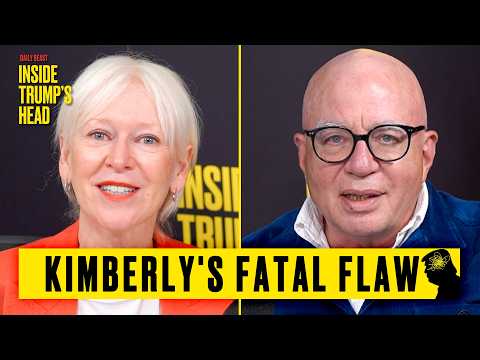
Canada's decision to retaliate against Donald Trump's 2018 tariffs provides the foundation for an unusually practical discussion about confronting political pressure without surrendering diplomatic principles. Former Canadian finance minister and deputy prime minister Chrystia Freeland joins The Daily Beast's Joanna Coles to discuss her experiences negotiating with Trump, the growing influence of powerful technology billionaires, and the challenges facing Western democracies. Drawing on her political career and her book Unreliable Boyfriend, Freeland offers an insider's perspective on international negotiations that combines personal anecdotes, strategic lessons, and forceful political opinions.
The conversation begins with Ukraine, where Freeland argues that Russia's invasion represents the most consequential confrontation between democracy and authoritarianism. Her personal connections to Ukraine and recollections of living in the Soviet Union give the discussion an additional dimension, particularly when she describes the restrictions and everyday hardships associated with authoritarian government. However, her assertion that Trump openly supports Vladimir Putin and deliberately seeks to undermine Ukraine receives little critical examination. Coles also makes serious allegations about Elon Musk's control over Ukraine's military communications and the resulting loss of civilian lives without presenting independently verifiable evidence. These concerns deserve investigation, but the conversation frequently treats political interpretations and disputed allegations as established conclusions.
The examination of concentrated wealth and political influence raises some of the interview's most substantial questions. Freeland compares America's increasingly powerful technology executives with Russia's oligarchs, explaining how wealthy individuals who initially believed they could control political leadership eventually found themselves subordinated to Vladimir Putin. Her argument that democratic institutions protect wealthy individuals as well as ordinary citizens is particularly interesting because it frames stronger regulation as a safeguard rather than simply a punishment. She also advocates renewed antitrust enforcement and restrictions on money's influence in American politics. Unfortunately, the discussion remains largely theoretical, offering few concrete proposals for regulating multinational technology companies or reducing their political influence without international cooperation.
Freeland becomes considerably more persuasive when describing Canada's negotiating strategy during Trump's first administration. Her three-part approach emphasizes cooperation where mutual interests exist, refusal to capitulate under pressure, and direct engagement with Americans outside the White House. The principle of refusing to escalate while remaining unwilling to back down gives the discussion a memorable strategic framework. Particularly useful is her explanation of the so-called doughnut strategy, which involved communicating with governors, mayors, businesses, and labor organizations to generate domestic American opposition to damaging trade policies. These firsthand accounts provide practical substance that is missing from some of the broader geopolitical commentary, although her suggestion that coordinated international retaliation would have fundamentally altered Trump's subsequent behavior remains speculative.
The personal recollections of negotiating with Trump are equally revealing. Rather than presenting him as uniformly unpleasant or ineffective, Freeland acknowledges his charisma, humor, and ability to flatter people into cooperation. Her admission that receiving the nickname "the killer" from Trump was unexpectedly flattering illustrates the psychological complexity of dealing with a powerful political opponent. The conversation also benefits from lighter moments, including Freeland's description of European and Canadian negotiators using The Lord of the Rings as shorthand for their experiences with Washington. Comparing trips to the American capital with journeys to Mordor gives the interview some welcome humor while communicating the atmosphere of those negotiations. These anecdotes make an otherwise technical subject more accessible without requiring viewers to understand the intricacies of trade agreements.
The discussion becomes more personal when Coles asks about Freeland's experiences as a woman operating in predominantly male political environments. Freeland offers a thoughtful response, explaining that she generally approached negotiations as a professional rather than consciously emphasizing her gender, while acknowledging that gender-based assumptions sometimes affected how colleagues perceived her. Her account of walking away from European trade negotiations demonstrates how diplomatic firmness can coexist with an outwardly conciliatory approach. Equally refreshing is her rejection of the idea that politicians deserve special sympathy for the demands of public office, particularly when people working difficult, poorly paid jobs face comparable or greater sacrifices. These reflections add depth to the conversation, although Coles's consistently enthusiastic praise for Freeland and her book limits the interview's willingness to challenge its guest.
As political commentary, the presentation is energetic, accessible, and consistently engaging, but its editorial perspective is unmistakable. Coles and Freeland share a strongly critical interpretation of Trump, Musk, and contemporary authoritarian movements, leaving relatively little room for competing explanations or difficult follow-up questions. Claims about foreign social media interference, electoral manipulation, tariff popularity, and changing international alliances would benefit from specific evidence and additional context. The numerous sponsorship interruptions also disrupt the progression of the discussion, particularly during its more serious geopolitical sections. Nevertheless, Freeland's direct experience, occasional self-awareness, and ability to translate complicated negotiations into recognizable human situations make this a worthwhile interview for viewers interested in diplomacy, political leadership, and the relationship between wealth and democracy.
Pros
- Chrystia Freeland's firsthand experience negotiating Canadian trade agreements provides valuable insight into the practical challenges of dealing with the Trump administration.
- The three-part negotiating strategy offers a clear and memorable explanation of how governments can combine cooperation, resistance, and public diplomacy.
- Freeland's acknowledgment of Trump's personal charm and persuasive abilities adds nuance to an otherwise strongly critical political discussion.
- The comparison between Russian oligarchs and contemporary American technology billionaires raises meaningful questions about concentrated wealth, political influence, and democratic accountability.
- Personal experiences in Ukraine and the former Soviet Union give Freeland's defense of liberal democracy greater historical and emotional depth.
- Memorable negotiating anecdotes, including the Lord of the Rings comparisons and discussions of gender dynamics, make complex political subjects entertaining and accessible.
- Freeland's reflections on political privilege and the pressures of public service provide a welcome departure from conventional political self-promotion.
Cons
- Serious allegations concerning Trump's relationship with Putin and Musk's alleged interference with Ukrainian defenses are presented without sufficient supporting evidence or meaningful challenges.
- Assertions about foreign influence operations, election interference, and American public opinion rely heavily on broad claims rather than clearly identified research or documented examples.
- The interview's consistently sympathetic treatment of Freeland and repeated praise for her book weaken its journalistic independence and limit substantive scrutiny.
- Proposals for restraining plutocratic influence and strengthening democratic cooperation remain broad, with limited attention to specific policies, implementation difficulties, or potential unintended consequences.
- The suggestion that Trump's concessions demonstrate a consistent willingness to retreat under pressure oversimplifies complicated diplomatic outcomes and is not adequately tested against contrary examples.
- Frequent sponsorship interruptions and occasional shifts between geopolitical analysis, personal anecdotes, and book promotion undermine the conversation's overall focus.
Chrystia Freeland delivers an engaging and occasionally illuminating account of international diplomacy, combining practical negotiating lessons with broader warnings about authoritarianism and concentrated corporate power. Her firsthand experiences are the interview's greatest asset, but the lack of challenging questions and insufficient substantiation of several consequential political allegations weaken its analytical credibility. The result is worthwhile political commentary that succeeds more convincingly as an insider's account of negotiating with Trump than as a thoroughly evidenced examination of today's geopolitical threats.