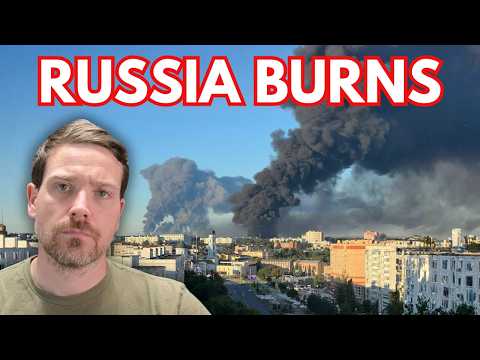
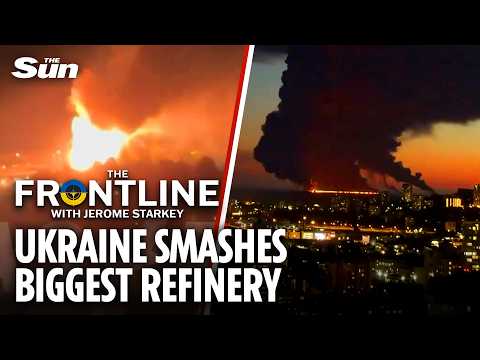
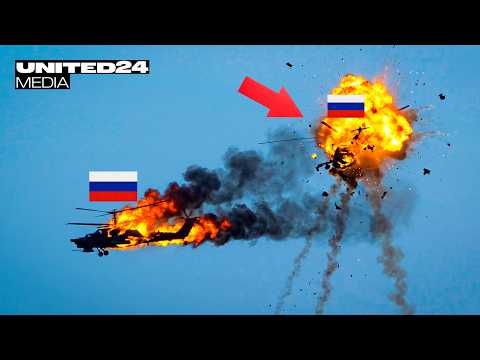
Ukraine’s growing ability to attack military targets far beyond the immediate front is presented as the connecting thread between very different developments on land, in the air, and across the Black Sea. Philip Ingram argues that attacks on logistics, communications infrastructure, air bases, and naval assets matter more strategically than incremental movements along the enormous eastern front. That operational-level framing gives the coverage useful coherence, although the presentation frequently moves from describing Ukrainian successes to declaring their broader consequences with considerably more certainty than the material presented can independently establish.
The frontline footage supplies some of the most immediate and sobering material. A Ukrainian commander reportedly driving into an exposed area to retrieve two wounded soldiers becomes an illustration of leadership and morale, while footage of a Russian soldier narrowly destroying an approaching drone demonstrates how little time troops sometimes have to react. Ingram is particularly effective when discussing the psychological terror created by drone warfare rather than treating the technology merely as equipment statistics. At the same time, the narration is plainly sympathetic to Ukrainian forces, and emotionally loaded descriptions of Russian soldiers and Ukrainian actions sometimes push the segment closer to advocacy than detached military analysis.
The discussion becomes more strategically interesting when it turns to strikes deep inside Russia. An attack on the Progress facility in the Samara region is characterized as an effort to undermine Russia’s developing satellite communications capabilities, alongside a reported strike on Savasleyka Air Base. The explanation of why satellite communications, logistics, and other infrastructure can affect battlefield effectiveness is accessible and worthwhile. However, claims that these attacks have “crippled” a satellite network, overwhelmed Russian air defenses, or represent a turning point are much stronger than the evidence actually detailed here, particularly because damage assessments and the longer-term operational consequences are not extensively documented.
Ingram’s distinction between tactical and operational warfare is the analytical centerpiece. His argument is that Ukraine can hold Russian forces along the front while progressively attacking the systems that allow those forces to continue fighting—fuel, ammunition, vehicles, communications, bases, and transportation routes. That framework also makes the reported Ukrainian gains in Donetsk more meaningful than a simple list of recaptured settlements. The account says Ukrainian forces exploited Russian redeployments and damaged logistics before counterattacking, but figures such as nearly 2,400 Russian vehicles and specialized pieces of equipment destroyed or damaged in a month would benefit from clearer sourcing and qualification.
The Black Sea section most directly delivers on the central subject, describing a combined attack involving uncrewed surface vessels, aerial drones, and Neptune missiles against Novorossiysk. Four Russian vessels are said to have been hit, including two Admiral Grigorovich-class frigates, while satellite imagery is described as indicating substantial damage rather than total losses. That distinction is important because the ships are not portrayed as sunk. Still, assertions that they will remain out of action for the foreseeable future and that the entire Black Sea has effectively become a high-risk zone for Russia go beyond the limited damage assessment provided.
A particularly useful point comes after the attack itself: damaging a vessel has greater strategic significance when convenient repair infrastructure is unavailable. Ingram explains that Sevastopol traditionally provided important repair facilities for the Black Sea Fleet and argues that Russian vessels displaced from Crimea have fewer options, while passage restrictions through the Bosporus further complicate movement. He appropriately qualifies part of this discussion by saying he does not believe Novorossiysk possesses equivalent facilities rather than presenting that specific point as established certainty. This logistical perspective is more informative than simply celebrating successful strikes because it explains how repeated damage could accumulate into a larger operational problem.
As a piece of military commentary, the presentation is energetic, clearly structured, and good at connecting individual battlefield events to logistics and operational strategy. Its weakness is the repeated use of terms such as “masterclass,” “devastating,” “brilliant,” “panic,” and “turning point,” combined with confident predictions about Russian political weakness and Ukraine emerging as the winner. Those judgments may express Ingram’s interpretation, but the coverage provides relatively little counterevidence, uncertainty analysis, or discussion of Ukrainian setbacks that might test the thesis. The result is engaging and often illuminating analysis whose strongest strategic explanations are more convincing than some of its sweeping conclusions.
Pros
- Connects deep strikes, logistics attacks, frontline operations, and naval warfare through a coherent operational-level strategy.
- Explains why fuel, ammunition, communications, repair infrastructure, and transportation networks can matter as much as territorial gains.
- Uses frontline drone encounters to convey both the tactical realities and psychological intensity of contemporary warfare.
- Distinguishes significant damage to the Russian vessels from claims that the ships were completely sunk.
- The discussion of Black Sea repair constraints adds valuable strategic context beyond the immediate strike.
- Acknowledges the immense scale of the front and Ukraine’s difficulty assembling enough concentrated combat power for major breakthroughs.
Cons
- Highly partisan and celebratory language frequently blurs the boundary between military analysis and advocacy.
- Several major conclusions—including a crippled satellite network, overwhelmed Russian defenses, political erosion in Moscow, and a strategic turning point—are asserted more confidently than the evidence presented supports.
- Large battlefield figures and some damage assessments receive insufficient sourcing or methodological explanation.
- Claims about the future availability of damaged warships are difficult to independently evaluate from the information provided.
- Little attention is given to evidence that might challenge the broader argument that Russia is being progressively hollowed out or that Ukraine is becoming the clear prospective winner.
Strong explanations of logistics, operational warfare, naval repair constraints, and asymmetric striking power make this a useful account of how Ukraine is attempting to impose costs far beyond the immediate front. Its analysis is less persuasive when battlefield successes become sweeping declarations about Russian collapse, political weakness, or the war’s eventual winner without comparable evidence or uncertainty. The strategic framework is valuable, but a more measured treatment of contested claims would substantially strengthen it.