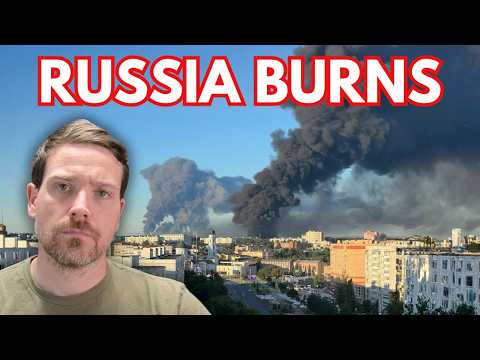
Ukraine's deployment of two heavily protected tanks near Kharkiv offers a striking example of how traditional armored warfare is adapting to a battlefield dominated by drones. Philip Ingram examines the operation alongside reports of substantial Russian casualties, Ukrainian territorial gains, and increasingly sophisticated unmanned ground systems. His central argument is that Ukraine is moving beyond static defensive warfare toward coordinated maneuver operations that exploit Russian command weaknesses. The result is an informative and confidently delivered military analysis, although its strongly pro-Ukrainian framing occasionally places greater certainty on battlefield developments than the available evidence establishes.
The discussion of ground robotics provides some of the most interesting material. An amphibious unmanned vehicle reportedly completes a 40-kilometer frontline supply mission, while other robotic systems demonstrate drone-defense nets, battlefield recovery capabilities, and the evacuation of damaged equipment. Ingram explains why these developments matter beyond their technological novelty, emphasizing logistics, personnel protection, and morale. His observation that successful military operations depend heavily on reliable resupply gives these examples practical significance. Importantly, he also acknowledges the limitations of robotics, using Ukrainian infantry operations near Lyman to illustrate why human soldiers remain essential in complex urban combat.
The Kharkiv tank operation is another particularly effective case study. Ingram describes how Ukrainian forces reportedly combined protective cage armor, electronic warfare, surveillance drones, FPV systems, and heavy bomber drones to support an armored advance against Russian positions. His explanation challenges simplistic assumptions that modern drones have rendered tanks obsolete. Instead, he argues that armored vehicles remain valuable when integrated into coordinated operations with appropriate protection and battlefield awareness. The account of both tanks surviving reported drone strikes reinforces this argument, although a successful individual engagement cannot establish how consistently such tactics will work across different combat conditions.
Operation Vivaldi receives the most substantial attention, with Ingram examining Ukrainian advances around Lyman and the broader Russian effort to threaten the Donetsk fortress belt. He describes an operation involving deception, surprise, reclaimed settlements, and remotely operated explosive vehicles used against fortified positions. The geographical explanations are especially useful when discussing river barriers, vulnerable Russian supply routes, and the difficulties of conducting counterattacks across defended waterways. However, the reported recovery of approximately 176 square kilometers, more than 5,000 Russian casualties, and 250 prisoners is presented without sufficiently detailed independent verification. These figures provide important context for the claimed success, but viewers should distinguish reported Ukrainian battlefield results from independently confirmed outcomes.
Russian military leadership and battlefield reporting form another major theme. Ingram argues that commanders have exaggerated territorial control, circulated outdated footage, and relied on misleading information to conceal setbacks. His discussion of alleged discrepancies between Russian operational maps and actual frontline positions raises legitimate questions about military accountability and the consequences of unreliable intelligence. He also contrasts Volodymyr Zelensky's frontline visits with Vladimir Putin's more insulated leadership style. While this comparison strengthens the narrative, the suggestion that these differences directly explain Ukrainian adaptability and Russian failures is more interpretive than demonstrably established. The repeated characterization of Russian commanders as fundamentally dishonest also leaves limited room for examining competing explanations or uncertainties.
Ingram's broader assessment of changing Ukrainian tactics is arguably the presentation's greatest analytical strength. He explains how empowering junior commanders, exploiting boundaries between Russian formations, and combining ground maneuver with unmanned systems could produce advantages against a more rigid command structure. His discussion of General Drapati's approach offers a useful framework for understanding the claimed transition from attritional warfare toward greater tactical flexibility. The examination of potential Russian coordination failures along administrative boundaries is particularly thoughtful, although Ingram appropriately identifies some of these conclusions as his own assessments. Elsewhere, speculation about possible sabotage behind a Russian Tu-95 bomber crash, sweeping claims about Russia's inability to replace military equipment, and the opening financial figures would benefit from more supporting evidence and qualification.
The presentation maintains an engaging pace despite covering a considerable range of developments, moving from military technology to armored assaults, operational geography, command doctrine, and strategic implications. Ingram's direct commentary makes complex military concepts understandable, while his repeated attention to terrain, logistics, and combined-arms coordination gives the analysis substance. Nevertheless, phrases such as "masterclass," "supreme command control," and "monumental shift" occasionally make the reporting sound more celebratory than analytical. The headline's dramatic casualty figure also deserves caution: the stated 2,090 Russian troops represents reported killed and wounded combined, not confirmed deaths. A more consistent separation between verified developments, battlefield claims, and informed speculation would make an already useful discussion considerably stronger.
Pros
- Provides detailed explanations of how Ukrainian tanks, electronic warfare, surveillance drones, and strike systems can operate together in coordinated battlefield assaults.
- Highlights practical advances in unmanned ground vehicles, including amphibious resupply, drone-defense systems, and robotic equipment recovery.
- Explains the military importance of logistics, terrain, river crossings, defensive positions, and operational supply lines.
- Offers substantial geographical and tactical analysis of reported Ukrainian advances around Lyman and the Donetsk fortress belt.
- Examines how decentralized command, tactical initiative, and exploitation of organizational boundaries can influence battlefield performance.
- Connects alleged Russian reporting failures to broader questions about command effectiveness, operational awareness, and military decision-making.
- Balances enthusiasm for emerging military technologies with recognition that infantry remains essential in close-quarters combat.
Cons
- Major casualty figures, territorial gains, and claims of Russian battlefield losses receive insufficient independent verification or supporting source detail.
- Strongly pro-Ukrainian language sometimes presents favorable interpretations as more conclusive than the available evidence warrants.
- Speculation about sabotage in the Tu-95 crash introduces possibilities without substantial evidence supporting either explanation.
- Comparisons between Ukrainian and Russian leadership occasionally oversimplify complicated organizational and operational differences.
- Claims about Russian military production, financial pressures, and command deception would benefit from additional context and more careful qualification.
- Predictions about Ukraine's ability to retain captured territory and Russia's difficulty responding sometimes extend beyond what individual battlefield developments can establish.
Philip Ingram delivers an engaging and technically informative examination of Ukraine's changing military tactics, with particularly valuable explanations of ground robotics, combined-arms operations, and the strategic importance of terrain. His ability to connect individual battlefield engagements with broader questions of command flexibility and operational planning makes the discussion worthwhile for viewers interested in modern warfare. However, dramatic language, limited independent verification of major claims, and an occasionally one-sided interpretation of events prevent the analysis from achieving the evidentiary balance its subject deserves.