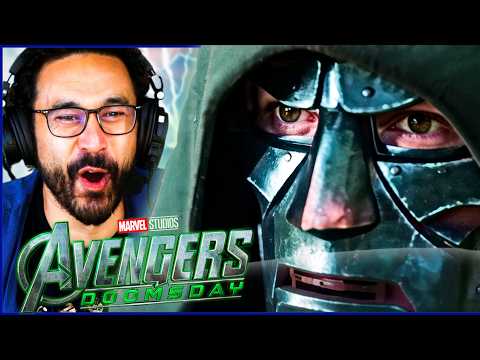
The reaction begins at maximum intensity before the trailer even plays. Tickets are already secured, the release day is treated as a holiday, and the hosts frame the moment as the culmination of a relationship with the MCU stretching from Iron Man through Infinity War and Endgame. That history matters because their excitement is not primarily about analyzing a new trailer shot by shot. They are reacting to the prospect of another Avengers-scale theatrical event, complete with opening-day crowds, 4DX and 3D, costumes, repeat viewings, and the possibility of experiencing something they believe could surpass the franchise's previous peaks.
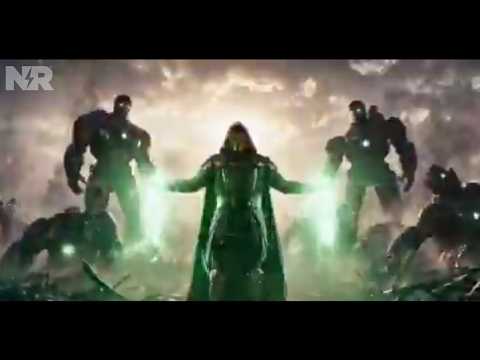
Doctor Doom provides the center of that excitement. One host draws on his familiarity with the character to emphasize that Doom can operate at very different moral and power levels depending on the story, then interprets the trailer as presenting an unusually dangerous version. Thor's apparent fear, Doom's calm presence, Charles and Erik's reactions, and a moment involving Thor's hammer are all treated as signals that this threat is fundamentally different from Thanos. The hosts repeatedly predict that this interpretation will eclipse previous screen versions of Doom, but those judgments remain expectations based on the trailer and their knowledge of the character rather than conclusions the finished film has established.
The trailer itself clearly lands with extraordinary force for both viewers. They praise its music, buildup, selected shots, character combinations, and restraint in showing Doom, with one host becoming visibly overwhelmed enough to stop and collect himself. A second viewing lets them focus more closely on details they missed while reacting the first time, including Cyclops, Mystique, Gambit, Shang-Chi, Namor, the Fantastic Four, the Thunderbolts, and other characters occupying spaces the hosts have never previously seen them share. Their enthusiasm is infectious precisely because it is unfiltered; this is less critical breakdown than documentation of two longtime fans realizing that characters and crossovers they have imagined are now appearing together on screen.
That sincerity is also responsible for the video's largest analytical weakness. Predictions escalate almost immediately from excitement to certainty: the film is declared more impactful than Infinity War and Endgame, Doom is expected to outclass every previous interpretation, the movie is said to be capable of changing everything, and multiple theatrical viewings are treated as inevitable. None of those claims can be evaluated from a trailer alone. The hosts occasionally recognize that they cannot prepare for what the movie will actually do and acknowledge uncertainty around characters such as Scarlett Johansson's Black Widow, but the overwhelming tone leaves little room for skepticism about whether the finished film can satisfy expectations this enormous.
Some of the best discussion comes when the hosts connect individual moments to their memories of earlier MCU experiences. Chris Evans' appearance reminds them of the entrance built around his silhouette in Infinity War, Gambit's movement evokes an earlier version of the character, and Thor's behavior is contrasted with how he responded to Thanos before and after defeat. Their recollections of being emotionally devastated by Infinity War and Endgame explain why another Avengers film carries unusual personal significance. Even when the comparisons become hyperbolic, they communicate how franchise continuity can turn a trailer into something more meaningful for viewers who have followed these characters for years.
The reaction becomes much looser after the second viewing. A Mountain Dew label unexpectedly turns into a joke about Doom manipulating reality, declined card transactions become another sign that the villain is interfering with the hosts' lives, and the conversation wanders through food orders, theater seating, costumes, birthdays, GTA 6, possible cameos, and what characters might still be hidden. These tangents are often funny because the hosts play off each other's escalating absurdity, but they substantially extend a reaction whose central verdict was already clear after the first replay. Repeated declarations that Doom is different and that the movie will be unprecedented eventually add volume more than new analysis.
The closing discussion gives all that excess a more meaningful context. The hosts describe major movies as events people can anticipate when everyday life feels difficult, comparing the feeling to waking up for a childhood field trip and arguing that entertainment can provide a welcome distraction. Their claim that people who do not emotionally invest in movies are missing something is unnecessarily dismissive—viewers can engage with entertainment in very different ways—but their own investment is unmistakably genuine. They are not trying to offer a detached assessment of whether the film will succeed. They are celebrating the return of a communal blockbuster experience that, for them, has already begun with buying tickets and watching the first full trailer.
Pros
- The hosts' excitement feels genuinely rooted in years of following the MCU rather than manufactured for the reaction.
- Doctor Doom's perceived threat is discussed through specific trailer moments involving Thor, Charles, Erik, and the villain's restrained presentation.
- Rewatching the trailer allows the hosts to notice characters and crossover combinations that were overwhelmed by their initial reaction.
- Comparisons with Infinity War and Endgame effectively explain why another Avengers event carries such emotional significance for them.
- The chemistry between the hosts turns spontaneous distractions, including the Mountain Dew and declined-card jokes, into entertaining running bits.
- The closing discussion thoughtfully captures why major theatrical releases can become anticipated communal experiences rather than simply another movie.
Cons
- Claims that the film will surpass Infinity War and Endgame, redefine Doom, and change everything are far more certain than a trailer can support.
- Repeated declarations about Doom's power and the unprecedented nature of the movie become redundant after the central point is established.
- Long tangents about drinks, food, tickets, seating, and unrelated releases make the reaction considerably less focused.
- The hosts speculate about possible appearances, including Scarlett Johansson and Deadpool, without evidence from the trailer establishing those characters will appear.
- Dismissing people who do not emotionally experience movies in the same way is unnecessary and weakens an otherwise personal celebration of fandom.
What stays with the hosts is not one reveal but the sense that years of separate characters and stories are converging into another enormous theatrical event. Thor's fear, Doom's composure, Gambit, Shang-Chi, familiar X-Men characters, the Fantastic Four, the Thunderbolts, and other crossover imagery give them enough material to imagine something even larger than the Avengers films they already regard as defining experiences. Whether the finished movie can possibly meet those expectations is another question. As analysis, the reaction is too hyperbolic and repetitive to establish much about the film beyond what its trailer makes the hosts feel. As a record of fandom, however, that feeling is the entire attraction. They replay shots, shout over reveals, speculate wildly, joke about Doom interfering with their credit cards, and discuss opening day as something worth structuring their lives around. The enthusiasm sometimes overwhelms the commentary, but it also captures exactly why a major trailer can feel like the beginning of the event rather than merely an advertisement for it.