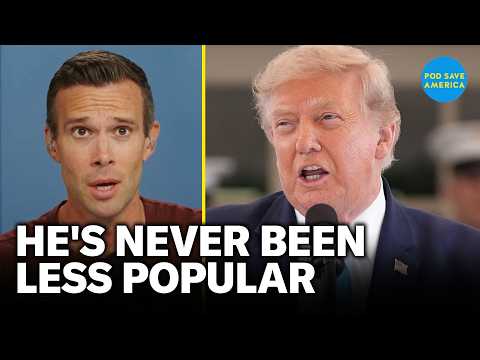
Economic dissatisfaction provides the central foundation for the argument, with the discussion opening on a Fox News poll in which 63% of registered voters said the Trump administration had made the economy worse. The same survey found widespread negative assessments of economic conditions and a 15-point Democratic advantage when voters were asked which party would better handle inflation and higher prices, making those figures a meaningful piece of evidence rather than merely hostile commentary. Fox News independently reported those results from its September 11–14 survey of 1,211 registered voters, which carried a ±3-point sampling error.
From there, the presentation effectively builds its case around the contrast between Republican messaging and public frustration over affordability. Vice President JD Vance's request for more time is treated as especially awkward because Republicans already control the presidency and Congress, while clips about high fuel prices and continued inflation reinforce the broader theme that economic promises are colliding with voters' experiences. The structure is clear and easy to follow, although phrases suggesting that nobody has benefited from administration policies move beyond what the material presented can establish.
The Iran conflict becomes the second major component of the argument, connecting foreign policy with household expenses through a report estimating that Americans have spent substantially more on gasoline and diesel since the fighting began. The included exchange with Vance is useful because it gives the administration's reasoning directly: he argues that Trump's desire to avoid foreign entanglements did not amount to a promise never to use military force, particularly where Iran's nuclear ambitions were concerned. That counterargument prevents the segment from completely reducing the dispute to one side's characterization, even as the narrator clearly rejects the administration's position. Separate Fox polling has also documented substantial voter opposition to the conflict and concern about the administration's strategy for ending it.
The congressional section similarly benefits from allowing competing explanations to appear on screen. Speaker Mike Johnson defends the altered House schedule by citing legislation passed, tax reductions, falling violent crime, manufacturing, wages, prescription costs, and border enforcement, while Democratic leadership characterizes the decision as abandoning Washington during an affordability crisis. The narrator plainly favors the Democratic criticism, but including Johnson's extended defense gives viewers enough of the opposing argument to understand the dispute rather than receiving only a paraphrased version of it.
Affordability is where the compilation is most cohesive. Trump's dismissal of the political emphasis on affordability is placed alongside Republican acknowledgment that prices remain too high, followed by Fox discussions about unfulfilled proposed payments and polling on taxation, capitalism, and socialism. These clips create an interesting tension within conservative messaging, particularly when commentators acknowledge dissatisfaction while attributing the underlying problem to government spending. However, the presentation does little to disentangle inflation, energy prices, fiscal policy, tariffs, war-related effects, and other economic forces, so complicated questions of causation are frequently compressed into a straightforward indictment of Trump.
That limitation reflects the larger editorial approach. The selection of clips is energetic, specific, and anchored by recognizable polling and direct statements, but nearly every element is arranged to reinforce the same conclusion, while counterarguments are generally included as material to rebut rather than possibilities to examine at comparable depth. The closing book promotion also arrives abruptly after a substantive discussion. As political commentary, the piece makes its case efficiently; as analysis, it would be stronger with greater attention to polling methodology, economic causation, competing explanations, and the distinction between evidence of voter dissatisfaction and predictions about what that dissatisfaction will ultimately mean electorally.
Pros
- Grounds its central affordability argument in specific Fox News polling rather than relying entirely on partisan assertion.
- Uses extended clips from Vance and Johnson that allow important administration and Republican arguments to be heard directly.
- Connects economic polling, fuel costs, the Iran conflict, congressional messaging, and affordability into a coherent political narrative.
- Highlights genuine tensions between claims of economic accomplishment and polling showing widespread voter dissatisfaction.
- Maintains a brisk pace despite moving across several related political and economic subjects.
Cons
- Treats voter dissatisfaction as more politically conclusive than polling alone can establish, particularly with the midterm election still ahead.
- Economic causation is oversimplified, with inflation, government spending, energy prices, tariffs, and the Iran conflict receiving little analytical separation.
- Counterarguments are included but generally framed for rebuttal rather than examined with the same scrutiny applied to Republican claims.
- Sweeping statements about who has benefited from administration policies go beyond the evidence actually presented.
- The promotional ending interrupts an otherwise focused discussion of affordability and political accountability.
Specific polling and well-chosen political clips give the commentary a stronger evidentiary foundation than its emphatic presentation initially suggests. Its weakness is not a lack of concrete material but a tendency to turn complicated economic and electoral questions into a more certain partisan narrative than the evidence by itself supports.