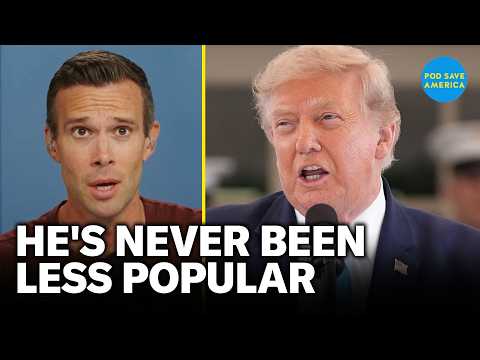
Donald Trump’s repeated attacks on Fox News are framed here as more than another dispute with a network that occasionally delivers coverage he dislikes. The argument is that his frustration is arriving alongside unfavorable polling, economic anxiety and signs that some Republican candidates are increasingly worried about their own electoral prospects. That combination gives the commentary a coherent central idea: Trump is blaming the messenger at a moment when the political message itself may be losing effectiveness.
The strongest material comes when the presentation moves beyond Trump’s rhetoric and cites specific polling. Reuters/Ipsos is described as putting his approval at 32%, while a Fox national poll is said to place it at 39%. The discussion also highlights polling suggesting weakening support among non-MAGA Republicans and negative assessments of economic conditions. These figures are presented as evidence that the problem extends beyond a single hostile survey, although the commentary would be stronger if it spent more time explaining differences in methodology, timing and voter samples before treating separate polls as confirmation of one broad trend.
Economic dissatisfaction forms the second major pillar of the argument. Clips about grocery prices, gas, housing and mortgage rates are contrasted with Trump’s insistence that the country has exceptional economic numbers and merely suffers from poor communication. That contrast is effective because it demonstrates the political problem regardless of whether every causal claim made by individual speakers is correct: voters who believe their household finances are deteriorating are unlikely to be persuaded simply by being told that economic conditions are historically strong.
The analysis is less disciplined when it turns economic frustration into confident judgments about why particular prices or indicators are moving. Statements attributing mortgage rates and other costs directly to Trump, tariffs or war are presented through clips without enough supporting context to establish those causal relationships. Likewise, an anecdote from a person who returned to work because of expenses is useful for illustrating dissatisfaction but cannot establish the condition of the broader economy. The piece is more persuasive when discussing political perception than when implying that every economic consequence has a simple partisan cause.
The Fox News angle produces some of the liveliest material. A segment about Hamburger Helper becomes an effective comic example of the awkward lengths sympathetic coverage can sometimes take, while Trump’s complaints about Fox reporting unfavorable polling reinforce the broader thesis that he is increasingly attacking information that conflicts with his preferred narrative. Karl Rove’s stated decision to vote for a Democrat in a Texas race also provides a concrete example of a prominent Republican-aligned figure breaking with his party’s nominee, though one individual decision should not be mistaken for evidence of a mass shift.
Presentation-wise, the hosts keep the discussion energetic through clips, quick exchanges and sarcasm, and the conversational back-and-forth prevents a polling-heavy subject from becoming dry. The weakness is that the rhetoric sometimes races ahead of the evidence. Claims about Republicans “decimating” opponents, Trump’s support “dwindling,” campaign money moving because races are effectively lost, and the meaning of his appearances in heavily Republican states would benefit from more direct sourcing and qualification. The overall case for genuine political vulnerability is plausible within the evidence presented, but describing a midterm disaster as effectively established is considerably stronger than the material demonstrates.
Pros
- Multiple polling examples give the central argument more substance than relying on a single unfavorable survey.
- Trump’s attacks on Fox are effectively connected to a broader discussion of political messaging and voter dissatisfaction.
- Economic polling and voter concerns provide useful context for why positive administration messaging may be struggling.
- Clips of Trump and Fox personalities allow viewers to hear important portions of the dispute directly.
- The energetic host exchanges make a potentially dry discussion of approval ratings and midterm politics accessible.
Cons
- Different polls are treated as broadly interchangeable without much discussion of methodology, timing or sampling.
- Several economic cause-and-effect claims receive less supporting evidence than the political analysis surrounding them.
- Individual anecdotes and Karl Rove’s voting decision are illustrative but have limited value for measuring broader voter behavior.
- Some conclusions about Republican campaign strategy and impending midterm outcomes are stated more confidently than the evidence shown supports.
- Frequent sarcasm adds entertainment but occasionally substitutes ridicule for deeper examination of competing explanations.
A clear collection of polling, economic concerns and Trump’s own remarks makes a credible case that his political position has become more difficult and that blaming Fox cannot by itself resolve that problem. The commentary is sharpest when comparing public messaging with measurable voter dissatisfaction, but its case would be stronger with greater methodological context and more restraint about predicting what those warning signs will mean in the midterms.