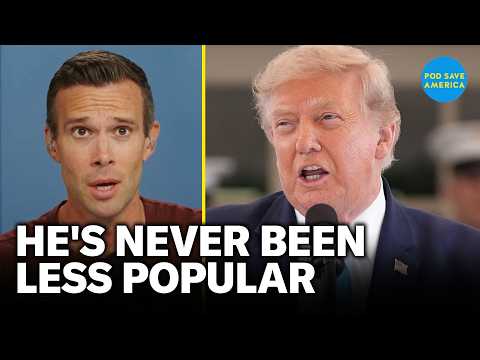
The video centers on recent polling showing President Donald Trump with deeply negative approval ratings according to surveys discussed by CNN data analyst Harry Enten. It uses those polling results as the foundation for a broader political argument that Trump's administration has alienated independent voters and is facing significant electoral headwinds ahead of future elections. The presentation combines news clips, commentary, social media posts, and an extended interview with Democratic congressional candidate Chris Pappas to build its case.
The opening section is among the video's strongest because it relies on identifiable polling data and televised analysis rather than simply asserting conclusions. The discussion compares Trump's approval ratings with previous presidents, including Richard Nixon, George W. Bush, and Barack Obama, providing historical context for the polling being discussed. While approval polls fluctuate over time and individual surveys have limitations, the presentation clearly attributes these figures to the polling organizations and televised commentary instead of presenting them as independently verified facts.
As the video progresses, however, it shifts away from reporting and increasingly into advocacy. Numerous policy criticisms are presented regarding inflation, healthcare, foreign policy, immigration, vaccination, and government programs. Many of these points are expressed as factual conclusions without acknowledging competing interpretations or providing supporting evidence within the presentation itself. Several highly charged claims—including statements about military readiness, crude oil supplies, disease outbreaks, election integrity, and alleged government cover-ups—are presented as established realities despite being subjects of significant political dispute. Viewers should distinguish between the host's interpretations and independently verified facts.
The review of Republican media appearances likewise emphasizes selective clips intended to illustrate perceived disconnects between Republican messaging and everyday economic concerns. While these excerpts support the video's central argument about political messaging, they are presented without broader context that might explain or qualify the speakers' remarks. As a result, the segment functions more as political commentary than balanced analysis.
A substantial portion of the video consists of an interview with Democratic congressional candidate Chris Pappas regarding New Hampshire's Senate race. The conversation allows the candidate to discuss campaign priorities, healthcare, affordability, democracy, and criticisms of his Republican opponent. While informative for viewers interested in Democratic campaign messaging, the interview is largely unchallenged and does not include responses or perspectives from opposing candidates. This makes the segment resemble a campaign interview rather than an adversarial political interview.
The discussion surrounding Jeffrey Epstein-related allegations is another area where caution is warranted. The video references reporting involving emails and associations while raising questions about political figures. Although it repeatedly frames certain issues as questions rather than definitive accusations, the presentation also encourages viewers to draw broader conclusions based on circumstantial associations. Allegations of this nature require careful treatment, and viewers should recognize the distinction between reported associations, unanswered questions, and proven misconduct.
From a production standpoint, the video maintains a fast pace, incorporates numerous clips, and transitions smoothly between commentary and interviews. The host delivers his arguments confidently and keeps the narrative moving, making the lengthy presentation engaging for viewers who already share similar political perspectives. Those seeking a more balanced examination, however, may find the consistently one-sided framing limiting.
Pros
- Grounds its opening discussion in identifiable polling data and televised political analysis.
- Clearly separates news clips, commentary, and interview segments, making the structure easy to follow.
- Maintains an energetic pace that keeps a long political discussion engaging.
- Provides viewers with an extended interview discussing campaign priorities rather than relying solely on brief sound bites.
- Consistently presents a coherent argument about the political implications of declining approval ratings.
Cons
- Frequently shifts from evidence-based reporting into strongly opinionated political advocacy.
- Presents numerous contested political, economic, and foreign policy claims without supporting evidence or acknowledgment of alternative interpretations.
- Offers little engagement with opposing viewpoints or counterarguments.
- Uses emotionally charged language throughout, which may reduce its appeal for viewers seeking objective political analysis.
- Raises questions surrounding public figures and alleged associations without always providing sufficient context to distinguish speculation from established facts.
This video is best understood as political commentary built around recent polling rather than as a neutral news analysis. Its strongest moments are those grounded in publicly discussed approval ratings and structured political reporting. As it broadens into policy critiques, campaign advocacy, and allegations involving political figures, the presentation becomes substantially more interpretive and opinion-driven. Viewers interested in progressive political commentary will likely find it persuasive and engaging, while those seeking a balanced examination should supplement it with reporting from multiple sources before drawing conclusions about the contested issues discussed.