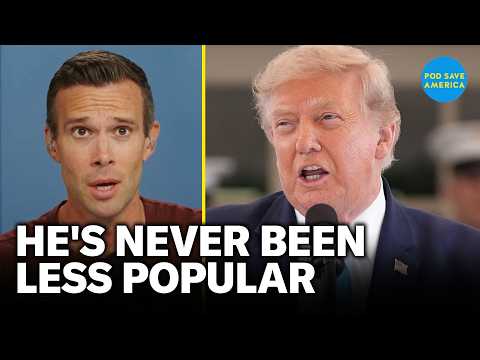
Donald Trump’s promise of a $5,000 payment to every American adult if Republicans retain the House and Senate gives the commentary a remarkably concrete political target. The basic premise is accurately represented: Trump made the conditional “Trump dividend” pledge at the Republican midterm convention in Dallas, and contemporary reporting estimated that such payments would cost well over $1 trillion. The presentation immediately treats the proposal as an attempt to purchase political support rather than approaching it as a conventional policy announcement, setting an openly adversarial tone for everything that follows. Reuters +1
Getting to that subject takes an extraordinarily long route. Extended stories about hibachi chefs, Power Rangers, an injured personal trainer, and a San Francisco pizza seller dominate much of the runtime before the political argument fully arrives. Individually, several of these stories are vivid and funny, particularly the recurring pizza negotiation in which supposedly different offers keep amounting to the same price. That eventually becomes an effective metaphor for the creator’s contention that Trump repeatedly repackages promises of future payments, but the setup is so expansive that viewers primarily interested in the stated political subject may wonder when the discussion is going to begin.
Once there, the central criticism has a stronger factual foundation than some of the surrounding rhetoric. The creator questions how the proposed payment would be funded, calculates its total cost at roughly $1.2 trillion, and compares it with previous talk of DOGE and tariff-related payments. Reporting similarly put the new proposal’s price above $1 trillion, noted that Trump initially provided few implementation details, and reported that congressional approval would be necessary. Those are substantive reasons to question the proposal’s feasibility, and they would have supported a much deeper examination than the video ultimately provides. Reuters +1
The weakest part of the argument is the repeated insistence that the proposal is simply and definitively a “bribe.” That may work as political rhetoric, and critics have likewise described the proposal as an effort to buy votes, but the legal question is more complicated than the presentation acknowledges. Reporting on the proposal has cited legal experts distinguishing a broadly available government benefit conditioned on an election outcome from paying particular individuals in exchange for their votes. Treating the label as self-evident therefore collapses an important distinction between an ethical or political criticism and a specific legal characterization. AP News +1
Other assertions receive even less support within the presentation. Claims about independent journalists taking direct White House instructions, Elon Musk wanting government operations eliminated because they were investigating him, and midterm mail-ballot litigation constituting attempts at “rigging” elections are presented confidently without evidence sufficient to establish those conclusions. The broader discussion of institutional media and independent commentators raises worthwhile questions about incentives, trust, neutrality, and journalistic standards, but it would be more persuasive if those questions were separated from allegations about motives that the video does not substantiate.
Comedy remains the dominant delivery mechanism even when the subject becomes serious. Jokes about Grindr crashing during the Republican convention, Hasan Piker’s physique, Tim Scott’s appearance, the national debt, and Trump supporters keep the monologue energetic, while the callback to the pizza seller gives the sprawling presentation some structural cohesion. Yet ridicule frequently replaces analysis: viewers receive considerably more material about personalities and perceived absurdity than about how the proposed dividend could legally be authorized, where its funding might originate, or what its fiscal consequences could be. The result is entertaining partisan commentary with a legitimate policy question at its center, rather than a rigorous examination of that question.
Pros
- The $5,000 proposal provides a specific political claim around which the commentary can build rather than relying entirely on generalized criticism.
- Questions about the enormous cost, funding, and feasibility of the proposed payments are substantive and supported by contemporaneous reporting.
- The recurring pizza-sales analogy gives the discussion a memorable way to connect the new pledge with the creator’s criticism of previous promised payments.
- Personal stories and callbacks create a distinctive comedic voice despite the unusually long route to the main subject.
- The discussion of weaknesses in both institutional and independent media raises a worthwhile issue about how audiences decide whom to trust.
Cons
- Calling the proposal definitively a “bribe” fails to distinguish political or ethical criticism from the more complicated legal question.
- Serious allegations about journalists, Elon Musk, and election-related litigation are asserted without enough supporting evidence or qualification.
- The extended hibachi, Power Rangers, personal-training, and pizza stories delay the central political discussion considerably.
- Personal mockery of political figures and convention participants sometimes displaces examination of the actual policy proposal.
- The video identifies important questions about authorization, funding, and fiscal feasibility without investigating them in enough depth.
The creator finds an effective comic framework for questioning an extraordinary election-season cash promise, and the proposal’s enormous potential cost gives that skepticism real substance. However, the commentary is considerably stronger when examining feasibility and recurring promises than when presenting disputed legal characterizations and political allegations as settled conclusions, leaving an entertaining monologue that could have benefited from tighter structure and more careful sourcing.