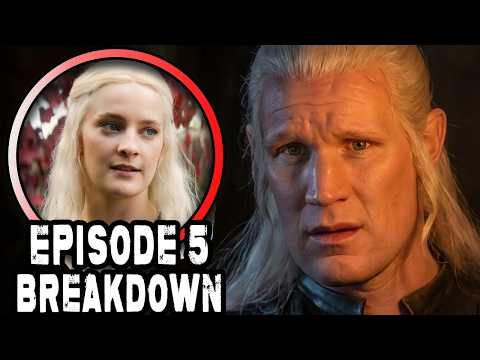
The most effective analysis comes from treating the episode's title, "Unbowed, Unbent, Unbroken," as more than a House Martell reference. Charlie connects Ormund Hightower's admiration for Meria Martell's resistance during Aegon's Conquest with his own increasingly ruthless campaign against Rhaenyra, arguing that Ormund cares less about whether his methods are honorable than whether they work. That idea carries through his sabotage inside King's Landing, his manipulation of Daeron, and the strategic lesson built around cyvasse. It gives the breakdown a useful thematic anchor in an episode otherwise scattered across Harrenhal, King's Landing, Rook's Rest, the Riverlands, and the approaching conflict at Tumbleton.
Harrenhal provides some of the richest material, particularly through Aemond's visions and Alys Rivers. The breakdown connects his recurring nightmare of Rook's Rest, Aegon's laughter, his fetal posture, and his references to Alicent with the childhood wounds that continue shaping him. Alys humming to him and taking on an increasingly maternal role leads Charlie to interpret their relationship less romantically than viewers familiar with the books might expect, instead seeing Aemond searching for the maternal affection he believes Alicent denied him. References to drowning, Helaena's earlier prophecy, and the Gods Eye are also tied to the anticipated confrontation between Aemond and Daemon. These connections are persuasive as foreshadowing, although predictions that the battle itself will be delayed until Season 4 remain speculation about the adaptation rather than something the episode establishes.
The parallel treatment of Aegon strengthens that character reading. Aegon also believes Alicent favored his brother, creating an irony in which both sons see the other as the loved child. His complaints about being kept from tournaments are contrasted with Larys Strong's harsher perspective on privilege, disability, rejection, and hardship, culminating in Larys effectively telling him that his advantages did not make him a good king. Charlie also highlights Aegon's violent pleasure after killing the man who discovers his crown, suggesting that humiliation and resentment are pushing him in a darker direction even as Larys tries to steer him toward escape. Bringing Aegon and Aemond's insecurities together is more insightful than simply cataloging their individual scenes.
Rhaenyra's deterioration becomes the other major character thread. Her fixation on finding Aemond and Vhagar is repeatedly contrasted with Daemon's warnings that unrest in King's Landing deserves immediate attention, especially after the Gold Cloaks' brutality and the earlier feast. Their extended High Valyrian conversation is read as evidence that mounting conspiracies and pressures are making Rhaenyra increasingly paranoid and prone to poor decisions. The discovery that Ormund has hired people to murder Gold Cloaks and make the killings appear to be popular retaliation supports the idea that at least some of her fears have a real foundation. Charlie is particularly good at tracing how Ormund's actions, Daeron's newly minted coins, the unrest among the smallfolk, and Rhaenyra's obsession with revenge begin converging into a broader destabilization strategy.
Alicent and Helaena's storyline adds another variation on family dysfunction. The moon tea, Helaena's refusal to terminate her pregnancy, Alicent's attempted escape plan, and the use of the same passages associated with Blood and Cheese all receive close attention. Charlie interprets Helaena's pregnancy through her desire to retain control over something that belongs to her after losing Jaehaerys, while Alicent's willingness to leave Jaehaera behind becomes further evidence of her desperate and compromised decision-making. The breakdown also repeatedly searches Helaena's dialogue for prophetic significance, from her interest in nightshade to her desire to see the moon. Given the character's established visions, looking for foreshadowing is reasonable, but the analysis sometimes pushes ordinary details toward prophecy simply because Helaena is involved, without enough evidence to settle what those moments mean.
Criston Cole's collapsing Riverlands campaign gives the episode its clearest military trajectory. The Winter Wolves and Riverlords outmaneuver his smaller force, traps disable the horses, the bridge at Stony Sept becomes inaccessible, and Gwayne Hightower repeatedly urges him to abandon the mission for Tumbleton. Charlie reads Criston's refusal as effectively a declaration that he expects—and perhaps wants—to die pursuing the Riverlords, while Gwayne's eventual departure signals that he has no intention of sharing that fate. The breakdown also links Ormund's lessons about Dorne and Aegon's Conquest to the wider question of whether superior force, dragons, or unconventional tactics determine victory. Daeron defeating Ormund at cyvasse with the dragon piece becomes an especially neat visual counterpoint to Ormund's lengthy argument about conquest and resistance.
The video's greatest strength and main weakness come from the same impulse: nearly everything is connected to something else. Intro tapestry changes, Harrenhal's curse, the Gods Eye, Blood and Cheese, Daemon's history as Prince of Flea Bottom, Dornish resistance, future battles, A Feast for Crows, Lannister ambitions, possible relationships, dragon behavior, and prospective HBO projects all become part of the discussion. For knowledgeable viewers, that density makes the breakdown rewarding because scenes are placed within character history, book material, and recurring themes rather than merely recapped. It also produces stretches where possibilities are stacked rapidly—Vhagar sensing her future death, Ormund possibly arranging the earlier graffiti, Helaena's moon request foreshadowing something unknown, Mysaria potentially changing sides, or Baela and Addam becoming romantic—without much distinction between strong textual clues and imaginative possibilities.
The result is an energetic and impressively comprehensive companion to an episode that Charlie himself considers continued setup for larger battles. His strongest observations involve mirrored family trauma, Rhaenyra's growing instability, Ormund's strategic manipulation, Criston's fatalism, and the repeated use of history to comment on the present war. The weaker moments come when enthusiasm for Easter eggs turns ambiguous dialogue or imagery into possible future clues simply because a connection can be imagined. Even so, the breakdown gives a table-setting episode more shape by showing how many character arcs and military plans are approaching their breaking points.
Pros
- The House Martell motto and Ormund's discussion of Meria Martell provide a strong thematic framework for his increasingly ruthless strategy.
- Aegon and Aemond's parallel beliefs that Alicent loved the other brother more create a thoughtful connection between their separate scenes.
- Rhaenyra's fixation on Aemond is effectively contrasted with Daemon's concern about immediate unrest and Ormund's destabilization campaign inside King's Landing.
- Criston Cole's worsening military position and Gwayne's growing desire to leave are traced clearly toward the breakdown's interpretation of Criston's fatalism.
- Book references, earlier-season callbacks, character history, and visual details add substantial context for viewers already invested in the wider story.
Cons
- Predictions about the Gods Eye battle, future episode battles, Mysaria's loyalty, Baela and Addam, and other unresolved developments sometimes blur the boundary between analysis and speculation.
- Helaena's dialogue is repeatedly treated as potential prophecy even when the breakdown cannot identify what details such as the moon or nightshade would actually foreshadow.
- The sheer number of Easter eggs, side theories, adaptation predictions, and franchise references can make the discussion feel crowded when the strongest character analysis deserves more room.
- Speculation that Vhagar may sense her own future death or that Ormund orchestrated earlier graffiti is intriguing but not established by the episode as presented.
The breakdown makes a setup-heavy episode more rewarding by identifying strong parallels among Aegon, Aemond, Alicent, Rhaenyra, Criston, and Ormund while connecting their personal failures to the war gathering around them. Its eagerness to turn ambiguous details into foreshadowing occasionally outruns the evidence, but the depth of character, historical, and book context makes this a substantial companion to the episode rather than a simple scene-by-scene recap.