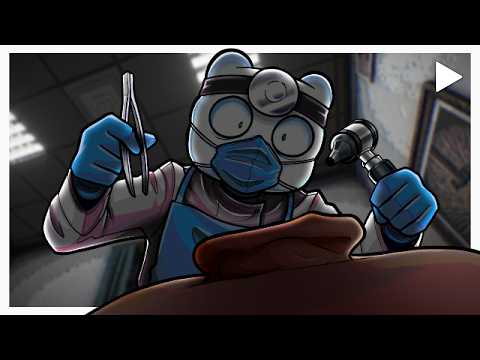
A fan-made horror game turns Steak and his friends into exaggerated monsters, victims, and unlikely heroes, but much of the entertainment comes from how closely its environments resemble places the player recognizes from real life. The recreation of Steak’s apartment immediately becomes a major attraction, with familiar rooms, furniture, food, and other details prompting repeated surprise. That personal connection gives the playthrough a quality that a more conventional horror game could not easily reproduce.
Chapter one mixes that familiarity with deliberately absurd comedy. Steak’s enormous character model, the maid outfits, food scattered around his apartment, toilet jokes, and increasingly ridiculous dialogue keep undermining the supposed danger. The humor is loud and juvenile, but it fits the stream’s intentionally chaotic style. When the story shifts toward characters disappearing or apparently being eaten, the presenter’s exaggerated reactions help maintain an energetic balance between horror and comedy rather than treating any of it too seriously.
The second chapter is substantially more interesting because it expands both the environments and the mystery. Splink’s arrival, the drive to the family home, and the remarkably detailed recreation of that house give the stream something more substantial to explore than a sequence of scares. The presenter repeatedly identifies specific features—including bedrooms, setups, closets, a pantry, theater room, pool, pets, and family photographs—which makes the developers’ attention to detail easy to appreciate even without knowing how perfectly accurate every element actually is.
That extended house tour is also where the pacing becomes weakest. Excitement over recognizable details leads to numerous repeated reactions, interrupted sentences, detours, and pauses in the main storyline. Discovering the hidden VHS tape gives the exploration a purpose, but the stream spends so much time marveling at individual objects and rooms that viewers primarily interested in the horror narrative may become impatient. The live-chat interaction contributes further unpredictability, sometimes revealing clues while also pulling attention away from whatever is happening onscreen.
Once the familiar house transforms into a distorted, dreamlike version of itself, the horror becomes more effective. Altered rooms, strange paintings, impossible architecture, unexplained noises, and the command to “wake up” create tension through environmental changes rather than relying entirely on pursuit sequences. Cruz’s unexpected return—badly injured but alive—then provides a useful narrative hook, while the mysterious phone call and power failure establish a stronger sense that another threat is operating beyond Steak himself.
The closing reveal gives the otherwise scattered story its most intriguing idea: the apparent Romi is identified as a mimic associated with Demon Child, while Steak seems to have been attempting to protect the group. The presenter immediately interprets this as evidence that Steak may secretly be good, though the game leaves an obvious contradiction because Steak’s earlier behavior included attacking and eating characters. Treating that interpretation as a theory rather than a settled explanation is appropriate, and the unresolved contradiction gives a potential third chapter somewhere meaningful to take the story.
Pros
- Detailed recreations of Steak’s apartment and the family home give the playthrough an unusually personal hook.
- Chapter two expands the game with exploration, hidden VHS material, dreamlike environments, and a larger mystery.
- The transformed house sequence creates effective horror through distorted familiar surroundings.
- Steak’s apparent attempt to protect the characters introduces an intriguing twist without fully resolving the mystery.
- Energetic reactions and absurd character moments complement the game’s horror-comedy tone.
Cons
- Repeated shouting, phrases, and reactions can become exhausting during longer sequences.
- Extensive exploration of familiar household details significantly slows the main story.
- Live-chat distractions and frequent tangents make parts of the playthrough difficult to follow.
- The narrative remains deliberately messy, particularly regarding Steak’s motives and the relationship between its different threats.
- Juvenile toilet and bodily-function humor is used heavily enough to limit the appeal for viewers who prefer more focused horror.
The personal connection between the player and the game’s recreated locations makes this far more distinctive than a routine horror playthrough, while the second chapter adds enough mystery to suggest a surprisingly ambitious ongoing story. Uneven pacing and relentless chaotic commentary sometimes bury the scares, but the detailed environments, strange humor, and late narrative twist make the experience consistently memorable.