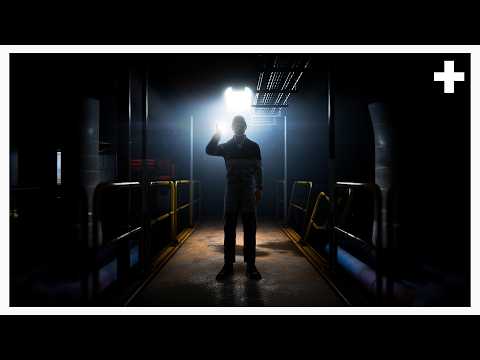
A tiny blip on the radar gives the host his first hint that he has company in the maze. By the time he has picked up a couple of keys, he’s already doubting his ability to find the way back to the stairs. That early stretch gets plenty out of a familiar Roblox horror setup. Every closet looks like a useful landmark until it becomes the only place he wants to be.
The first encounter works because the host is still trying to distinguish a warning from a quirk of the dungeon. He briefly talks himself out of being scared by the lights, then recoils when something actually appears. Soon he’s wondering whether he can hear a distorted song and whether he has enough stamina to make it down the hall. Those reactions give the early scares room to build, and his habit of pleading with the creature as though it might hear him out makes the panic funny.
The search gains direction when he finds where the keys go and realizes there’s a code to enter. There’s a satisfying moment when his theory about the long hallway leads him back to the stairs, followed by the deflating discovery that he has two keys when he thought he had three. His running commentary is clearest in moments like that, when there’s a decision to follow and an immediate result. As he revises his mental map aloud, it gets harder to tell which routes offer a new possibility and which simply take him around the same loop.
The radar remains harder to read than the maze. Sometimes it gives him time to decide whether to move, and sometimes the creature is practically on top of him before he sees it register. He wonders aloud whether it’s moving faster than the radar sweeps or growing more aggressive as he gets closer to escaping. Those guesses capture the confusion of being chased, but the playthrough never settles whether either explanation fits what happened.
Once the creature starts hanging around the same area, too many encounters end with another wait in a closet. The host gets some mileage out of greeting his pursuer like an overbearing acquaintance, though the jokes wear thinner as the search stalls. The Halloween charms briefly give him something else to notice, especially when he realizes he mistook the pumpkin for decoration. That side objective stays incidental, and by the time he’s close to escaping, he’s happy to leave the remaining charms behind.
Finding the fourth key produces the biggest release of the playthrough. The host briefly celebrates an escape from the creature and then admits he accomplished nothing, which makes the eventual celebration feel earned. He calls it quits after clearing Part One and gives a candid assessment of how quickly the game went from spooky to repetitive. The ending delivers the payoff for the search that kept him going.
Pros
- The early uncertainty around the lights and sounds gives the first encounter time to build.
- The host’s exasperated conversations with the creature bring humor to the chases.
- Finding the key slots and the code gives the search a clear objective.
- The return to the stairs shows the host putting his growing familiarity with the maze to use.
- The final key delivers a satisfying payoff after several escapes that brought him no closer to the exit.
Cons
- Repeated trips to the same closets drain tension from the later chases.
- The running route commentary becomes difficult to follow when several paths loop back to familiar hallways.
- The radar’s erratic usefulness leaves some encounters hard to make sense of.
- The unfinished Halloween charm hunt adds another objective with little payoff.
There’s a funny progression from trying to understand the creature to bargaining with it for enough time to open one more drawer. The host’s investment makes the escape worth seeing, even when the search takes longer than the scares can sustain.