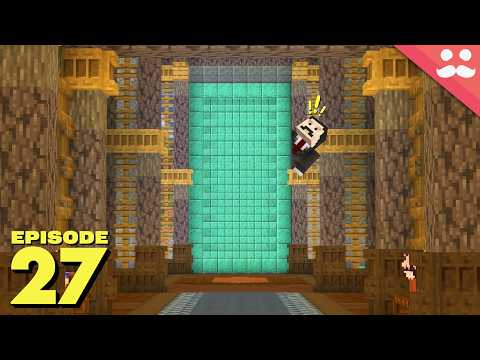
Connecting the enormous gothic base to the ground sounds like routine cleanup, but the change immediately addresses one of its most noticeable unfinished qualities. Extending the deepslate downward gives the structure a more convincing foundation, while the decision to soften overly contrasting pillars with additional material shows how much attention is being paid to transitions rather than simply filling empty space. Even unfinished, the terrain work makes the base feel less like a massive structure hovering above its surroundings and more like something deliberately anchored into the landscape.
Before that building work begins, the delayed reveal of the Tango killing machine provides a funny payoff to the previous installment. Watching the elaborate ride repeatedly malfunction is arguably more entertaining than a flawless demonstration would have been: ravagers attack at the wrong moments, the intended berry-bush death fails, and multiple attempts are needed before the contraption finally behaves. The genuine enthusiasm for the music, timing, and teammates' work also gives this section an appealing celebratory quality, particularly once it is revealed that their team won the competition by a single point despite there being no actual prize.
The main project deliberately shifts away from spectacular construction toward accumulated corrections. Window edges gain iron bars, unsupported pillars receive proper connections, awkward stone blocks disappear, and the remaining village is flattened to clear the surrounding terrain. Much of this work involves tiny choices that could easily go unnoticed at normal viewing distance, yet the commentary does a good job explaining why stairs, slabs, wall blocks, gradients, and transitions matter. Seeing individual decisions tested rather than simply receiving a finished-build reveal makes the process useful for viewers interested in Minecraft detailing.
The flying buttresses provide the episode's clearest visual transformation. Their gradual color transition creates the impression of changing light and shadow, while their deliberately imperfect matching introduces a little asymmetry instead of mechanically duplicating both sides. More importantly, the buttresses strengthen the upward lines of the architecture and expose how unfinished some neighboring areas still are. That leads naturally into cutting openings in the upper tower for a future bedroom, where practical concerns about flying access and a possible balcony become part of the architectural planning rather than an afterthought.
Smaller interruptions prevent the methodical construction from becoming too monotonous. Zombie villagers require an unexpected detour into curing, dwindling block supplies become a recurring concern, and forgotten pieces of roofing reveal just how many unfinished fragments remain scattered around such a large project. These moments reinforce the episode's central idea particularly well: completing a huge Minecraft build is not just about creating major structures but repeatedly discovering and resolving dozens of neglected details.
The later stretches become increasingly focused on spikes, wall blocks, tower ornamentation, and other extremely subtle additions. Repeating established detailing across multiple towers improves consistency and makes the skyline noticeably more elaborate, while finally linking previously freestanding towers to the main structure resolves another longstanding oddity. There is thoughtful restraint in acknowledging that some connections or material choices may still need revision rather than presenting every experiment as permanently solved. At the same time, viewers looking for a dramatic new build may find this portion repetitive, since many of the improvements involve variations on the same small-scale decorative technique.
Presentation-wise, the loose collection of chores works because there is a clear architectural theme tying them together: making the base feel more complete, grounded, and coherent before new blocks arrive with the next game update. The episode openly recognizes that there is no single enormous accomplishment to showcase, and that honesty suits the material. What emerges instead is an effective demonstration of refinement, showing how many individually modest changes can collectively transform a build whose broad shape was already established.
Pros
- Grounding the base, completing buttresses, and connecting freestanding towers address meaningful structural weaknesses rather than adding detail purely for decoration.
- Explanations of gradients, transitions, depth, asymmetry, and repeated motifs clearly communicate the reasoning behind numerous building choices.
- The malfunctioning Tango contraption provides a funny and energetic opening before the more methodical construction work begins.
- Flying buttresses, spikes, window openings, and tower details collectively produce visible improvements to the base's gothic silhouette.
- Unplanned problems and experimentation preserve a natural building-process feel instead of reducing the episode to polished before-and-after reveals.
Cons
- The deliberately scattered collection of cleanup jobs gives the episode less of a central construction payoff than a major new build would provide.
- Repeated placement of spikes and wall details becomes somewhat repetitive during the later stages.
- Several areas remain intentionally unresolved, including surrounding terrain, water, bedroom windows, and some material choices, limiting the sense of completion.
Small architectural corrections prove surprisingly satisfying when they are tied together by clear design reasoning and a willingness to revisit old work. The modest scope produces fewer dramatic moments, but the steady visual refinement, enjoyable experimentation, and amusing opening sequence make this a rewarding building-focused installment.