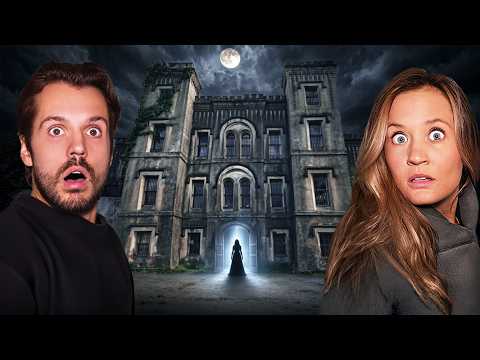
Hurricane Katrina’s physical legacy provides some of the most unsettling imagery here, particularly once the exploration moves beyond New Orleans’ famous cemeteries and into places left deteriorating for decades. The combination of a flooded Cold War bunker, the abandoned Lindy Boggs Medical Center, and the former Six Flags creates a strong progression from historical curiosity to increasingly hazardous urban exploration. Although the framing promises paranormal encounters, much of the tension actually comes from something more tangible: trespassing concerns, unstable structures, contaminated water, syringes, darkness, and uncertainty about who else might be inside.
The cemetery material gives the outing more substance than a straightforward ghost hunt. Above-ground tombs, family vaults, flooding, decomposition practices, and the reuse of burial spaces are discussed at length, with Wendigoon frequently expanding on the history. Some details are presented confidently without sourcing, however, and the conversation about the War of 1812 becomes particularly casual and simplified. The historical sections work best as colorful context rather than rigorous historical documentation, especially when complicated events are reduced to patriotic jokes and broad summaries.
A visit with the Voodoo Bone Lady is one of the more worthwhile departures from the haunted-city premise. She directly challenges popular portrayals of Voodoo as a practice centered on curses and malicious magic, explaining her religious beliefs, the meaning she assigns to ritual objects, and her understanding of the tradition’s relationship to African religions. Wendigoon and the others are receptive rather than dismissive, and their discussion about how unfamiliar religious rituals can look disturbing when stripped of context is thoughtful. At the same time, historical and theological assertions made during the conversation—including claims about origins, age, terminology, and relationships among different traditions—are largely presented from the participants’ perspectives rather than independently established.
The abandoned Cold War bunker shifts the tone dramatically. Floodwater, possible asbestos, stagnant air, syringes, a deep drop, and other obvious hazards make the location compelling to watch but also highlight how reckless this form of exploration can become. The participants themselves repeatedly recognize those dangers, sometimes after entering, and their retrospective commentary is unusually candid about inadequate protective equipment. That honesty helps, but it does not erase the uncomfortable spectacle of people knowingly entering condemned or contaminated spaces without suitable precautions.
Lindy Boggs Medical Center produces the episode’s eeriest sequence without requiring anything supernatural. The abandoned hospital’s Katrina history gives the setting genuine gravity, while standing water, deteriorated interiors, scattered syringes, personal belongings, and a pair of bright red heels create immediate unease. The group initially speculates about footprints and what the belongings might mean, but later examination produces a mundane and sadder possibility: the items may simply have belonged to someone sheltering there. That willingness to reconsider the spooky interpretation is important, particularly in a genre that can easily turn ambiguity into unsupported paranormal certainty.
Six Flags provides the strongest sustained exploration because the contrast between an amusement park’s original purpose and its ruined condition is inherently striking. Wind and loose metal generate unexplained noises, while several participants believe they hear voices or children laughing. Crucially, they repeatedly acknowledge ordinary possibilities and the psychological effect of spending hours discussing frightening subjects in darkness. Nothing shown establishes a paranormal explanation, but the uncertainty is enough to create atmosphere, and the later realization that demolition makes such footage difficult or impossible to recreate gives the material additional documentary interest.
The presentation is much looser than the underlying locations deserve. Retrospective commentary with Wendigoon adds useful corrections, context, humor, and hindsight, but constant jokes, Patreon promotion, channel plugs, sponsor material, repeated discussions of the same frightening moments, and extended banter regularly interrupt the momentum. There is also an uneasy tension between appreciating these locations as pieces of New Orleans history and treating dangerous trespassing as an adventure. Still, the chemistry is natural, the participants occasionally correct their own earlier statements, and the strongest stretches allow ruined places and their histories—not manufactured paranormal proof—to supply the suspense.
Pros
- The cemetery, Cold War bunker, hospital, and abandoned amusement park provide unusually varied settings with substantial historical and cultural context.
- The Voodoo Bone Lady segment gives a practitioner meaningful space to challenge sensationalized portrayals of her religion.
- Retrospective commentary adds useful corrections and acknowledges ordinary explanations for several supposedly eerie discoveries.
- The abandoned hospital and Six Flags sequences create genuine tension without establishing ambiguous sounds or objects as proof of paranormal activity.
- Footage of locations subsequently undergoing demolition gives parts of the exploration an unintended documentary value.
Cons
- Historical and religious claims are frequently presented conversationally without enough sourcing or qualification to establish their accuracy.
- Entering condemned, flooded, contaminated, or otherwise hazardous properties without appropriate protection introduces serious and repeatedly acknowledged safety concerns.
- Frequent jokes, promotions, tangents, and repeated commentary make an already lengthy exploration considerably less focused.
- The haunted-city framing sometimes encourages ominous speculation around ambiguous sounds and personal belongings before more ordinary explanations are considered.
New Orleans supplies enough real history, cultural complexity, disaster scars, and urban decay that the exploration rarely needs supernatural certainty to be fascinating. Its most effective moments embrace that ambiguity, while its weakest come from hazardous choices, loose factual treatment, and an overstuffed presentation that occasionally obscures the remarkable locations being documented.