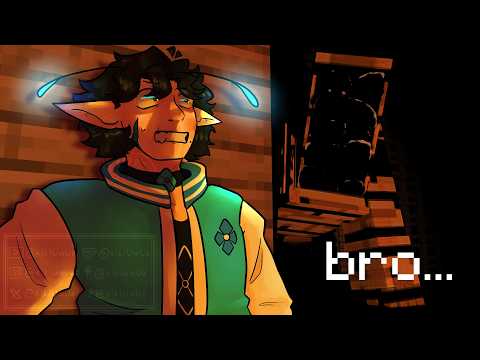
Two enormous disembodied arms climbing out of a dark well establish the central idea with remarkable efficiency: sometimes knowing less about a threat makes it more frightening. One in the Well supplies pounding pursuit sounds and an urgent climb but deliberately withholds the expected monster reveal, turning a glance downward into confirmation that there is almost nothing concrete to see. That opening provides a strong practical foundation for the larger argument that fully modeled enemies can lose some of their power once players understand their appearance, movement and predictable behavior.
The discussion becomes more interesting with Grun, where an ordinary gardening job gradually fills with suspicious details. Missing tools encourage exploration, a previous gardener leaves clues, people watch from windows and crevices, and the homeowner is presented as a lurking threat without becoming a conventional pursuing monster. The comedy about Dutch language and European petty theft keeps the presentation playful, but the humor generally supports rather than destroys the unease. More importantly, the example demonstrates how changing rules and uncertain intentions can keep players wondering whether they are actually in danger.
An academic study on creepiness is used to give that uncertainty a psychological framework. The presentation says participants were more likely to judge confusing images as creepy and dangerous and connects that result to the idea that ambiguity can prepare people for a possible threat without confirming one. It is a useful connection, although the discussion moves quickly from one described study into broad claims about human fear responses and evolutionary caution. Those explanations are presented confidently enough that more qualification about what the cited research specifically established would have strengthened the analytical side.
The comparison between Obsession and The Backrooms extends the argument beyond games. Unexplained movements and gestures are praised for leaving the source of discomfort difficult to define, while a visible, apparently escapable monster is criticized for replacing the existential unease of the original Backrooms concept with a more conventional threat. The criticism becomes somewhat dismissive when discussing later Backrooms lore and familiar horror plotting, but the underlying point is clear: cataloguing entities, levels and rules can transform an unknowable space into something audiences can mentally organize.
Pools supplies the most developed environmental example. Its repeating corridors, strange pool geometry, limited visibility and interconnected spaces support an argument that architecture itself can create vulnerability. The discussion invokes prospect-refuge theory to explain why spaces without useful overlooks, protected positions or comprehensible entrances can feel unsafe. That framework fits the imagery being described well, though the historical and psychological claims surrounding the theory are asserted rather than carefully established, so they work better here as an interpretive lens than as definitive proof of why players react a particular way.
Proximate pushes the thesis furthest by replacing conventional vision with an uncertain machine interpretation of the environment. Object labels, distances and confidence percentages initially become substitutes for sight, only for that system to become frightening when its classifications grow less dependable around possible human forms and disturbing laboratory evidence. The cleverness of the example is that the threat reportedly never attacks at all: the player constructs an internal picture of the facility, learns to trust an imperfect interface and then has that confidence undermined. It persuasively demonstrates how a horror mechanic can make incomplete information itself the antagonist.
The focused atmospheric approach largely succeeds, tying several very different works together around ambiguity rather than merely listing scary games. There is still some repetition as the conclusion returns several times to the absence of monsters, chase sequences and jump scares, and the lengthy War Thunder sponsorship interrupts the carefully cultivated mood despite jokes designed to make it fit. Even so, the presentation ultimately makes a thoughtful distinction between outright fear and the sustained creepiness of never knowing whether anything will happen, while stopping short of claiming that this quieter approach is necessarily the most intense form of horror.
Pros
- Uses One in the Well, Grun, Pools and Proximate to demonstrate distinct ways that unseen or uncertain threats can create tension.
- Connects environmental design, incomplete information and player imagination into a coherent argument rather than simply praising atmosphere.
- Proximate provides an especially effective example of turning unreliable perception into a horror mechanic.
- The comparison with increasingly explicit Backrooms lore clearly illustrates how explaining a threat can reduce its ambiguity.
- The more restrained presentation style complements the subject and still leaves room for humor.
Cons
- Psychological and evolutionary explanations sometimes extend beyond what the single described creepiness study directly establishes.
- Prospect-refuge theory is applied persuasively but presented with more certainty than the discussion itself substantiates.
- Some criticism of conventional monsters and later Backrooms material becomes reductive rather than exploring why explicit threats can also work.
- The extended sponsorship significantly disrupts an otherwise deliberately maintained atmosphere.
- The closing argument repeats several points about absent monsters, jump scares and chase sequences after the thesis is already clear.
A focused examination of ambiguity makes a convincing case that horror can thrive on incomplete information rather than visible enemies and predictable pursuit sequences. Its strongest moments show how mechanics, architecture and unreliable perception can recruit the player's imagination into creating the threat, even if some psychological explanations deserve more caution. The atmospheric experiment is thoughtful, distinctive and considerably more interesting than a simple celebration of monster-free horror.