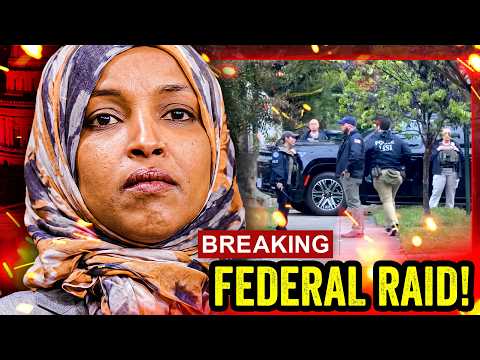
Jesse Watters builds an aggressive political commentary around allegations involving Representative Ilhan Omar, her father's military background, and questions about her family's immigration history. Opening with claims of federal searches, seized electronic devices, and subpoenas, Watters presents the situation as an expanding investigation with potentially serious consequences for Omar's citizenship. The introduction creates urgency and establishes several lines of inquiry, but its dramatic language also introduces a recurring weakness: allegations, reported investigative developments, and speculative conclusions frequently receive similar levels of emphasis.
The central argument concerns Omar's alleged acquisition of derivative citizenship through her father. Watters explains that this form of citizenship depends on specific legal circumstances, including a parent's naturalization and the child's age at the relevant time. He then raises questions about Omar's birth year, her father's naturalization records, and whether her father qualified for refugee status. These are potentially significant legal issues, and explaining their connection gives the segment some informational value. However, the presentation does not establish that the alleged discrepancies invalidate Omar's citizenship, nor does it adequately distinguish missing documentation from proof that naturalization never occurred.
Watters devotes considerable attention to Omar's father, describing him as a colonel who served under Somalia's former military dictatorship. He connects that service to atrocities committed by the regime, including mass killings, landmine deployment, and other abuses. The historical allegations are serious, and Watters briefly acknowledges that he does not know whether Omar's father personally committed war crimes. That qualification matters, but it is weakened by repeated suggestions that military rank and association with the regime establish individual culpability. The segment also cites reported Soviet training and a former officer's account of military academy leadership without providing enough supporting documentation to assess those claims independently.
The discussion broadens to other former Somali military figures who reportedly entered the United States, including one individual whom Watters says was found liable for torture in a civil proceeding. This comparison raises a legitimate question about historical refugee screening and accountability for alleged human rights abuses. Nevertheless, the argument relies heavily on association, using other individuals' conduct to reinforce suspicions about Omar's father without demonstrating a direct connection. Watters also incorporates a commentator's concerns about selective enforcement, but largely dismisses the underlying question of whether investigations are being conducted consistently and fairly.
Financial allegations provide a second major storyline. Watters references questions about Omar's financial disclosures, campaign spending involving her husband's firm, and alleged connections between people in her political circle and fraud in Minnesota. These subjects warrant scrutiny when supported by reliable evidence, particularly where public officials' financial reporting and campaign expenditures are concerned. Yet the presentation moves quickly between previously identified campaign-finance issues, ongoing investigative claims, and broader accusations of corruption. The suggested connections between Omar and the reported multibillion-dollar fraud receive little substantive explanation, leaving viewers without a clear understanding of what wrongdoing, if any, has been established against her personally.
The commentary becomes especially problematic when Watters shifts from individual allegations to Minnesota's Somali community. References to Somali political representation, Minneapolis's changing demographics, and the names of criminal defendants are used to suggest broader problems with assimilation and national loyalty. These rhetorical choices contribute little to evaluating Omar's legal circumstances and risk encouraging viewers to judge an entire immigrant community through unrelated allegations against particular individuals. Watters also interprets Omar's childhood recollection of encountering homelessness in New York as evidence of hostility toward America, although the quoted anecdote does not independently support that characterization. His concluding appeal to voters makes the segment's partisan objective unmistakable.
Pros
- The opening clearly identifies several reported investigative developments, giving viewers an immediate understanding of the allegations driving the commentary.
- The explanation of derivative citizenship introduces a relevant legal concept and connects it to specific questions about naturalization and age.
- Discussion of Somalia's former military dictatorship raises important historical questions about refugee screening and potential accountability for human rights abuses.
- References to financial disclosures, campaign expenditures, and judicial authorization identify issues that could merit further examination through documented legal processes.
- Watters' energetic delivery, direct language, and organized progression between immigration and financial allegations create an attention-grabbing presentation.
- The acknowledgment that Omar's father has not been shown to have personally committed war crimes provides an important, if insufficiently developed, qualification.
Cons
- Serious allegations about citizenship, immigration fraud, and potential deportation are presented with greater certainty than the evidence supplied establishes.
- The discussion provides insufficient documentary support for claims about Omar's father's naturalization, military responsibilities, and eligibility for refugee status.
- Historical association with an abusive military regime is repeatedly used to imply individual wrongdoing without establishing personal responsibility.
- Financial investigations, campaign-spending controversies, and broader Minnesota fraud allegations are linked through suggestion rather than clearly demonstrated evidence.
- References to Somali immigrants' names, political influence, and perceived loyalty introduce sweeping ethnic generalizations that distract from the specific allegations.
- Sarcasm, insinuation, and selective interpretations of quoted remarks frequently replace careful examination of alternative explanations.
- The explicitly partisan conclusion prioritizes electoral persuasion over a balanced assessment of the legal questions raised.
Jesse Watters delivers a forceful and tightly focused political commentary that raises potentially consequential questions about immigration records, historical accountability, and financial transparency. However, its investigative ambitions are undermined by insufficient substantiation, repeated guilt-by-association arguments, and troubling generalizations about Somali Americans. The segment is effective at generating controversy and political urgency but considerably less successful at providing the careful, evidence-driven analysis necessary to support its most serious implications.