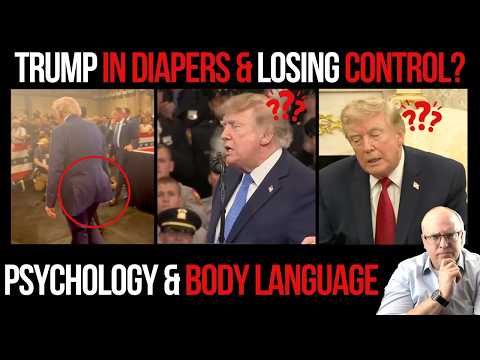
Small changes in Donald Trump’s speech and physical movements are treated here as pieces of a much larger neurological pattern. Dr. G repeatedly isolates moments in which Trump appears to stumble over words, pronounce names unusually, jerk an arm or torso, or struggle with verbal fluency, arguing that their frequency makes them more significant than ordinary speaking mistakes. The accumulation of examples gives the analysis a clear throughline, but the leap from observable behavior to possible neurological disease is considerably less secure than the presentation sometimes suggests.
The commentary is strongest when it stays close to what viewers can actually observe. Clips are replayed to highlight particular pronunciations, movements of Trump’s right arm, a sudden forward motion while greeting someone, and apparent difficulty producing certain phrases. Dr. G also acknowledges at one point that everyone occasionally trips over words, which is an important qualification. Looking across several settings rather than building the entire case around a single awkward moment is likewise a more responsible approach to pattern recognition, even though repetition alone cannot establish the medical cause of a behavior.
Problems emerge when those observations are connected to specific conditions. Difficulty enunciating is described as potentially consistent with post-stroke effects, dementia, Alzheimer’s disease, or Lewy body dementia, while later remarks raise the possibility of a progressive neurodegenerative disease or an unspecified medical event about a year earlier. These are presented as possibilities rather than diagnoses, and the opening explicitly says the discussion is not a psychological evaluation. Even so, no medical examination, neurological testing, clinical history, medication information, or other direct evidence is provided that could establish why the observed behaviors occurred, making the repeated disease references substantially more speculative than the visual observations themselves.
Some body-language interpretations have a similar evidentiary problem. Dr. G concludes that a forward jerk is involuntary rather than an attempt to hear someone, suggests reduced use or weakness of Trump’s right hand, and links apparent spasms while listening to other speakers with agitation because Trump supposedly dislikes having to stand and listen. He further interprets facial tension and unusual breathing as evidence that Trump is becoming overwhelmed. These explanations may be hypotheses worth considering, but the footage as described does not independently establish internal emotional states, involuntary movement, muscular weakness, or neurological impairment.
The verbal examples are more concrete but still require caution. Mispronunciations, slurring, apparent word-finding problems, and the moment interpreted as difficulty remembering Clinton’s name can all be identified and compared, yet attributing them to neurological decline requires more than recognizing that they happened. The presentation frequently moves from “this sounds unusual” to “this is neurologically concerning” without supplying a baseline analysis demonstrating how often comparable mistakes occurred previously or systematically measuring whether their frequency has actually increased. Claims that Trump now does these things “constantly” and has declined dramatically over roughly a year therefore carry more certainty than the evidence presented here can comfortably support.
The closing argument pushes the speculation further by predicting that Trump may begin making fewer public appearances because the alleged problems will become increasingly difficult to control. A recent reduction in appearances is mentioned, but no evidence is offered connecting that scheduling observation to health or neurological functioning. That prediction illustrates the central weakness of the piece: potentially interesting observations repeatedly become foundations for increasingly consequential medical conclusions without the intermediate evidence necessary to demonstrate those conclusions.
As a piece of close visual commentary, the presentation is focused, accessible, and unusually specific about exactly which movements and speech patterns concern its host. As an assessment of Trump’s health, however, it demands considerably more restraint. The disclaimer that this is opinion rather than an evaluation helps establish an important boundary, but repeatedly invoking strokes, several forms of dementia, neurological deficits, a possible prior medical event, progressive disease, and future deterioration makes that boundary increasingly difficult to maintain in practice.
Pros
- Uses examples from multiple public settings rather than relying on one isolated speech mistake or physical movement.
- Replays specific moments so viewers can understand which verbal and physical behaviors are being interpreted.
- Explicitly acknowledges that ordinary people sometimes stumble over words and states that the commentary is not a psychological evaluation.
- Maintains a focused presentation built around identifiable speech and movement patterns.
Cons
- Repeated references to stroke effects, dementia, Alzheimer’s disease, Lewy body dementia, and neurodegenerative disease go well beyond what the presented observational evidence can establish.
- Interpretations of involuntary spasms, right-hand weakness, agitation, overwhelm, and memory failure are often stated with greater confidence than the footage alone supports.
- Claims of dramatic decline and constantly worsening symptoms are not backed by a systematic longitudinal comparison or quantified baseline.
- Speculation that reduced public appearances could reflect increasing difficulty concealing the alleged problems extends the argument beyond the evidence presented.
Close examination reveals several moments that can reasonably be described as unusual, but observing them is very different from determining their medical cause. The presentation is effective at directing attention to recurring behaviors, yet its repeated neurological hypotheses and predictions of progressive deterioration substantially outrun what those clips alone can demonstrate. Greater separation between observable changes and possible diagnoses would make the analysis considerably more rigorous.