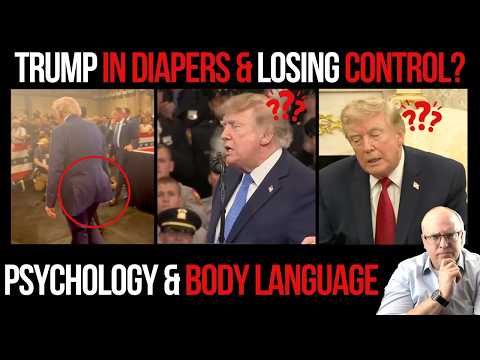
A brief arm movement during Donald Trump’s NASA speech becomes the centerpiece of an unusually serious medical interpretation, with Dr. G describing the sequence of an arm jerk, blinking, vocal hesitation and movement of the opposite arm as a “distinct neurological event.” He compares the pattern with focal aware or focal motor seizures and raises the possibility of post-stroke effects, while stopping short of claiming a specific diagnosis. That qualification matters, but the analysis still moves quickly from observing ambiguous behavior on recorded footage to asserting that something neurological is clearly occurring.
The presentation is at its best when it slows footage down, identifies exactly what viewers should watch and then replays the sequence at normal speed. Similar attention is given to Trump’s jaw movements, an elbow jerk, a tongue movement and apparent difficulty producing a word. These demonstrations make the argument easy to follow, and Dr. G sometimes acknowledges reasonable limits, such as noting that an isolated mouth movement would not justify a major conclusion and that myoclonic activity can have multiple causes. However, the repeated visual scrutiny cannot establish the underlying medical cause of movements seen in short public clips.
The speech analysis expands from motor behavior into cognition. Trump’s repetition of the claim about 81 stock-market highs is interpreted as disorientation, while an awkward phrase about getting something “going again” is presented as evidence of word-finding difficulty. Dr. G argues that Trump covers such problems with humor and later characterizes the material as showing memory and judgment difficulties. Those interpretations may give viewers specific behaviors to consider, but no clinical examination, medical history, neurological testing or alternative explanation is provided to establish that ordinary repetition, improvisational speech or verbal mistakes reflect neurological decline.
The Lake America material pushes the argument considerably further. Lateral jaw movements while Trump speaks and writes are characterized as another neurological sign, while the phrase “without the oven” is treated as evidence of diminished filtering. Dr. G then connects the broader decision involving Canada to impaired judgment, arguing that Trump’s policy behavior itself stems from neurological problems. At that point the analysis moves beyond observable body language into a causal medical explanation for political decision-making, and the footage presented does not provide enough evidence to support that conclusion.
That same problem affects the discussion of Trump’s uncle and supposed genetic interest in space. The remarks are described as strange, but unusual conversational logic is not independently meaningful evidence of neurological dysfunction. An elbow movement occurring alongside a verbal stumble and a brief tongue-and-eye movement are likewise treated as pieces of a cumulative neurological pattern. Looking for patterns across repeated observations can be useful, but accumulating individually ambiguous behaviors does not by itself resolve the uncertainty surrounding their causes.
The opening disclaimer says this is not a psychological evaluation and repeatedly frames some conclusions as opinions or possibilities. Yet the language elsewhere becomes much more definitive: viewers are told that they have watched activity “travel across his brain,” that the behavior is clearly neurological, that Trump is declining, and that neurological problems are affecting his judgment. Those are substantial medical claims, and the certainty of the wording is difficult to reconcile with the acknowledged absence of a diagnosis or the limited evidence available from public footage.
As a piece of commentary, the analysis is organized, visually specific and accessible enough that viewers can understand why particular moments attracted attention. As an assessment of Trump’s neurological health, however, it relies too heavily on remote interpretation of movements, speech errors and political behavior to justify its strongest conclusions. The possibility of neurological explanations can reasonably be raised as a hypothesis, but distinguishing that possibility from evidence establishing seizure activity, stroke effects or cognitive decline would make the discussion substantially more rigorous.
Pros
- Replays and close attention to specific arm, jaw, eye, tongue and speech movements make the observations easy for viewers to examine themselves.
- The discussion acknowledges at several points that individual movements can have multiple explanations and does not formally diagnose a particular seizure disorder.
- Connecting motor observations with surrounding speech provides more context than simply presenting isolated freeze-frames.
Cons
- Serious neurological interpretations are drawn from public footage without clinical examination, medical history, testing or sufficient consideration of non-neurological explanations.
- The claim that viewers can watch neurological activity travel across Trump’s brain is presented with a level of certainty the footage alone cannot establish.
- Political decisions and unusual remarks are attributed to impaired neurological judgment without evidence demonstrating that causal connection.
- The initial disclaimer and occasional cautious wording conflict with later categorical assertions that Trump is neurologically declining.
Careful replay and clearly identified behavioral details make the presentation easy to follow, but the medical conclusions repeatedly become more confident than the available evidence warrants. Raising neurological possibilities is one thing; treating ambiguous movements, verbal mistakes and political judgment as a coherent demonstration of decline requires substantially stronger evidence than public footage can provide.