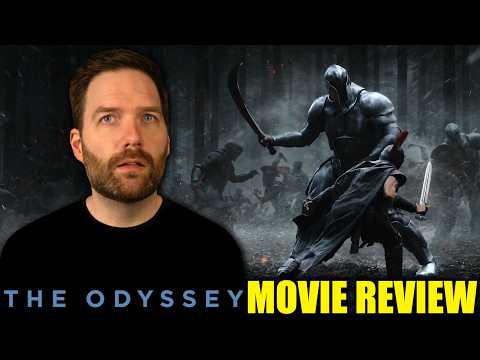
The strongest consensus among the three reviewers is that Christopher Nolan has made the kind of large-scale theatrical experience they want Hollywood to produce more often. They praise the film as immersive, visually imposing, emotionally satisfying, and consistently engaging despite its nearly three-hour runtime, with two reviewers ultimately awarding it a 10 and the third settling on a 9. Their enthusiasm is substantial, but the discussion does identify limitations involving pacing, modern dialogue, uneven casting, a comparatively muted visual palette, and changes to Homer’s story. Those criticisms rarely threaten the recommendation, yet they give the conversation more substance than the repeated declarations that the film is simply “epic.”
The modernized dialogue is one of the first potential obstacles they address. Nolan apparently avoids heightened period speech in favor of contemporary phrasing, which initially feels strange against the ancient Greek setting. For at least one reviewer, that disconnect largely disappears after the opening portion as the story takes over. The production design receives a similar defense: armor that had attracted criticism before release does not bother the group, and some designs are considered inventive. More broadly, Hoyte van Hoytema’s cinematography, shadows, environments, action, and physical sense of place are repeatedly cited as reasons to seek out the film on the largest screen possible, even though one reviewer wishes the imagery contained more of the bright greens and deep blues he associates with the Aegean.
The cast receives enthusiastic but not indiscriminate praise. Matt Damon’s Odysseus is considered convincing as both a capable leader and a deeply flawed man enduring a punishing journey home, while Anne Hathaway is singled out as being among the film’s best performers. Robert Pattinson earns particularly strong approval for making his antagonist thoroughly detestable, and John Leguizamo is praised as Odysseus’ loyal servant. Opinions on Tom Holland are less unified: one reviewer thinks he does a wonderful job portraying a son living beneath his father’s legend, while another feels his youthful appearance makes the role harder to accept. Zendaya and Elliot Page are identified as weaker casting choices, although the reviewers emphasize that their limited screen time prevents either performance from seriously damaging the film.
Their discussion becomes more interesting when it turns to adaptation rather than spectacle. The group argues that Nolan trims or merges portions of Homer’s narrative to create a more efficient cinematic structure, with one reviewer specifically describing the result as a cleaned-up version of Odysseus that strengthens his relationships with his wife and son. They note that some of his transgressions and other material have been reduced or omitted, meaning the film should not be treated as a comprehensive reproduction of the ancient poem. At the same time, they appreciate the way the screenplay frames Odysseus’ adventures and mysteries surrounding his delayed return, believing the restructuring allows a familiar story to retain suspense and emotional momentum for audiences who do not already know where every encounter leads.
The mythological material appears to exceed their expectations precisely because Nolan does not strip it away in pursuit of realism. The gods are described as more implied and grounded than physically theatrical, yet their influence can still be felt, while the Cyclops, Circe, and other trials retain the supernatural danger essential to Odysseus’ journey. Circe’s sequence receives especially strong praise for body-horror imagery, and the group repeatedly remarks that portions of the film demonstrate how effective Nolan could be as a horror director. They also appreciate that Odysseus’ intelligence does not make him infallible: poor decisions create consequences, and his flaws prevent the character from becoming merely an unstoppable mythological hero.
Music and sound contribute heavily to the theatrical recommendation. The score is repeatedly praised for building tension through drums, crescendos, and increasingly intense accompaniment, particularly during the climax. The reviewers report few serious problems understanding dialogue in their screening despite Nolan’s reputation for challenging mixes, although one moment aboard a ship is acknowledged as difficult to decipher. More importantly, the combination of powerful theater audio, large-scale imagery, escalating music, and action gives them the sense of immersion they believe justifies seeing the film theatrically rather than waiting for home viewing.
The final act is what pushes the strongest reactions from admiration toward near-unqualified praise. The long-awaited return home, Odysseus confronting those who have occupied his household, and the emotional moments involving his family and dog are described as deeply satisfying payoffs to the journey. One reviewer does identify pacing problems caused by the episodic nature of the story and periods of meandering at sea, which helps explain his 9 rather than a 10. The others acknowledge imperfections as well, making clear that their 10s do not signify a literally flawless film. Their broader argument is that the scale, performances, mythology, tension, music, and conclusion combine into an exemplary version of event cinema—one strong enough that they want to revisit it in IMAX and believe skeptical viewers should experience it before deciding whether the surrounding online controversy is justified.
Pros
- The three reviewers explain their enthusiasm through specific elements including cinematography, large-scale action, sound, music, mythology, performances, and the emotional conclusion.
- Matt Damon, Anne Hathaway, Robert Pattinson, and John Leguizamo receive distinct performance praise rather than the ensemble being treated as uniformly excellent.
- The discussion recognizes that Nolan restructures, trims, and combines material from Homer rather than presenting the adaptation as a complete reproduction of the source.
- Circe, the Cyclops, divine influence, and other supernatural elements provide useful discussion of how Nolan balances grounded filmmaking with overt mythology and occasional horror.
- The reviewers identify Odysseus’ flaws, poor decisions, intelligence, and consequences as important reasons the central journey remains dramatically compelling.
- Their praise for the climax explains why the emotional resolution, rather than spectacle alone, elevates the film into a particularly memorable theatrical experience for them.
Cons
- The overwhelmingly enthusiastic discussion becomes repetitive, with multiple stretches reiterating that the film is epic, immersive, and deserving of a theatrical viewing.
- Criticism of Zendaya, Elliot Page, and some other casting choices remains relatively underdeveloped compared with the detailed praise given to stronger performances.
- One reviewer identifies meaningful pacing problems and meandering sections, but the group spends little time examining how those issues affect a film approaching three hours.
- Discussion of adaptation choices is useful but informal, and claims about what Nolan removed, merged, or changed are not explored systematically enough to assess fidelity in depth.
- Box-office predictions and arguments with people who had criticized the film before seeing it add energy to the conversation but contribute little to the actual evaluation of the movie.
The Angry Joe crew makes a passionate case for Nolan’s adaptation as genuine event cinema, finding its strongest qualities in immersive scale, committed performances, mythological danger, muscular sound and music, and a conclusion that gives the spectacle an emotional destination. Their excitement occasionally overwhelms deeper criticism, particularly around pacing and adaptation changes, but the specific reasons behind their high scores are clear enough to make the recommendation considerably more substantial than simple Nolan fandom.