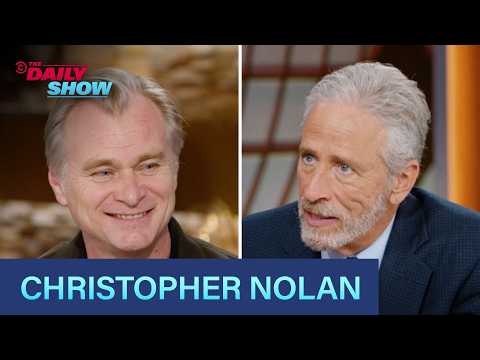
The review’s enthusiasm is immediate, but its strongest material comes when that excitement is tied to specific filmmaking choices. Christopher Nolan’s adaptation is presented not merely as another large-scale spectacle, but as an unusually physical production built around locations, practical techniques, IMAX photography, and an effort to capture as much as possible in camera. The discussion of crews hauling equipment into difficult locations, facilities being constructed for remote shoots, and cinematographer Hoyte van Hoytema working around the enormous cameras gives the praise useful substance rather than treating the production’s scale as impressive by default.
That emphasis on physical filmmaking also shapes the reviewer’s description of the finished movie. Rather than delivering the expansive computer-generated army shots associated here with films such as Troy, Nolan is said to keep viewers closer to the characters and their immediate surroundings. A nighttime storm at sea becomes the clearest example: darkness, lantern light, and flashes of lightning apparently take precedence over conveniently illuminated views of the ocean. The reviewer argues that this restraint makes the fantastical material feel unusually tangible, even when Odysseus encounters giants, sirens, the Cyclops, and other mythological elements. It is a compelling explanation of why the movie’s spectacle apparently feels different from more conventional epics.
The horror elements receive some of the most vivid praise. Without revealing major developments, the reviewer singles out the Cyclops sequence as frightening and convincing, then describes a later scene involving Samantha Morton’s character as essentially full horror. Ludwig Göransson’s score is similarly praised, particularly its unconventional instrumentation and contribution to the atmosphere. These observations are especially useful because they communicate that the film’s interpretation of mythology is not simply grand or adventurous; it can also become threatening, strange, and unsettling.
Matt Damon’s Odysseus is another major strength, although the spoiler-free format limits how deeply the performance can be examined. The reviewer suggests that the film has an interesting perspective on Odysseus as both hero and legend, and that Damon offers considerably more than the obvious action-star qualities his casting might initially suggest. That sounds promising, but repeated references to material being saved for a later spoiler discussion leave one of the review’s most interesting claims frustratingly underdeveloped. The enormous supporting cast is acknowledged more than it is evaluated, so viewers looking for insight into how Tom Holland, Robert Pattinson, Samantha Morton, or others fit into the ensemble receive relatively little beyond isolated comments.
The clearest reservation concerns the opening 10 to 15 minutes. Nolan is described as dropping viewers rapidly into a world of unfamiliar names, relationships, motivations, and chronology while editing with his characteristic efficiency. The reviewer admits to feeling lost initially and suggests the film can almost behave as though viewers have already studied Homer’s story. That criticism is particularly valuable because it identifies a potential accessibility problem for audiences arriving without much familiarity with the source material. The shifting chronology apparently adds another layer of concentration, though the reviewer stresses that the narrative becomes easier to follow once its rhythm is established.
That initial density also creates the review’s main distinction between the film’s two halves. The first is considered good but sometimes overloaded with information, occasionally creating the feeling of receiving an education when simple entertainment would be welcome. The second half is where the reviewer says the movie fully comes alive, culminating in a third act ranked among Nolan’s best. This progression prevents the assessment from becoming pure celebration: the film may require patience before its dramatic and emotional machinery fully engages, but the eventual payoff is described as exceptional.
As criticism, the review is somewhat constrained by how soon after the screening it was recorded. The reviewer openly describes feeling overwhelmed and wanting another viewing before discussing the film in greater depth, which is understandable for a dense production but also means several judgments remain more enthusiastic than analytical. Statements about the extraordinary realism, Damon’s interpretation, and the greatness of the third act are persuasive as immediate reactions, yet often stop just before explaining exactly what makes those elements work. Even so, the combination of specific production observations, a meaningful accessibility concern, and clearly communicated excitement makes this a useful spoiler-free first assessment rather than simple fan enthusiasm.
Pros
- Specific discussion of practical filmmaking, IMAX photography, lighting, locations, and production methods gives the visual praise meaningful context.
- The storm and horror sequences provide concrete examples of how the film apparently distinguishes itself from conventional large-scale epics.
- The reviewer identifies the dense opening and rapid information delivery as genuine potential barriers for newcomers.
- Matt Damon’s performance and the film’s interpretation of Odysseus are highlighted as more nuanced than the casting might initially suggest.
- The contrast between the demanding first half and much stronger second half gives the verdict useful balance.
Cons
- Several intriguing observations about Odysseus, major scenes, and character choices are deferred to a future spoiler discussion rather than developed here.
- Much of the large supporting cast receives little meaningful evaluation despite being emphasized early in the review.
- Superlative praise for the second half and third act is not explored with the same specificity as the discussion of the filmmaking techniques.
- The reviewer acknowledges still processing the film, making this feel more like an enthusiastic first reaction than a fully developed critical assessment.
This is an engaging first assessment whose excitement is most convincing when focused on the film’s unusually physical production, atmospheric mythology, horror elements, and apparent commitment to making epic fantasy feel tangible. The acknowledgment of a dense opening and demanding chronology adds needed balance, although the strongest claims about character, performance, and the later acts remain deliberately underexplored. As a spoiler-free reaction it communicates why Nolan’s approach impressed the reviewer, even if a more reflective analysis would be needed to fully justify the highest praise.