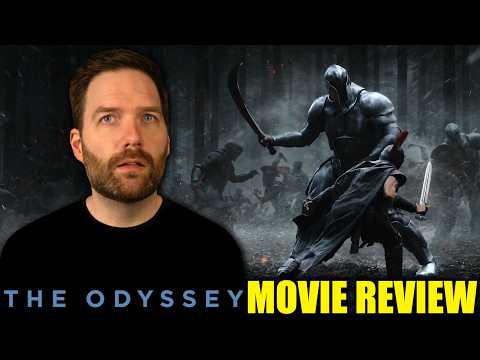
Ezra Klein builds his argument around a productive reversal: rather than treating Odysseus primarily as the ingenious trickster inherited from mythology, he reads Christopher Nolan’s version as a man confronting the destruction that tricksters and their values have left behind. That distinction gives the discussion a strong organizing idea. Klein begins with Odysseus’s contradictions, moves through Lewis Hyde’s conception of the trickster as both culturally necessary and potentially ruinous, and then uses that framework to argue that contemporary American politics has passed from useful disruption into moral degradation.
The most interesting film analysis concerns what Klein describes as Nolan’s transformation of “Zeus’s law.” He acknowledges that the movie’s formulation—treating the beggar and stranger as one would want to be treated—is not simply the ancient Greek principle as traditionally understood. Instead, he argues that Nolan has effectively inserted an ethic of reciprocity associated with Jewish and Christian traditions into the story. Citing Leviticus, Hillel and Matthew allows Klein to show precisely what he believes Nolan has changed and why that alteration matters to his interpretation. Importantly, he does not disguise the adaptation as historical authenticity; the deliberate anachronism is the point of his argument.
From there, however, the piece becomes substantially more political essay than film criticism. Donald Trump, Elon Musk, Stephen Miller and figures associated with the contemporary right are presented as modern manifestations of the destructive trickster impulse, while immigration, Medicaid, trade, international power and American foreign policy become tests of the reciprocal ethic Klein sees in Nolan’s film. The parallels are clearly argued, but they are Klein’s political and moral interpretation rather than conclusions demonstrated by the movie itself. Viewers looking primarily for close analysis of Nolan’s filmmaking, performances, imagery or adaptation choices receive relatively little of that compared with the extensive discussion of what the story can symbolize politically.
The Trojan War provides the essay’s most ambitious bridge between ancient violence and contemporary geopolitics. Klein interprets Nolan’s Odysseus as morally damaged by Troy rather than simply glorified for conquering it, then connects accumulated wartime fury with Hamas’s October 7 attack and Israel’s subsequent destruction in Gaza. He also invokes Benjamin Netanyahu’s “Super Sparta” formulation and Yuval Noah Harari’s criticism of becoming like Rome. These comparisons are rhetorically forceful, but they compress enormously different historical and political circumstances into a moral analogy. They work better as prompts for considering cycles of violence and domination than as evidence that those conflicts are genuinely equivalent.
The discussion is more persuasive when it stays with its broad philosophical tension between strength and reciprocity. Klein contrasts a worldview governed by what Stephen Miller calls the “iron laws” of strength and power with the Golden Rule and argues that civilization advances when raw dominance is constrained by ethical obligations toward strangers and weaker parties. His reading of Troy, Agamemnon’s fate and Ithaca’s deterioration reinforces that theme: violence and disregard for moral limits do not remain neatly confined to an enemy but help create a world in which similar behavior spreads. Whether or not one accepts Klein’s contemporary political applications, that is a coherent interpretation of the story he describes.
Presentation is unusually disciplined for an argument covering mythology, theology, film and current politics. The trickster motif keeps the many references from becoming completely disconnected, and the return to Hyde near the end gives the piece a satisfying structural loop: the crucial question becomes whether disruption ends in regeneration or leaves previously connected worlds permanently severed. Klein then extends that idea into an argument for reconnecting liberalism, patriotism and religious moral language. His final claim that enthusiasm for Nolan’s film signals the ending of the “age of the trickster,” however, reaches beyond what the evidence presented can establish. Audience hunger for a movie can have many causes, and no evidence is offered here demonstrating that it represents the political-cultural shift Klein hopes to see.
The result is strongest as an interpretive political essay that uses Nolan’s adaptation to recover an old moral vocabulary rather than as a comprehensive assessment of the film. Klein openly treats adaptation as transformation, identifies the historical discontinuity at the heart of his reading, and develops a clear thesis about hospitality, reciprocity, cruelty and power. The weakness is that nearly every major element eventually gets pulled toward the same contemporary diagnosis, leaving less room for competing readings of Odysseus, Nolan’s choices or the political examples themselves. Even so, the argument has enough specificity and internal structure to be more than a collection of topical analogies.
Pros
- The distinction between the traditional trickster Odysseus and Nolan’s morally chastened version provides a strong central thesis.
- Explicitly acknowledges that the film’s formulation of “Zeus’s law” differs from the ancient conception rather than presenting the adaptation as historical fact.
- The comparisons with Leviticus, Hillel and Matthew clearly explain the Judeo-Christian ethical framework Klein believes Nolan has introduced.
- Lewis Hyde’s regenerative-versus-destructive trickster framework gives the wide-ranging political and mythological discussion structural coherence.
- Connects Troy, Ithaca and Odysseus’s conduct into a meaningful argument about violence reproducing the disorder it supposedly defeats.
- Returns to the opening trickster framework at the end rather than abandoning it after the political discussion begins.
Cons
- The film increasingly serves as a vehicle for contemporary political commentary, leaving comparatively little attention to Nolan’s filmmaking or other aspects of the adaptation.
- Several modern political and geopolitical parallels are rhetorically powerful but depend on broad analogies between substantially different circumstances.
- Contemporary figures and events are consistently interpreted through one moral framework, with limited consideration of competing readings.
- The claim that enthusiasm for the film indicates the “age of the trickster” is ending is speculative and unsupported by evidence about why audiences are responding to it.
- The density of references to politicians, writers, religious texts, mythology and international conflicts occasionally stretches the central film analysis thin.
Klein offers a coherent and often compelling reading of Nolan’s adaptation as a story about what happens after cunning, domination and transgression have exhausted their usefulness. Its strongest insight is the identification of a deliberately modern moral ethic inside an ancient framework, while its weakness is the tendency to make the film carry more contemporary political meaning than the argument can firmly establish. As political-cultural criticism inspired by a movie, it is thoughtful and provocative; as film criticism, it is notably less complete.