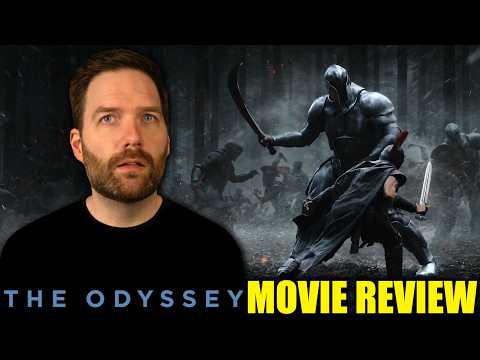
Rather than functioning as a traditional promotional interview, this conversation becomes an engaging discussion about filmmaking, literary adaptation, and Christopher Nolan's creative process. The interview centers on The Odyssey, but much of its appeal comes from Nolan explaining the practical and artistic decisions behind adapting one of history's most influential works while the host steers the discussion toward storytelling philosophy rather than simple production anecdotes.
One of the interview's strongest qualities is its focus on craftsmanship. Nolan repeatedly emphasizes the use of real locations, practical effects, full-scale ships, and physically demanding production methods instead of relying primarily on digital environments. The discussion about filming on real water, developing quieter IMAX camera systems, and completing an ambitious production under demanding conditions provides insight into the logistical challenges of large-scale filmmaking without becoming overly technical. The emphasis remains on how these decisions serve the audience's experience rather than simply showcasing production achievements.
The interview also explores the challenge of adapting revered source material. Nolan explains that the goal is not strict literalism but demonstrating respect for the original work while making creative choices that resonate with modern audiences. His comparison between adapting Homer's epic and directing Batman highlights a recurring philosophy: audiences respond when filmmakers clearly respect beloved material, even when interpretations differ from tradition. This discussion gives viewers a thoughtful look at adaptation without turning into a debate over fidelity.
Another highlight is the conversation about narrative structure and ambiguity. Nolan discusses diagramming stories before writing, his attraction to nonlinear storytelling, and why he deliberately avoids publicly confirming definitive interpretations of ambiguous endings in his films. These moments offer meaningful insight into his creative process while remaining accessible to viewers who may not have formal knowledge of screenwriting. The exchange naturally connects earlier films such as Memento, Inception, and Oppenheimer to his latest project without becoming a retrospective of his entire career.
The host contributes significantly by asking informed questions that encourage detailed responses rather than focusing on celebrity or promotional talking points. He frequently connects themes between Nolan's films and offers interpretations of The Odyssey as a meditation on war and its consequences. Those interpretations are presented as the host's reading of the film, and Nolan generally responds by discussing his intentions while deliberately leaving room for audience interpretation instead of confirming every analysis as definitive fact.
The discussion remains almost entirely positive toward the film, with very little critical examination. Because neither participant explores potential weaknesses, viewers looking for a balanced review or skeptical analysis of the movie itself may find the conversation more celebratory than evaluative. Likewise, many of the interview's themes assume at least some familiarity with Nolan's previous work and with Greek mythology, making portions of the discussion more rewarding for existing fans than complete newcomers.
Pros
- Offers unusually detailed insight into Christopher Nolan's filmmaking process and creative philosophy.
- Explores literary adaptation in a thoughtful, accessible way rather than relying on promotional talking points.
- Strong discussion of practical filmmaking techniques, IMAX production, and large-scale logistics.
- Host asks informed, open-ended questions that encourage substantial answers.
- Balances technical filmmaking discussion with broader themes about storytelling, myth, and audience interpretation.
- Includes interesting reflections connecting Nolan's previous films with his latest project.
Cons
- Functions more as an appreciative conversation than a critical examination of the film.
- Assumes some familiarity with Nolan's filmography and Greek mythology.
- Contains relatively little discussion of potential shortcomings or alternate perspectives on the adaptation.
- Viewers primarily seeking concrete plot details or behind-the-scenes footage may find the conversation more conceptual than practical.
This interview succeeds because it treats filmmaking as an art worth discussing in depth instead of simply promoting a new release. Christopher Nolan provides thoughtful explanations of his approach to adaptation, practical filmmaking, narrative structure, and audience interpretation, while the host keeps the conversation engaging with informed questions and genuine enthusiasm. Although the discussion is overwhelmingly positive and rarely challenges the film critically, it offers an insightful look into the creative thinking behind an ambitious adaptation and will be especially rewarding for viewers interested in storytelling and cinema.