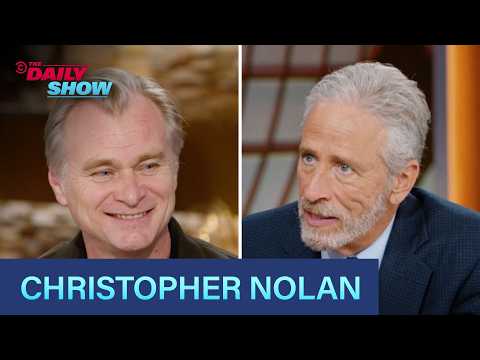
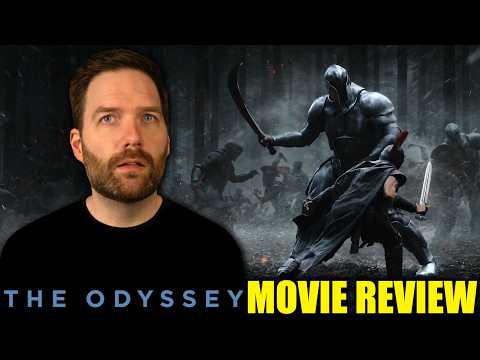
The excitement surrounding Christopher Nolan’s adaptation becomes more interesting when the reviewer stops talking about how enormous the film is and starts explaining why its emotional dimension surprised him. Coming from Oppenheimer, a film he initially found overwhelming before repeated viewings turned it into a personal favorite, he approached Nolan tackling Homer with unusually high expectations. The concern was not whether Nolan could make an ancient Greek voyage look epic, but whether such a familiar and frequently reinterpreted story could reveal anything fresh. His answer is an enthusiastic yes, largely because he sees the film as another exploration of guilt, heroism, family, memory, and the psychological consequences of what its protagonist has endured.
Matt Damon is central to that interpretation. The reviewer considers Odysseus one of Damon’s strongest performances because the role requires both commanding physical presence and a more vulnerable sense of disorientation. Rather than focusing entirely on Odysseus as a legendary hero returning from the Trojan War, he sees Damon portraying someone burdened by what that identity has cost him. That fits the reviewer’s broader view of Nolan’s recent work as increasingly interested in psychologically tormented protagonists and the meaning of heroism itself. Robert Pattinson is singled out among a strong supporting cast for bringing an eccentric energy, while John Leguizamo, Jon Bernthal, and Elliot Page are also praised. The assessment of the ensemble is enthusiastic but brief, with Damon and Pattinson receiving most of the actual performance analysis.
The expected technical admiration is present in abundance. Nolan and cinematographer Hoyte van Hoytema are praised for the color, IMAX photography, and 70mm presentation, which the reviewer describes as delivering the premium theatrical experience the project promises. Ludwig Göransson receives equally enthusiastic treatment for a score that incorporates flutes, choral vocals, and sounds associated with epic storytelling while retaining a modern sensibility. The reviewer’s admiration occasionally becomes hyperbolic, particularly when he raises the possibility of Göransson entering all-time-great territory, but he does identify why the music works for him rather than simply praising its scale: it adapts to the period instead of repeating the sonic approach of Oppenheimer.
Editing is where the review becomes meaningfully critical. Jennifer Lame’s work is praised for individual montages and sequences with the bold, rhythmic cutting the reviewer loved in Oppenheimer, but the complete film feels less cohesive. The first act is described as noticeably clunky, and even later sections can resemble individually accomplished sequences that have been assembled into an epic rather than flowing naturally as one continuous experience. He acknowledges that some fragmentation may suit a story spanning numerous locations, encounters, and periods, but still wishes the overall pacing were smoother. This is the review’s clearest reservation because it concerns the construction of the entire film rather than a minor performance or isolated creative choice.
The supernatural material provides the strongest bridge between craft and interpretation. The reviewer is particularly drawn to moments such as Odysseus encountering the dead, where ordinary ideas of time and space seem to break down and the film operates according to a more disturbing mythological logic. His comparison with Akira Kurosawa’s Dreams is explicitly personal rather than presented as evidence of direct influence, but it helps explain what he finds unusual about Nolan working in this territory. For a filmmaker the reviewer associates so closely with controlling and manipulating time and space, allowing those concepts to become unstable gives the mythological sequences an unsettling quality he sees as genuinely new terrain.
His claim that this is Nolan’s most personal film is more interpretive. The reviewer connects Odysseus’ guilt, fatherhood, absence, and struggle to return to his family with comments Nolan reportedly made in an interview with Jon Stewart about the enormous amount of life consumed by making movies and the effect that commitment has on time with loved ones. From there, he reads the film partly as an artist examining the personal cost of devotion to his work. The interpretation is thoughtful and consistent with the themes he identifies, but it remains the reviewer’s reading rather than something the discussion establishes as Nolan’s definitive intention. He is more convincing when describing thematic continuities across Interstellar, Oppenheimer, and this film than when treating biographical parallels as evidence for exactly what the adaptation means.
That uncertainty ultimately suits the reviewer’s response. He does not immediately declare the film Nolan’s masterpiece and specifically remembers that Oppenheimer needed time and repeat viewings to become his favorite. Instead, he leaves room for this film to evolve similarly while already calling it a great summer blockbuster and a thrilling theatrical experience. That combination of technical enthusiasm, meaningful criticism of the editing, and a more personal thematic reading gives the review substance beyond admiration for Nolan’s reputation. Its greatest limitation is that the reviewer’s excitement leads him to spend relatively little time on the supporting characters, adaptation choices, narrative clarity, or whether viewers without his investment in Nolan might respond differently, but his argument for the film’s emotional and psychological depth is clearly articulated.
Pros
- Matt Damon’s performance is connected directly to the reviewer’s interpretation of Odysseus as both commanding hero and psychologically burdened man rather than praised in generic terms.
- The cinematography, IMAX and 70mm presentation, and Ludwig Göransson’s period-conscious score receive specific technical appreciation.
- Jennifer Lame’s editing is evaluated with meaningful nuance, praising individual sequences while identifying cohesion and first-act pacing as weaknesses.
- The discussion of supernatural sequences explains why Nolan working outside his usual control of time and space feels creatively exciting to the reviewer.
- Connects guilt, heroism, fatherhood, memory, and absence across Nolan’s recent work to build a coherent thematic interpretation of the film.
- The reviewer avoids immediately declaring it Nolan’s best work and acknowledges that his response may change through repeated viewings.
Cons
- Praise for the supporting cast is mostly cursory outside of Damon and Pattinson, leaving several performances named rather than meaningfully evaluated.
- The claim that this is Nolan’s most personal film depends partly on interpreting biographical comments about filmmaking and family through the story rather than evidence establishing Nolan’s intended meaning.
- Enthusiasm for Nolan, van Hoytema, Göransson, and Lame occasionally assumes their established excellence instead of examining this film’s work as independently as it could.
- Beyond the editing, relatively little attention is given to narrative weaknesses, adaptation decisions, character development, or how effectively the film communicates its story to viewers less familiar with Nolan or Homer.
The reviewer makes his strongest case by looking beyond the expected IMAX spectacle and finding a darker, more vulnerable story about guilt, heroism, family, and the cost of absence, anchored by a performance from Matt Damon he considers unusually introspective. Some thematic conclusions are highly personal and the supporting material could receive deeper scrutiny, but thoughtful attention to editing, supernatural imagery, music, and Nolan’s evolving interests turns the enthusiasm into a substantive argument for an epic that may become richer with time.