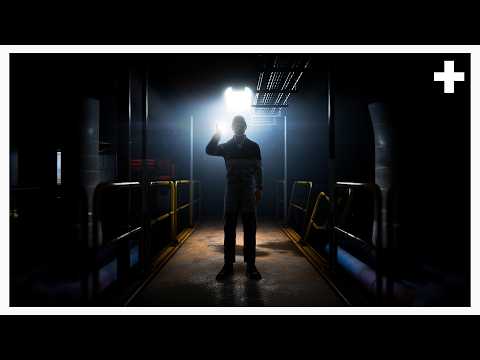
Pandora makes its best impression once the action finally escapes the sterile opening facility. Dense vegetation, bioluminescent plants, unusual wildlife, towering scale, and small graphical details such as the visible fibers on crafted materials repeatedly earn genuine admiration. Playing from the perspective of an unusually tall Na’vi also gives exploration a distinctive physical quality, while the first-person presentation proves more appealing to the players than expected. Even when they are mocking almost everything around them, the world itself occasionally stops the jokes long enough to command attention.
Getting there is considerably less successful. The opening story establishes young Na’vi being raised under human control, introduces Mercer as an overtly cruel authority figure, jumps forward eight years, and then eventually uses cryosleep to skip nearly another 16. The players find this setup heavy-handed rather than emotionally involving, particularly because Mercer’s villainy is communicated so aggressively and the supporting characters make little impression before the time jumps. Their disengagement becomes self-reinforcing: because they are barely invested in the characters, later reunions and revelations carry little weight, which gives them even more reason to ignore the narrative.
That indifference becomes the central comic engine of the playthrough. Conversations about Avatar lore repeatedly spiral into arguments over Na’vi biology, movie memories, Greek mythology, pies cooling on windowsills, future Avatar sequels, and increasingly elaborate nonsense. The edited narration works especially well as a counterweight, calmly explaining objectives and pointing out occasions when the players have ignored obvious instructions. Some tangents are genuinely funny because of the chemistry between the hosts, but others stretch so far beyond the game that viewers interested in a meaningful look at Frontiers of Pandora may wonder when the playthrough is coming back.
Navigation creates the episode’s funniest recurring conflict and its biggest analytical weakness. The players repeatedly accuse the game of failing to communicate objectives while overlooking highlighted materials, running away from quest areas, losing characters they are supposed to follow, doubling back on linear paths, or missing interface cues. To the episode’s credit, the editing frequently acknowledges this and directly contradicts the complaints when the mistake clearly belongs to the player. There are still moments when the abundance of glowing scenery appears to make important objects visually harder to distinguish, so the criticism is not entirely baseless, but the repeated failures make it difficult to judge the game’s guidance fairly from this session alone.
Combat raises a more substantive objection. A freshly crafted bow dispatching armored soldiers and mechanical suits with surprisingly little difficulty strikes both players as inconsistent with the apparent threat represented by human military hardware. They repeatedly suggest that disabling exposed components or attacking weak points would make those encounters feel more convincing. The criticism is based on an early slice of gameplay rather than a thorough examination of the combat system, but it identifies a real presentation problem within what is shown: massive machines do not feel especially intimidating when improvised arrows can rapidly tear through them.
There are glimpses of systems with more potential than the chaotic playthrough allows them to demonstrate. Gathering materials, crafting equipment, hunting wildlife, using Na’vi senses, hacking machinery, investigating environmental clues, connecting with ancestral plants, and acquiring the air-boost ability suggest a fairly broad mechanical foundation. The hacking sequence even receives some praise, and hunting briefly produces a more focused interaction with the environment. Yet almost every system is interrupted by another tangent or misunderstanding, leaving the episode better at documenting two comedians colliding with an open-world tutorial than at showing how those mechanics develop.
The result is an entertainingly dysfunctional introduction in which the hosts themselves become a bigger obstacle than Mercer, the RDA, or Pandora’s wildlife. Their chemistry produces several strong running jokes, and the editorial narration smartly refuses to pretend every navigational disaster is the game’s fault. At the same time, the constant sexual jokes, cultural riffs, deliberate distractions, and repeated failures to follow basic objectives can become exhausting, while speculative arguments about the wider Avatar universe often receive more attention than the game being played.
Pros
- Pandora’s lush environments, unusual wildlife, scale, and graphical detail receive deserved attention and provide the episode’s strongest visual material.
- The hosts have lively chemistry, turning navigation failures and misunderstandings into an effective recurring comedy routine.
- Deadpan editorial narration adds structure while humorously correcting several claims that the game has failed to provide directions.
- The episode identifies a worthwhile concern about powerful military machinery feeling surprisingly vulnerable to basic bow attacks.
- Brief encounters with crafting, hunting, hacking, investigation, and traversal show enough mechanical variety to suggest more depth beyond the opening tutorial.
Cons
- Extensive tangents about anatomy, movies, mythology, accents, food, and unrelated personal anecdotes frequently overwhelm the actual gameplay.
- Criticism of unclear navigation is weakened by repeated instances where visible instructions or objectives are ignored.
- Minimal engagement with the characters and dialogue makes the story difficult to evaluate beyond its admittedly heavy-handed opening.
- Early combat criticism is reasonable but arrives before the players have explored enough of the combat system to support broader conclusions.
- Repetitive sexual humor and prolonged arguments over simple objectives can make an already slow tutorial feel substantially longer.
The episode succeeds most as a comedy of two players being spectacularly ill-suited to following straightforward instructions, with smart editing ensuring the joke frequently lands on them rather than the game. Pandora itself emerges as visually impressive and mechanically promising, but the relentless tangents and self-inflicted confusion prevent this from becoming an especially informative examination of what Frontiers of Pandora actually offers.