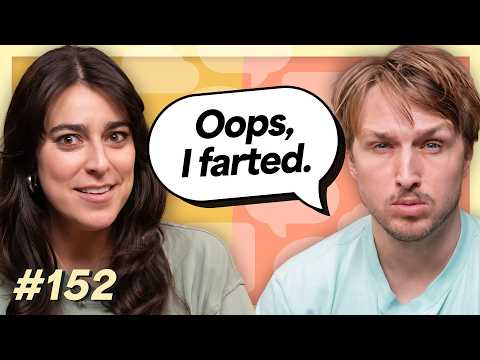
Michael Jackson’s death becomes the unlikely starting point for a broader test of just how many cultural landmarks Maya has somehow missed. The setup works because she immediately commits to answering seriously rather than deliberately playing up her ignorance, while Chandler’s elaborate presentation gives the stream-style conversation enough structure to keep moving. Her eventual 34-out-of-52 score also creates a satisfying little arc: the anticipated disaster turns into a surprisingly respectable 65 percent.
The opening dead-or-alive round establishes the central comedy quickly. Maya recognizes Michael Jackson after recently learning that he died, identifies Post Malone and Hillary Clinton, fails to recognize Marvin Gaye, and narrows Freddie Mercury down through a confused association with David Bowie. Chandler’s disbelief is funny precisely because Maya rarely seems embarrassed by the gaps; she explains that she simply did not grow up watching many movies and does not spend much time following pop culture now. That straightforwardness keeps the premise from feeling manufactured even when the reactions around her become exaggerated.
Actor and movie questions produce some of the best exchanges. Leonardo DiCaprio is recognizable to her, while Matt Damon and Brad Pitt initially seem nearly interchangeable until attractiveness becomes the deciding criterion. Later, an iconic Pulp Fiction poster produces almost no recognition at all, followed by a chain of confusion involving John Travolta, Samuel L. Jackson, Bruce Willis, Bruce Lee and Chuck Norris. The humor comes less from trivia itself than from hearing Maya build completely sincere chains of reasoning from tiny scraps of information.
Basketball provides a useful variation because Maya has recently become interested in the NBA, allowing Chandler to challenge the depth of that interest. She recognizes Michael Jordan but cannot name his team, struggles badly with Tim Duncan despite identifying as a Spurs fan, yet manages to name five Spurs players when challenged. These moments make the quiz more interesting than a simple sequence of failures because her knowledge is genuinely uneven: she can miss something Chandler considers obvious and then recover with a more specific answer seconds later.
The superhero and gaming sections further expose that inconsistency. Spider-Man and Batman are confidently assigned to Marvel and DC, respectively, while other answers depend heavily on guessing from appearance. Her confusion between Master Chief and Samus is treated like a catastrophe, but Link and Modern Warfare 2 are immediate successes. Overwatch, Grand Theft Auto and Goat Simulator generate similarly unpredictable results, making the quiz strongest when neither Maya nor the audience can be entirely sure whether the next supposedly obvious reference will land.
Chandler is an effective foil, but the presentation is intentionally messy. There are questionable clues, accidental giveaways, disputed scoring decisions, mistakes within the quiz itself and several moments where Chandler admits he is hardly the ideal pop-culture authority either. That “blind leading the blind” quality can be amusing, especially when names such as Renesmee are mangled or DC briefly becomes “December Comics,” but it also means the quiz never functions as a particularly rigorous test. The lengthy mattress sponsorship in the middle also interrupts the momentum at exactly the point when the rapid-fire questioning has found its rhythm.
What ultimately carries the material is the chemistry rather than the trivia. Maya’s confidence after lucky guesses, Chandler’s escalating frustration, chat reactions and recurring arguments over what supposedly “everybody” should know make the questions feel like prompts for conversation rather than the entire attraction. At the same time, the loose stream origins remain obvious: tangents about Rule 34 searches, celebrity appearances, basketball fandom and unrelated jokes sometimes linger beyond their payoff, and the closing ASMR gag adds another deliberately chaotic detour. A tighter edit could preserve the spontaneity while giving the quiz a cleaner pace.
Pros
- Maya’s sincere and highly uneven pop-culture knowledge creates unpredictable answers without needing an artificial competition gimmick.
- Chandler’s reactions and the pair’s argumentative chemistry turn straightforward trivia questions into effective comedy.
- The quiz covers enough territory—music, actors, movies, basketball, superheroes and games—to prevent any single category from becoming repetitive.
- The final 34-out-of-52 score gives the loosely structured challenge a clear payoff and reveals that Maya performed considerably better than the setup suggests.
Cons
- Inconsistent clues, accidental answers and disputed scoring make the quiz less coherent as an actual knowledge test.
- Several tangents and extended jokes slow a format that works best when the questions arrive quickly.
- The lengthy mid-video sponsorship noticeably breaks the momentum of the quiz.
- Chandler’s own gaps in knowledge occasionally undermine the premise that Maya is the uniquely uninformed participant.
The entertainment comes from watching wildly inconsistent knowledge collide with absolute confidence, helped considerably by the easy chemistry between Maya and Chandler. It is too loose and error-prone to work as a serious trivia challenge, but as a personality-driven comedy segment, the unpredictable answers and genuine reactions make the chaos consistently enjoyable.