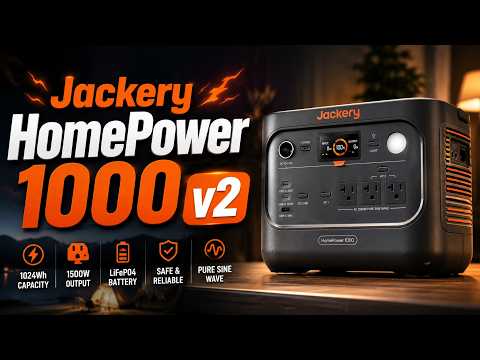
A 1,920-watt-hour portable power station becomes the practical focus here, with the forest setting providing an obvious reason for having electricity that can move between the cabin and outdoor work areas. Rather than discussing off-grid power in the abstract, the presentation connects the AllPower's R-2500 V2 to lighting, filming equipment, cordless-tool batteries and occasional corded tools. Those examples make its intended role in the cabin project easy to understand.
The specifications are presented clearly: 2,500 watts of continuous output, four AC outlets, USB-C connectivity, several charging methods and up to 1,000 watts of compatible solar input. The stated LiFePO4 battery life of more than 3,500 charging cycles and 15-millisecond UPS function are also highlighted. These are manufacturer-style product claims within a sponsored segment rather than independently tested results, an important distinction because no capacity, output, charging-speed or longevity measurements are performed here.
The strongest element is the way individual features are tied to actual working requirements. Moving the station near outdoor flood lights avoids lengthy extension-cable runs, while charging camera, drone and tool batteries reflects the less visible electrical demands of producing projects in a remote setting. The discussion of using a jigsaw or circular saw away from a fixed connection similarly gives the 2,500-watt output figure a practical purpose rather than leaving it as an isolated specification.
There is also a useful contrast between the creator's preference for hand tools and the situations in which electric equipment is more convenient. That fits naturally with a cabin-building project where traditional methods remain important but do not need to become an artificial limitation. The power station is consequently presented as supporting the existing workflow rather than replacing its established character.
The main weakness is that the segment functions much more as a sponsored product overview than a substantive test. There is no demonstration of how long particular loads run, whether demanding tools approach the unit's limits, how closely real usable capacity corresponds to the stated 1,920 watt-hours, or how effectively solar charging performs in the forest environment. Even one sustained tool test or practical runtime example would have made the product discussion considerably more informative.
Most importantly for viewers expecting a substantial cabin update, very little actual work on the home appears in the supplied material. The transition back to work on the table suggests a larger project context, but the content presented here ends just as that work is about to resume. As a result, the segment communicates a relevant piece of supporting equipment competently, yet provides only a narrow glimpse of the cabin progress implied by the broader premise.
Pros
- Connects the portable power station's specifications to credible cabin, workshop and filming uses rather than simply listing features.
- Clearly identifies the stated capacity, continuous output, charging options, solar-input capability and UPS function.
- Explains why portable electricity is useful for lighting and tool operation away from the cabin's fixed electrical connection.
- The creator's preference for hand tools gives the occasional use of electric equipment useful context.
Cons
- Manufacturer-style specifications and longevity claims are presented without independent testing or verification.
- No practical runtime, charging-speed, solar-performance or sustained-load tests show how the power station performs in this environment.
- The supplied content is dominated by the sponsorship and ends just as work on the table is about to resume, leaving the cabin project itself largely unexplored.
The forest-workshop context gives the portable power station a genuine practical role, and the presentation does a good job of explaining where its features could fit into everyday cabin work. However, limited hands-on testing and very little actual project progress make this more effective as a concise sponsored equipment overview than as a satisfying cabin-building installment.