The most useful part of this garden workday is its willingness to begin with problems rather than polished results. A wind-damaged rose tree needs its support repaired, two urns contain declining saxifrage, and a Japanese maple has abruptly crisped despite still having flexible branches. Instead of presenting confident diagnoses where the causes remain uncertain, the commentary repeatedly acknowledges that uncertainty, particularly around whether excess moisture, heat or some combination may be responsible for the container problems. That restraint makes the troubleshooting feel credible even when no definitive explanation is reached.
The rose-tree repair is especially clear because viewers can follow both the failure and the practical fix. A broken strap is replaced, existing tree rope is reused where possible, an extra length is added where needed, and some lower growth is trimmed afterward. The explanation that the softer rope is intended to avoid rubbing the plant adds useful context without turning a straightforward maintenance job into an unnecessarily technical lesson. There is also appropriate uncertainty about when the supports might eventually be removed, with thicker future trunks treated as a possibility rather than a guarantee that the trees will soon stand securely on their own.
Replacing the struggling saxifrage with sempervivums is another effective section because the planting decision is tied directly to the irrigation setup. The drip line is capped so the succulents can instead be hand-watered, with the presenter reasoning that an every-other-day schedule may be too frequent for them and noting that the soil is already very wet. Her statements about what caused the original decline remain personal observations rather than established horticultural conclusions, which is important because the evidence shown does not isolate a single cause. Transplanting the salvageable saxifrage into a more protected area near the pond also gives the failed container planting a constructive second act rather than simply discarding the plants.
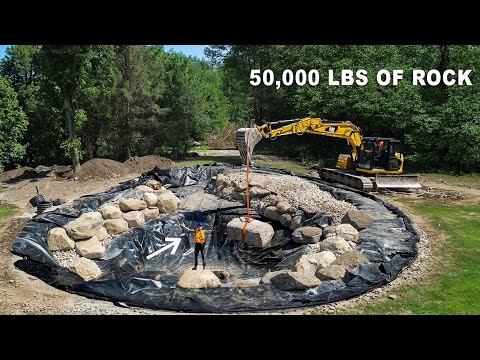
The video becomes much looser once the boulder placement begins, but that looseness also captures something genuinely informative about landscape composition. Rocks are rotated, shifted, rejected, accepted and reconsidered according to their shape, viewing angle, nearby plantings and the expected mature size of shrubs such as the black lace elderberry. The recurring desire to leave planting pockets around the stones demonstrates that the boulders are being treated as structural elements within a future planting scheme rather than isolated decorations. Showing uncertainty about particular arrangements is valuable because the finished-looking decisions emerge through trial rather than being presented as instantly obvious.
That extended process does, however, become repetitive. Many of the placement exchanges involve incremental tractor movements followed by another request to push, rotate or relocate essentially the same stone, and the running commentary frequently circles around whether a particular angle looks right. The banter between Laura and Aaron keeps the sequence personable, and small moments involving Benjamin's placement instructions, pumpkins, weeds and a joking confession about an unwanted crabapple preserve the channel's relaxed family-garden character. Still, a tighter edit could have retained the improvisational feeling while making the visual reasoning behind the strongest boulder groupings easier to absorb.
The closing tour helps justify the length by showing the ten newly placed boulders in relation to pathways, existing trees and future planting opportunities. It is particularly useful that one grouping is openly identified as less convincing and that the possibility of moving a stone later remains on the table. The accidental scuffing of the June Snow dogwood during placement is also shown rather than concealed, with the presenter saying she expects the tree to be fine while planning to watch it; that prognosis is her assessment, not something independently demonstrated here. By the end, the projects form a coherent picture of garden maintenance as an evolving process in which repairs, irrigation choices, plant relocation and larger landscape design continually affect one another.
Pros
- The troubleshooting sections clearly show practical responses to a failed tree support, struggling container plants and irrigation concerns without pretending every underlying cause is known.
- Reusing the saxifrage elsewhere and changing the urn irrigation strategy demonstrate thoughtful adaptation rather than simply replacing failed plants.
- The boulder-placement sequence reveals how viewing angles, mature plant size, spacing and future planting pockets influence landscape decisions.
- Uncertainty is handled well, with questionable plant health and imperfect rock arrangements generally described as observations or possibilities rather than settled facts.
- The final walkthrough provides useful spatial context and openly acknowledges which placements may still need adjustment.
Cons
- The boulder section is considerably longer than its informational content requires, with many similar positioning adjustments shown in real time.
- Some potentially useful horticultural questions, particularly why the saxifrage declined and what caused the Japanese maple to crisp, remain unresolved beyond informal speculation.
- Frequent conversational tangents add personality but occasionally interrupt the practical reasoning behind the day's gardening decisions.
- The accidental damage to the dogwood is acknowledged, but the confident expectation that it will recover is not supported with further evidence within the video.
This is strongest when ordinary garden problems lead naturally into visible, adaptable solutions rather than perfectly packaged answers. The lengthy boulder placement could be more disciplined, but its trial-and-error quality also illustrates how much landscape design depends on proportion, perspective and future growth. As a practical garden workday, it is personable, transparent and consistently useful even when the conclusions remain provisional.