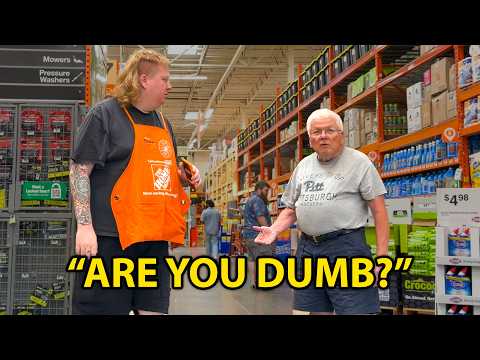
Moving the crew through hardware and retail stores creates a steady supply of unpredictable encounters, but the funniest material often comes after the original screaming premise has already been abandoned. Loud outbursts establish the familiar prank format early, with participants attempting to surprise shoppers and employees before blaming one another, yet the group quickly shifts toward walkie-talkie instructions, fake workplace scenarios and improvised confrontations. That looseness gives the outing variety, even if it makes the title's central concept feel more like a starting point than the actual structure.
The strongest exchanges rely on participants committing to absurd roles while unsuspecting people try to understand what is happening. One performer pretends to receive instructions from an overbearing boss, another approaches strangers on behalf of that supposed boss, and later bits involve fabricated employee disputes and accusations. These setups work best when they create escalating confusion rather than simply depending on volume. The performers are particularly effective at rapidly building on a stranger's response and turning an ordinary interaction into something increasingly ridiculous.
There is also a self-aware quality that helps keep the personalities entertaining between pranks. One participant repeatedly complains that he is too old to continue screaming in stores, calls attention to attempts at generating clips and declares that he is taking the high road before inevitably becoming involved again. The contradiction becomes a recurring joke of its own. Casual arguments within the group similarly provide energy during transitions, although the constant overlapping chatter can make conversations difficult to follow.
Not every interaction lands comfortably. Several bits continue after strangers have rejected an approach or shown visible irritation, including repeated requests for someone's phone number and false accusations that shoppers are stealing. Another extended encounter deliberately creates confusion around how a person should be addressed while repeatedly provoking them after they become angry. The resulting confrontation produces plenty of commotion, but it relies more on antagonizing the target than on a particularly clever premise.
The fake rehabilitation scenario illustrates both the strengths and weaknesses of the group's approach. Inventing an elaborate story that an unrelated shopper named Chris has escaped from rehab gives the performers something specific to build around, and their commitment creates an increasingly chaotic scene. At the same time, involving alcohol addiction and publicly identifying a stranger as an alcoholic pushes the humor into more uncomfortable territory, particularly because the target has little opportunity to understand why several people are suddenly confronting him.
Structurally, the opening house tour and extended celebration of the group's move to Los Angeles delay the main attraction considerably. The gratitude toward viewers and excitement about reaching a major personal milestone give useful context to the creators' enthusiasm, but much of this material operates independently from the prank outing that follows. Once the group reaches the stores, the pace improves substantially, with changing setups and spontaneous reactions providing enough variety to prevent the repeated public-interaction formula from becoming entirely predictable.
Pros
- The performers improvise quickly around unexpected reactions, producing several genuinely unpredictable exchanges.
- Walkie-talkie instructions and fake workplace scenarios provide more creative setups than screaming alone.
- Self-aware jokes about the group's own prank behavior add personality and recurring humor.
- Moving between different premises keeps the store encounters relatively varied.
Cons
- The lengthy house-tour introduction delays the central prank material.
- Several confrontations continue after strangers clearly indicate that they are uncomfortable or want the interaction to stop.
- False accusations involving theft and addiction rely heavily on embarrassing unsuspecting shoppers.
- Shouting, overlapping dialogue and rapidly changing conversations sometimes make exchanges difficult to follow.
- The original screaming premise becomes secondary to a loosely connected collection of other pranks.
Quick improvisation and strong chemistry give the outing more entertainment value than its extremely simple central premise would suggest. Its funniest sequences come from elaborate misunderstandings rather than screaming, but uneven boundaries with unsuspecting participants and a scattered structure keep the chaos from becoming consistently effective comedy.