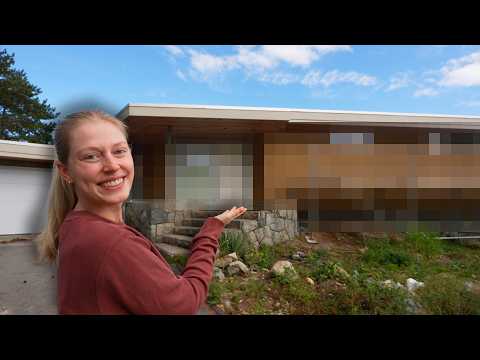
Rather than treating the renovation as a rapid makeover, this installment focuses on the slower, less glamorous work required to restore the cottage's exterior after demolition. The episode follows Craig and Amy as they clean up debris, protect the exposed roof from incoming rain, remove old concrete render, repair damaged stonework, and begin repointing the front wall with lime mortar. While the presentation remains upbeat and humorous, it also conveys the physical effort and time commitment behind each stage, giving viewers a realistic sense of incremental progress.
One of the video's greatest strengths is how clearly it documents the renovation process without pretending the hosts are experts. Craig frequently acknowledges when he is figuring things out as he goes, whether investigating old foundations, breaking up concrete, or deciding how best to tackle structural remnants. That openness makes the project feel approachable while avoiding exaggerated claims about construction expertise. Practical explanations—such as why lime mortar is being used, how it allows the building to breathe, or why damp coverings help regulate curing—provide useful context without overwhelming the narrative.
The presentation balances hard labor with personality. Long cleanup sessions, tool mishaps, improvised problem-solving, and moments of frustration are mixed with lighthearted banter between the hosts. Personal updates about family, emotional well-being, and everyday life make the renovation feel like part of a broader journey rather than a sequence of construction tasks. These moments are presented as personal experiences rather than universal advice, including Craig's comments about breathwork and emotional release.
Visually, the transformation is satisfying because the episode emphasizes preparation before revealing the finished work. Removing paint with a blowtorch, jet washing the granite, repairing deep voids with carefully selected stones, and gradually repointing the wall create a strong before-and-after payoff. Time-lapse sequences reinforce just how labor-intensive the work is, making the completed façade feel earned rather than the product of editing shortcuts. The hosts' enthusiasm for preserving the cottage's original stone character comes through naturally.
The episode also benefits from acknowledging uncertainty instead of presenting renovation decisions as settled. Questions about whether to build a porch, what color to choose for future windows and doors, and how existing foundations might influence future plans remain open for discussion. Inviting viewers to contribute ideas encourages engagement without suggesting that design choices have objectively correct answers. Likewise, references to plumbing discussions and future construction phases are framed as plans rather than completed outcomes.
The final section broadens the episode beyond home renovation by visiting the Highland Games. Rather than functioning as filler, the visit reinforces the couple's connection to their adopted community while introducing several traditional competitions and performances. The coverage remains observational, highlighting events such as stone lifting, piping, dancing, caber tossing, and tug-of-war without making broader historical or cultural claims that extend beyond what is shown. It provides an energetic conclusion that contrasts nicely with the week's demanding construction work.
Pros
- Provides an honest, step-by-step look at the labor involved in restoring a traditional stone cottage rather than relying only on dramatic before-and-after reveals.
- Clearly explains practical renovation decisions, including the use of lime mortar and exterior stone restoration, in accessible language.
- Balances technical progress with engaging personal storytelling and humor that keeps slower construction sequences interesting.
- Effectively uses time-lapses and visual comparisons to demonstrate the cumulative impact of many hours of work.
- Distinguishes future renovation plans and personal reflections from established facts, avoiding overstatement about the project's progress.
Cons
- The sponsored segment interrupts the renovation narrative and temporarily breaks the momentum.
- Some renovation decisions remain speculative, leaving viewers without clear resolutions until future episodes.
- Frequent jumps between construction updates, personal anecdotes, and travel footage occasionally reduce the episode's overall focus.
This episode succeeds by embracing the reality that meaningful restoration is built on countless small, demanding tasks rather than dramatic transformations alone. Its combination of practical renovation detail, genuine personality, and a satisfying visual payoff makes it an engaging installment that rewards viewers invested in both the project and the people behind it.