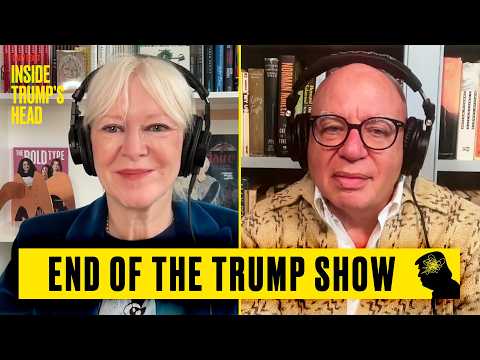
Donald Trump's increasingly unusual public remarks provide Rick Wilson and George Conway with plenty of ammunition for a sharp, frequently profane examination of his political future. From rambling observations about French food and the physical appearance of male politicians to questionable claims about transgender students and international trade, the conversation portrays a president whose public appearances have become increasingly difficult for his critics to take seriously. The second installment of Psycho Politics combines political satire, speculation about Trump's health, and electoral analysis into an entertaining discussion that is strongest when the hosts move beyond personal ridicule to examine the potential consequences for the Republican Party.
The opening segment, appropriately titled "Donny Dum-Dum," uses a collection of Trump's public remarks to establish the central argument that his communication skills and political instincts are deteriorating. Wilson and Conway highlight unusual pronunciations, unfinished sentences, repeated talking points, and extended digressions about physical attractiveness. Their reactions are often genuinely funny, particularly when discussing Trump's claims about examining Senator Jon Husted's appearance and his insistence that he wears very little makeup. However, the humor also exposes a weakness in their approach. Both commentators repeatedly interpret these moments as evidence of cognitive deterioration without establishing that the behavior reflects a medical condition rather than Trump's longstanding rhetorical habits, exaggerations, or improvisational speaking style.
The discussion becomes more substantive when the hosts challenge Trump's claims about schools arranging gender-transition surgeries without parental knowledge and his description of American trade with Canada. Conway's offer of $500,000 to anyone who can identify a school system performing the alleged procedures effectively emphasizes the extraordinary nature of Trump's accusation, while Wilson explains how supporters may rationalize exaggerated statements as expressions of a broader political concern. Their explanation of trade deficits also provides a useful corrective to the idea that purchasing Canadian goods amounts to simply giving American money away. These sections demonstrate how the program can combine humor with meaningful political criticism, although the economic figures and assumptions about Republican voters would benefit from clearer sourcing.
The conversation then shifts toward instability inside Trump's administration, particularly the controversy surrounding his departing press secretary and the uncertain position of White House Chief of Staff Susie Wiles. Wilson draws on his familiarity with Florida Republican politics to describe Wiles as an experienced, calculating political operator whose relationship with Trump has become increasingly difficult. His account of her involvement in Ron DeSantis's political rise and subsequent rivalry adds valuable background to the discussion. The hosts also explore how Trump's personal involvement in staffing decisions could undermine the authority of advisers who are supposedly responsible for managing the administration. Still, several allegations about internal maneuvering, professional misconduct, and behind-the-scenes relationships are presented without enough supporting evidence to distinguish established developments from political gossip.
One of the more interesting exchanges concerns the possibility that Wiles might eventually publish a revealing account of her White House experiences. Conway and Wilson argue that such a book could offer an unusually detailed picture of Trump's decision-making while allowing Wiles to defend her own reputation. Their discussion of the differences between daily political reporting and retrospective books provides a useful explanation of how private conversations can reshape public understanding of familiar events. Yet the argument gradually becomes speculative, with imagined publishing advances, hypothetical revelations, and predictions about Wiles's motivations taking the place of verifiable information. The material is engaging, but its entertainment value exceeds its immediate evidentiary strength.
The final major section delivers the program's most substantial political analysis, with Wilson predicting significant Republican losses in the approaching midterm elections. He compares the political atmosphere with 1994 and 2006, emphasizing economic dissatisfaction, presidential unpopularity, and the possibility that traditionally reliable Republican voters will stay home. His explanation of voter-turnout categories is particularly accessible, showing why candidates who benefited from Trump's ability to attract occasional voters might struggle when he is not personally on the ballot. The discussion also identifies potential surprises in Mississippi, Florida, Kansas, and South Carolina, while considering the limitations of large campaign expenditures. These specific electoral examples give the conversation more analytical weight, although Wilson's confidence sometimes outruns the evidence presented. Assertions about polling models, fundraising, changing district competitiveness, and likely turnout are not accompanied by enough detail for viewers to independently assess the predictions.
The closing discussion returns to Trump's physical and mental condition, with Wilson predicting that a significant health incident will become publicly impossible to conceal. This conclusion reinforces the program's central theme but also illustrates its most serious limitation. Observations about Trump's appearance, movement, age, and speech do not establish a medical diagnosis or reliably predict a future health crisis. References to alleged medication use are similarly unverified, and the hosts' recurring descriptions of Trump as mentally unwell frequently blur the distinction between political criticism and clinical judgment. Their openly anti-Trump perspective is never concealed, particularly given their shared history with the Lincoln Project and their newly announced political venture. That transparency helps viewers understand the conversation's perspective, but the personal insults, confident speculation, and limited consideration of alternative explanations prevent it from functioning as a balanced assessment of presidential fitness or Republican electoral prospects.
Pros
- Uses specific clips of Trump's public remarks to create an entertaining foundation for discussing his communication style, political messaging, and public image.
- Wilson's experience in Republican politics adds useful context to the discussion of Susie Wiles, internal White House relationships, and the challenges facing Republican candidates.
- Effectively challenges extraordinary claims about school-arranged gender-transition procedures and explains a basic misconception surrounding trade deficits.
- Provides an accessible explanation of low-propensity voters and why Republican turnout could suffer without Trump personally appearing on the ballot.
- Examines historical midterm elections and identifies specific congressional and Senate contests that could reveal broader changes in the political environment.
- The hosts' familiarity with each other creates a lively, spontaneous conversation with sharp humor and an engaging back-and-forth.
Cons
- Repeatedly interprets Trump's speech patterns and public behavior as evidence of cognitive impairment without sufficient medical evidence or consideration of alternative explanations.
- Makes speculative predictions about Trump's physical health, including an anticipated medical incident, that cannot be established from the observations discussed.
- Relies on unverified allegations and insider speculation when discussing White House personnel disputes, Susie Wiles's motivations, and possible future revelations.
- Presents sweeping electoral forecasts and selected polling claims without enough numerical detail, methodology, or sourcing to evaluate their reliability.
- Frequent personal insults and extended jokes about physical appearance occasionally overwhelm more substantive political arguments.
- The strongly partisan perspective leaves little room for competing interpretations of Trump's political resilience, Republican campaign strategies, or potential election outcomes.
Rick Wilson and George Conway deliver an energetic political conversation that combines sharp satire, insider perspectives, and worthwhile analysis of Republican electoral vulnerabilities. Their strongest material examines campaign dynamics, White House personnel conflicts, and the political consequences of Trump's public messaging, but excessive speculation about his mental and physical health weakens the credibility of their broader argument. Entertaining and occasionally insightful as partisan commentary, the discussion would be considerably stronger with more rigorous evidence and a clearer separation between observable behavior, political interpretation, and medical conjecture.