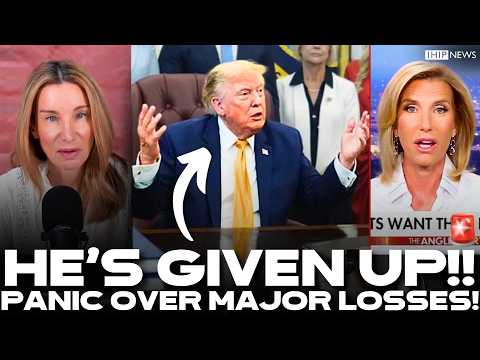
Donald Trump's appearance in Dalton, Georgia, provides the material for a sharply critical commentary covering protesters, controversial remarks about Muslims, unusual observations about his appearance, and questions surrounding his physical condition. The host presents these moments as evidence of a president whose public behavior deserves greater scrutiny, but the discussion frequently moves beyond what the footage can establish. Although several clips raise legitimate questions about Trump's rhetoric, the presentation relies heavily on ridicule, personal speculation, and politically charged interpretations.
The opening focuses on protesters appearing in what the host describes as a strongly Republican area of Georgia. Their presence is celebrated as a sign that opposition to Trump remains visible even in traditionally conservative communities. This establishes the video's openly partisan perspective, with the host encouraging viewers to attend future appearances and make their objections known. The footage provides an interesting example of public dissent, but the discussion offers little information about the protesters, their numbers, or whether their presence reflects any broader change in political attitudes.
Trump's comments about wearing makeup and his repeated descriptions of other men as handsome become opportunities for extended mockery. The host compares the color of Trump's face with his hands and jokes about his possible bisexuality, connecting those remarks to speculation about age-related changes in inhibition. References to a previous discussion with Dr. Adam are used to introduce the possibility of cognitive decline, but no clinical evidence is presented to establish such a connection. These segments may entertain viewers who already dislike Trump, yet they turn ordinary observations and ambiguous remarks into insinuations about sexuality and neurological health that the available material cannot substantiate.
The discussion becomes more substantive when Trump makes derogatory comments about Abdul El-Sayed, including references to his Muslim identity and accusations involving jihadism and the Muslim Brotherhood. The host challenges the apparent contradiction between describing someone as both a radical leftist and a jihadist, arguing that these political and religious labels do not fit together coherently. This is one of the stronger sections because it examines specific statements rather than concentrating entirely on Trump's appearance. However, the commentary would be more persuasive with additional context about the allegations and a clearer distinction between criticizing discriminatory rhetoric and establishing the factual accuracy of the underlying political claims.
A fundraising appeal follows, directing viewers toward the host's midterm election initiative and specifically encouraging donations to El-Sayed. The host reports raising more than $160,000, largely through small-dollar contributions, and acknowledges several repeat donors. This segment demonstrates how the channel attempts to translate political frustration into participation and financial support for favored candidates. At the same time, the shift from criticizing presidential rhetoric to promoting a particular political fundraising effort makes the advocacy purpose unmistakable. Viewers seeking independent political analysis may find that the appeal further reduces the distance between reporting, commentary, and campaigning.
The final major section concentrates on Trump's hair being disturbed by the wind, apparent outlines beneath his trousers, and footage showing him walking past a vehicle before being redirected by Secret Service personnel. The host interprets these images as evidence of leg braces and raises questions about why Trump seemingly cannot walk longer distances. While the footage gives viewers specific moments to examine, visible clothing contours do not conclusively establish the presence of medical braces, and the vehicle interaction does not independently demonstrate impaired mobility or a health-related restriction. The suggestion that these incidents reveal serious physical deterioration is therefore considerably stronger than the evidence provided. Sarcastic commentary about Trump's movements and appearance further weakens an argument that would benefit from careful observation and restraint.
As political entertainment, the presentation maintains a lively pace by moving between rally clips, television footage, social media reactions, and the host's personal commentary. The direct delivery and frequent use of recorded examples make the discussion accessible, particularly for viewers who enjoy confrontational political coverage. Nevertheless, the repeated personal insults, sexual jokes, and speculative medical interpretations overshadow more substantial criticism of Trump's statements. Promotional interruptions and an extended closing sequence also diminish the overall focus. The result is an energetic partisan reaction that occasionally identifies meaningful issues but rarely gives competing explanations or uncertainty sufficient consideration.
Pros
- Footage from Trump's Georgia appearance provides concrete examples for examining his public statements and behavior.
- The discussion of remarks targeting Abdul El-Sayed raises legitimate concerns about religious stereotyping and inflammatory political accusations.
- Coverage of protesters in a heavily Republican area highlights visible political opposition and encourages civic participation.
- The combination of rally excerpts, television coverage, and social media reactions keeps the presentation varied and engaging.
- The host's direct, energetic commentary gives the material a clear perspective and makes it accessible to an audience interested in political criticism.
Cons
- Speculation about Trump's sexuality and possible cognitive decline relies on insinuation rather than convincing evidence and distracts from legitimate political criticism.
- Claims about visible leg braces, restricted walking distances, and physical deterioration are presented with greater certainty than the footage supports.
- Persistent ridicule of Trump's hair, makeup, appearance, and mannerisms often substitutes personal mockery for meaningful analysis.
- The discussion of protesters and political reactions lacks sufficient context to establish their broader significance.
- The fundraising appeal introduces an explicit campaigning objective that compromises the presentation's value as independent political commentary.
- Repeated subscription requests, promotional material, and an extended closing sequence interrupt the main discussion.
This is an energetic but uneven political commentary that works better as partisan entertainment than as a reliable examination of presidential behavior. Its criticism of inflammatory religious rhetoric provides genuine substance, but speculative health claims, personal mockery, and selective interpretations undermine its credibility. Viewers looking for sharp anti-Trump commentary may find it engaging, while those seeking a careful, evidence-based assessment will find too many conclusions unsupported.